mRNA Expression by RT-PCR
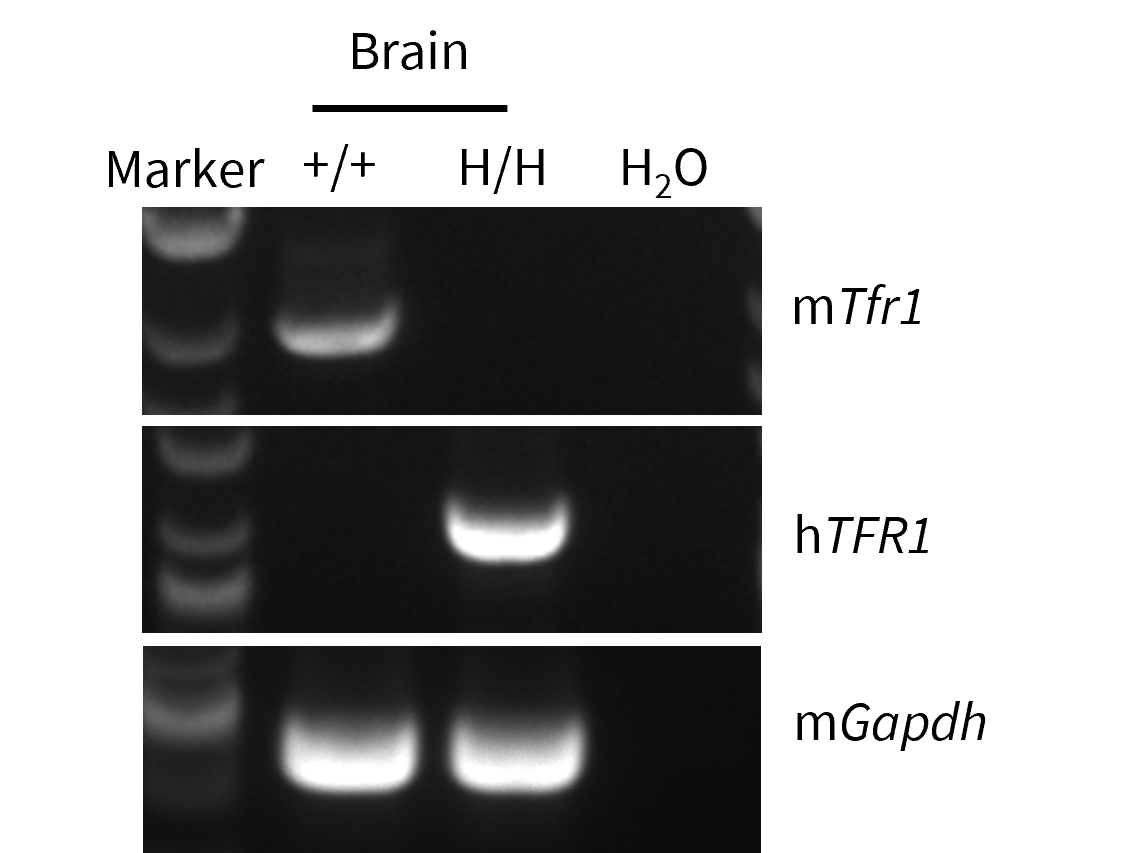
- Mouse Tfr1 mRNA was detectable in wild-type mice but not in homozygous B-hAPOE3/hTFR1 mice.
- Human TFR1 mRNA was only detectable in homozygous B-hAPOE3/hTFR1 mice, but not in wild-type mice.
Strain specific analysis of TFR1 mRNA expression in wild-type C57BL/6JNifdc mice and homozygous B-hAPOE3/hTFR1 mice by RT-PCR. Brain RNA was isolated from wild-type C57BL/6JNifdc mice (+/+) and homozygous B-hAPOE3/hTFR1 mice (H/H, H/H), then cDNA libraries were synthesized by reverse transcription, followed by PCR with mouse or human TFR1 primers. Mouse Tfr1 mRNA was detectable in wild-type mice but not in homozygous B-hAPOE3/hTFR1 mice. Human TFR1 mRNA was only detectable in homozygous B-hAPOE3/hTFR1 mice, but not in wild-type mice.
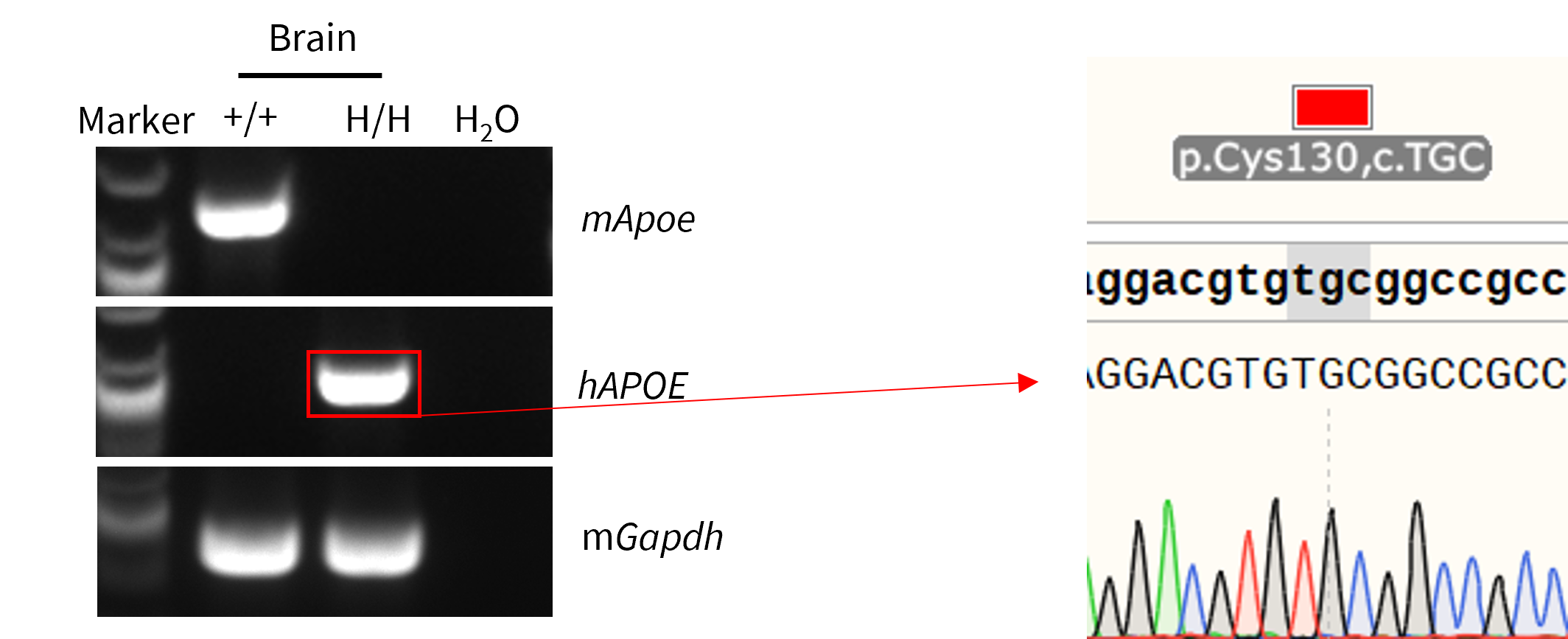
- Mouse Apoe mRNA was detectable in wild-type mice but not in homozygous B-hAPOE3/hTFR1 mice.
- Human APOE mRNA was only detectable in homozygous B-hAPOE3/hTFR1 mice, and the results were confirmed via Sanger sequencing.
Strain specific analysis of APOE3 mRNA expression in wild-type C57BL/6JNifdc mice and homozygous B-hAPOE3/hTFR1 mice by RT-PCR. Brain RNA was isolated from wild-type C57BL/6JNifdc mice (+/+) and homozygous B-hAPOE3/hTFR1 mice (H/H, H/H), then cDNA libraries were synthesized by reverse transcription, followed by PCR with mouse or human APOE primers. Mouse Apoe mRNA was detectable in wild-type mice but not in homozygous B-hAPOE3/hTFR1 mice. Human APOE mRNA was only detectable in homozygous B-hAPOE3/hTFR1 mice, but not in wild-type mice. And the results were confirmed via Sanger sequencing.
TFR1 Protein Expression Analysis
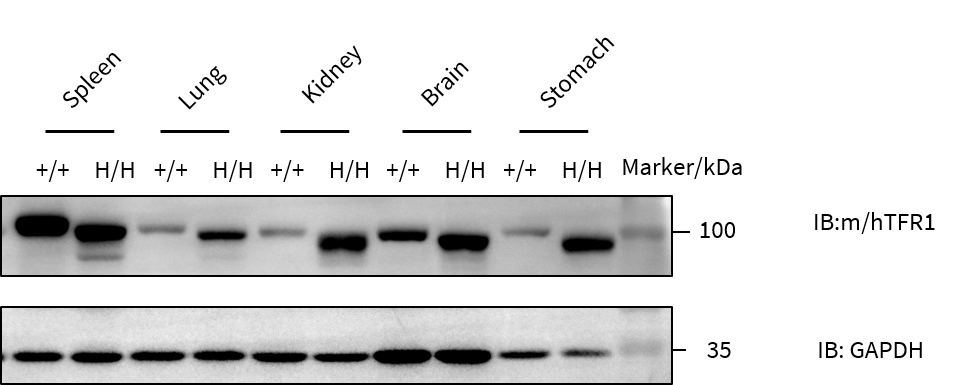
- TFR1 was detected in spleen, lung, kidney, brain and stomach from wild-type mice and homozygous B-hAPOE3/hTFR1 mice, as the antibody used cross-reacted with both human and mouse TFR1 protein.
Western blot analysis of TFR1 protein expression in homozygous B-hAPOE3/hTFR1 mice. Various tissue lysates were collected from C57BL/6JNifdc mice (+/+) (female, 7-week-old) and homozygous B-hAPOE3/hTFR1 mice (H/H) (female, 7-week-old) , and then analyzed by western blot with anti-TFR1 antibody (Abcam, ab214039). 40 μg total proteins were loaded for western blotting analysis. TFR1 was detected in spleen, lung, kidney, brain and stomach from wild-type mice and homozygous B-hAPOE3/hTFR1 mice, as the antibody used cross-reacted with both human and mouse TFR1 protein.
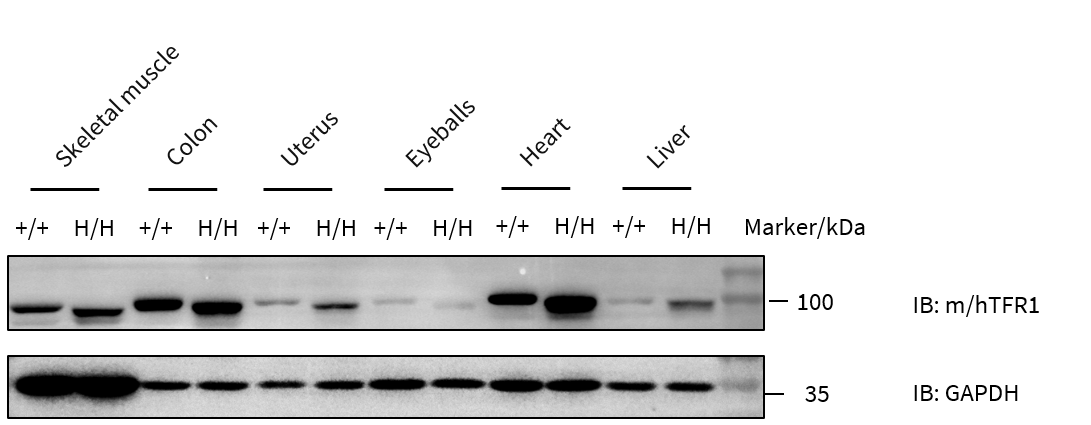
- TFR1 was detected in skeletal muscle, colon, uterus, eyeballs, heart and liver from wild-type mice and homozygous B-hAPOE3/hTFR1 mice, as the antibody used cross-reacted with both human and mouse TFR1 protein.
Western blot analysis of TFR1 protein expression in homozygous B-hAPOE3/hTFR1 mice. Various tissue lysates were collected from C57BL/6JNifdc mice (+/+) (female, 7-week-old) and homozygous B-hAPOE3/hTFR1 mice (H/H) (female, 7-week-old) , and then analyzed by western blot with anti-TFR1 antibody (Abcam, ab214039). 40 μg total proteins were loaded for western blotting analysis. TFR1 was detected in skeletal muscle, colon, uterus, eyeballs, heart and liver from wild-type mice and homozygous B-hAPOE3/hTFR1 mice, as the antibody used cross-reacted with both human and mouse TFR1 protein.
APOE3 Protein Expression Analysis in Serum
- Human APOE was detected in serum from homozygous humanized APOE lines, but not from wild-type mice.
Strain specific analysis of human APOE expression in homozygous B-hAPOE3 mice, B-hAPOE3/hTFR1 mice, B-hAPOE4 mice and B-hAPOE4/hTFR1 mice by ELISA. Serum was collected from wild-type C57BL/6JNifdc mice (+/+), homozygous B-hAPOE3 mice (female, n=3, 6-week-old), B-hAPOE3/hTFR1 mice (female, n=3, 6-week-old), B-hAPOE4 mice (female, n=3, 8-week-old) and B-hAPOE4/hTFR1 mice (female, n=3, 8-week-old), and serum were then analyzed by ELISA with human-specific APOE ELISA kit (Abcam, ab233623). This ELISA kit specifically recognized human APOE protein, as no signal was detected in serum from wild-type mice. Human APOE was only detectable in serum from homozygous humanized APOE lines, with comparable expression level across these groups.
APOE3 Protein Expression Analysis in Brain
- Human APOE was detected in cortex and hippocampus from homozygous humanized APOE lines.
Strain specific analysis of human APOE expression in homozygous B-hAPOE3 mice, B-hAPOE3/hTFR1 mice, B-hAPOE4 mice and B-hAPOE4/hTFR1 mice by ELISA. Cortex and hippocampus were collected from homozygous B-hAPOE3 mice (female, n=3, 6-week-old), B-hAPOE3/hTFR1 mice (female, n=3, 6-week-old), B-hAPOE4 mice (female, n=3, 8-week-old) and B-hAPOE4/hTFR1 mice (female, n=3, 8-week-old), and samples were then analyzed by ELISA with human-specific APOE ELISA kit (Abcam, ab233623). Human APOE was only detectable in cortex and hippocampus from homozygous humanized APOE lines, with comparable expression level across these groups.
* When publishing results obtained using this animal model, please acknowledge the source as follows: The animal model [B-hAPOE3/hTFR1 mice] (Cat# 114082) was purchased from Biocytogen.