
B-hCD3EDG/HLA-A2.1 mice

C57BL/6-Cd3etm1(CD3E)Bcgen Cd3dtm1(CD3D)Bcgen Cd3gtm1(CD3G)Bcgen B2mtm2(B2M/HLA-A2.1/H2-D)Bcgen /Bcgen • 112756

B-hCD3EDG/HLA-A11.1 plus mice
B-hCD3EDG/HLA-A2.1 plus mice

B-hCD3EDG/HLA-A2.1 mice

Catalog Number: 112756
Strain Name: C57BL/6-Cd3etm1(CD3E)Bcgen Cd3dtm1(CD3D)Bcgen Cd3gtm1(CD3G)Bcgen B2mtm2(B2M/HLA-A2.1/H2-D)Bcgen /Bcgen
Strain Background: C57BL/6
NCBI gene ID: 916,915,917,3105 (Human)
Aliases: T3E; TCRE; IMD18; CD3epsilon; T3G; IMD17; CD3GAMMA; CD3-GAMMA; HLAA
---
Licensing option available

B-hCD3EDG/HLA-A2.1 mice

on this page

  • Description
  • Targeting strategy
  • Phenotypic analysis
  • FAQ section

Posters

View All

    Publication

      Description
      • CD3EDG includes the CD3ε, CD3δ, and CD3γ chains of the TCR/CD3 complex, which supports T cell antigen recognition, signal transduction, and T cell development.
      • HLA-A2.1 is a human MHC class I allele that presents peptide antigens to cytotoxic T cells and is widely used in TCR, TCR-mimic antibody, vaccine, and cell therapy research.
      • B-hCD3EDG/HLA-A2.1 mice combine humanized CD3EDG with a chimeric B2M/HLA-A*0201/H-2Db class I molecule in a C57BL/6 background.
      • B-hCD3EDG/HLA-A2.1 mice support evaluation of CD3-targeted antibodies, HLA-A2.1-restricted TCR-based therapeutics, and immuno-oncology strategies requiring human CD3 and HLA-A2.1 biology.
      • Human CD3E and human HLA-A2.1 expression, H-2Db expression, and leukocyte subpopulation profiles in spleen, blood, and lymph node have been characterized in this model.

      Key Advantages

      • Dual humanized CD3EDG and HLA-A2.1 platform for T cell immunology research
      • Human CD3E expression validated in splenic T cells by flow cytometry
      • Human HLA-A2.1 and mouse H-2Db expression characterized in spleen by flow cytometry
      • Spleen, blood, and lymph node leukocyte subpopulations analyzed in homozygous mice
      • Supports pharmacological and safety evaluation of oncology antibodies and T cell-directed therapeutics
      • Useful for HLA-A2.1-restricted TCR, TCR-mimic antibody, vaccine, and cell therapy development

      Validation

      • Targeting Strategy Validation: B-hCD3EDG/HLA-A2.1 mice were generated by breeding B-hCD3EDG mice with B-HLA-A2.1 mice to combine humanized CD3EDG and HLA-A2.1-related class I presentation biology.
      • CD3E Protein Validation: Human CD3E was detected in B-hCD3EDG/HLA-A2.1 splenic T cells by flow cytometry, while mouse CD3E signal was detected in wild-type C57BL/6 mice.
      • HLA Protein Validation: Human HLA-A2.1 and mouse H-2Db expression were characterized in splenocytes from wild-type and B-hCD3EDG/HLA-A2.1 mice.
      • Phenotypic Validation: Leukocyte and T cell subpopulations in spleen, blood, and lymph node were analyzed, with CD4+ and CD8+ T cell populations analyzed in B-hCD3EDG/HLA-A2.1 mice.
      • Application Validation: The model is suitable for pharmacological and safety evaluation of oncology antibodies and HLA-A2.1-restricted immune therapies.

      Application

      • HLA-A2.1-restricted TCR therapy research
      • TCR-mimic antibody and peptide-HLA drug evaluation
      • CD3-targeted antibody and T cell engager studies
      • Vaccine and antigen-presentation research
      • Oncology antibody pharmacology and safety evaluation
      • Humanized T cell immunology and cell therapy development
      Targeting strategy

      B-hCD3EDG/HLA-A2.1 mice were obtained by breeding B-hCD3EDG mice with B-HLA-A2.1 mice. In B-hCD3EDG/HLA-A2.1 mice, chimeric human CD3EDG is expressed while the corresponding mouse Cd3edg genes are disrupted.
      For HLA-A2.1 humanization, mouse B2m exons 1-3 were replaced by a sequence containing human B2M CDS and HLA-A*0201, including the leader sequence, α1 and α2 domains, ligated to a fragment of murine H-2Db containing the α3, transmembrane, and cytoplasmic domains. This strategy supports human HLA-A2.1-restricted antigen presentation in a CD3EDG-humanized background.

      Mouse and Human CD3E Protein Expression Analysis

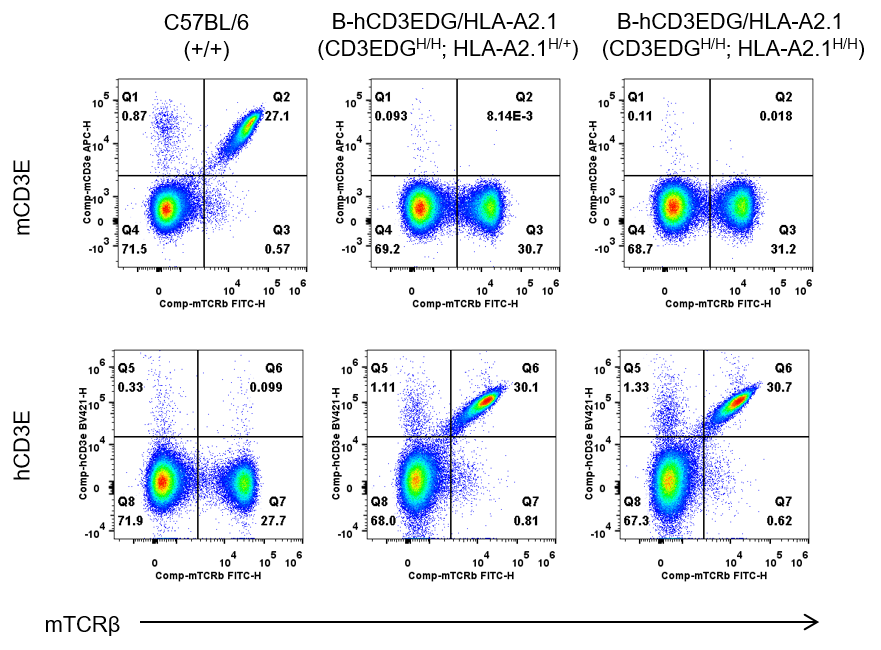
      Strain specific CD3E expression analysis in wild-type C57BL/6 mice and humanized B-hCD3EDG/HLA-A2.1 mice by flow cytometry. Splenocytes were collected from wild-type C57BL/6 mice and B-hCD3EDG/HLA-A2.1 mice, and analyzed by flow cytometry. Mouse CD3E was detectable in wild-type C57BL/6 mice (+/+). Human CD3E was detectable in B-hCD3EDG/HLA-A2.1 mice (CD3EDGH/H; HLA-A2.1H/+) and B-hCD3EDG/HLA-A2.1 mice (CD3EDGH/H; HLA-A2.1H/H) , but not in wild-type C57BL/6 mice (+/+).

      Mouse and Human HLA Protein Expression Analysis

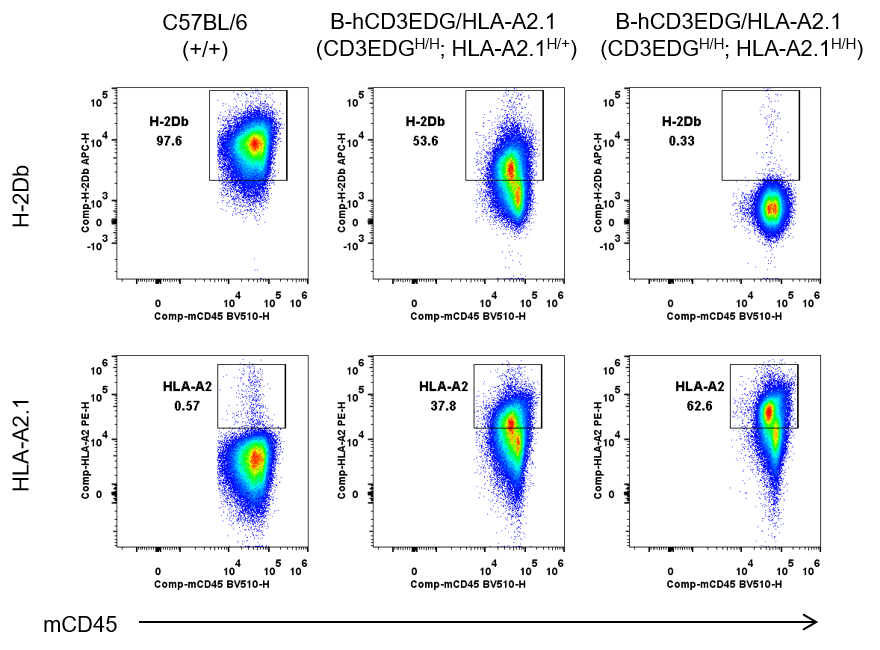
      Strain specific HLA expression analysis in wild-type C57BL/6 mice and B-hCD3EDG/HLA-A2.1 mice by flow cytometry. Splenocytes were collected from wild-type C57BL/6 mice and B-hCD3EDG/HLA-A2.1 mice, and analyzed by flow cytometry. Mouse H-2Db was detectable in wild-type C57BL/6 mice (+/+) and B-hCD3EDG/HLA-A2.1 (CD3EDGH/H; HLA-A2.1H/+). Human HLA-A2.1 was detectable in B-hCD3EDG/HLA-A2.1 (CD3EDGH/H; HLA-A2.1H/+) and B-hCD3EDG/HLA-A2.1 (CD3EDGH/H; HLA-A2.1H/H), but not in wild-type C57BL/6 mice (+/+).

      Frequency of leukocyte subpopulations in spleen

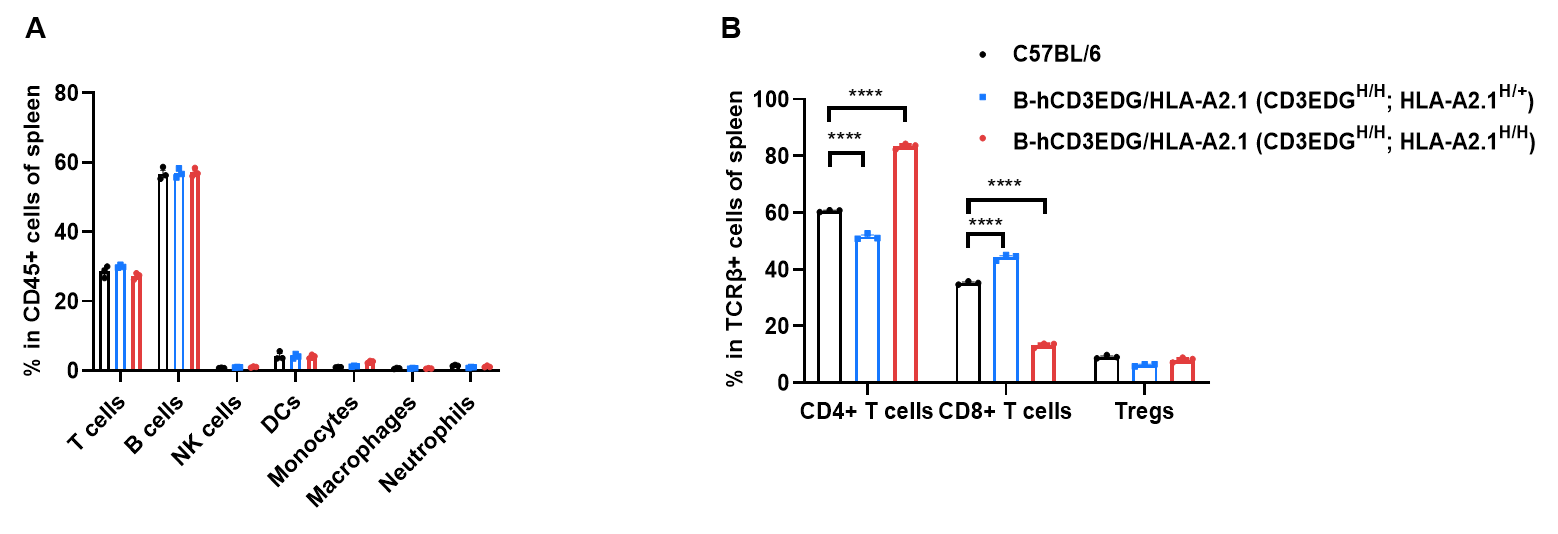
      Frequency of leukocyte subpopulations in spleen by flow cytometry. Splenocytes were isolated from wild-type C57BL/6 mice and homozygous B-hCD3EDG/HLA-A2.1 mice (n=3, 7-week-old). (A) Flow cytometry analysis of the splenocytes was performed to assess the frequency of leukocyte subpopulations. (B) Frequency of T cell subpopulations. Frequencies of T cells, B cells, NK cells, dendritic cells, neutrophils, monocytes and macrophages in B-hCD3EDG/HLA-A2.1 mice were similar to those in the C57BL/6 mice. Compared with C57BL/6 mice, the frequency of  CD4+ T cells and CD8+ T cells changed in B-hCD3EDG/HLA-A2.1 mice, especially the frequency of CD8+ T cells in B-hCD3EDG/HLA-A2.1 mice (CD3EDGH/H; HLA-A2.1H/H)  decreased significantly. Values are expressed as mean ± SEM. *p < 0.05, **p < 0.01, ***p < 0.001, ****p < 0.0001.

      Frequency of leukocyte subpopulations in blood

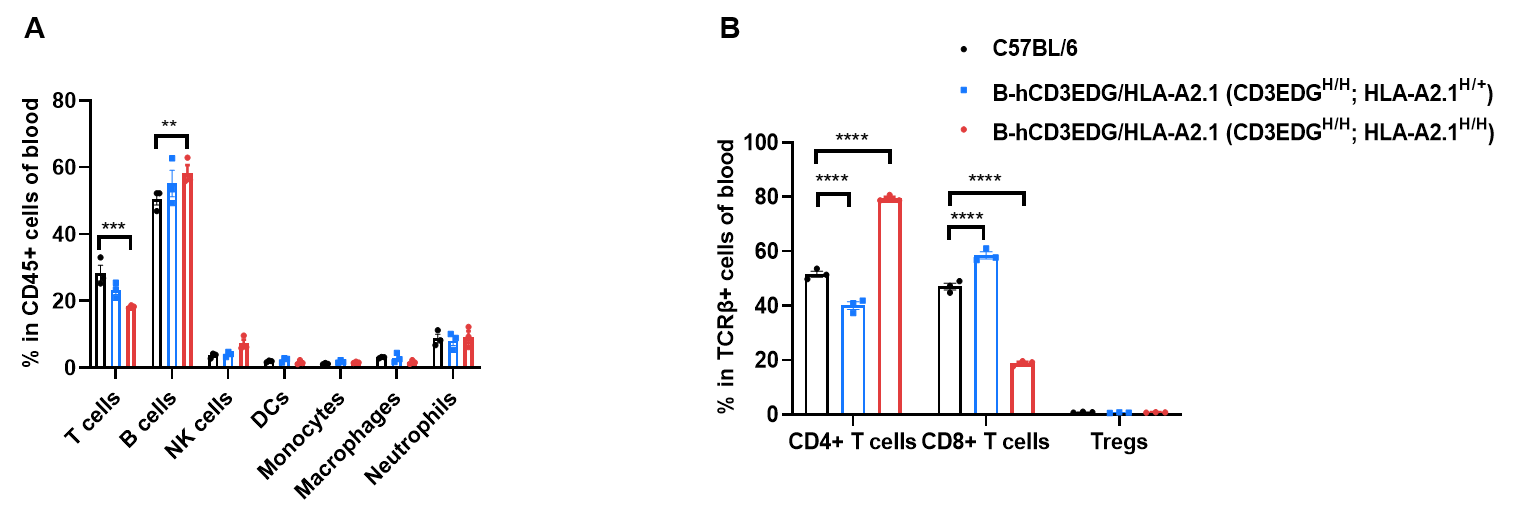
      Frequency of leukocyte subpopulations in blood by flow cytometry. Blood cells were isolated from wild-type C57BL/6 mice and homozygous B-hCD3EDG/HLA-A2.1 mice (n=3, 7-week-old). (A) Flow cytometry analysis of the blood leukocytes was performed to assess the frequency of leukocyte subpopulations. (B) Frequency of T cell subpopulations. Frequencies of NK cells, dendritic cells, neutrophils, monocytes and macrophages in B-hCD3EDG/HLA-A2.1 mice were similar to those in the C57BL/6 mice. Compared with C57BL/6 mice, the frequency of  CD4+ T cells and CD8+ T cells changed in B-hCD3EDG/HLA-A2.1 mice, especially the frequency of CD8+ T cells in B-hCD3EDG/HLA-A2.1 mice (CD3EDGH/H; HLA-A2.1H/H)  decreased significantly. Values are expressed as mean ± SEM. *p < 0.05, **p < 0.01, ***p < 0.001, ****p < 0.0001.

      Frequency of leukocyte subpopulations in lymph node

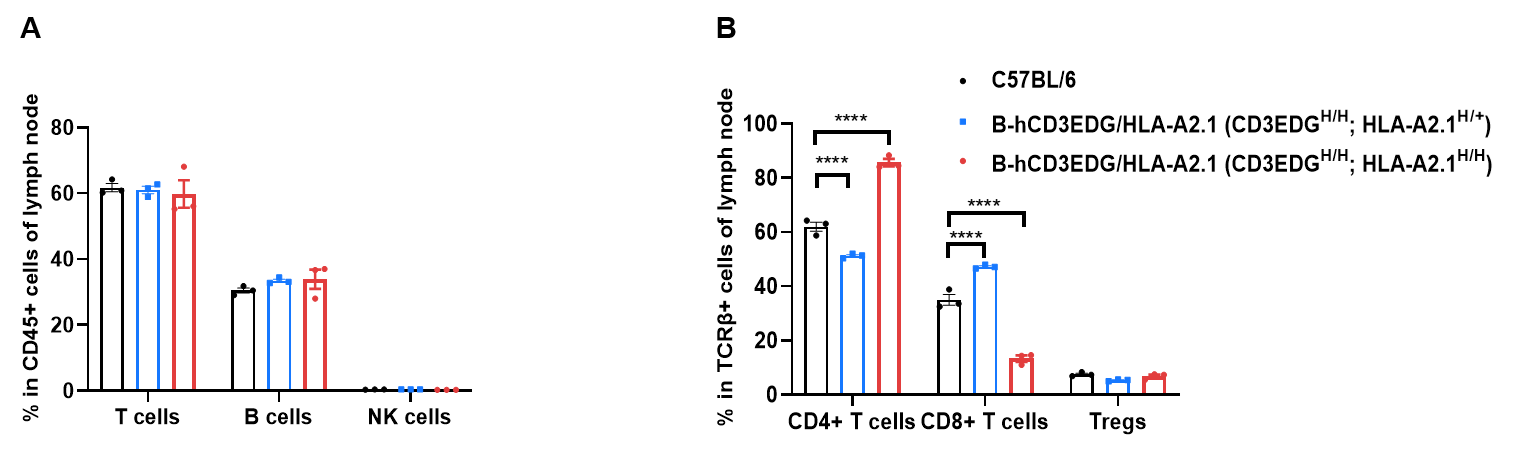
      Frequency of leukocyte subpopulations in lymph node by flow cytometry. Lymph nodes were isolated from wild-type C57BL/6 mice and homozygous B-hCD3EDG/HLA-A2.1 mice (n=3, 7-week-old). (A) Flow cytometry analysis of the leukocytes was performed to assess the frequency of leukocyte subpopulations. (B) Frequency of T cell subpopulations. Frequencies of T cells, B cells and NK cells in B-hCD3EDG/HLA-A2.1 mice were similar to those in the C57BL/6 mice. Compared with C57BL/6 mice, the frequency of  CD4+ T cells and CD8+ T cells changed in B-hCD3EDG/HLA-A2.1 mice, especially the proportion of CD8+ T cells in B-hCD3EDG/HLA-A2.1 mice (CD3EDGH/H; HLA-A2.1H/H) decreased significantly. Values are expressed as mean ± SEM. *p < 0.05, **p < 0.01, ***p < 0.001, ****p < 0.0001.

      FAQ section

      Q1: What are B-hCD3EDG/HLA-A2.1 mice?

      B-hCD3EDG/HLA-A2.1 mice are dual humanized mice combining human CD3E, CD3D, and CD3G expression with a chimeric human B2M/HLA-A*0201/H-2Db class I molecule in a C57BL/6 background.

      Q2: Why is HLA-A2.1 important in immuno-oncology research?

      HLA-A2.1 presents peptide antigens to cytotoxic T cells and is widely used for HLA-restricted TCR therapy, TCR-mimic antibody, vaccine, and cell therapy development.

      Q3: How was CD3E expression validated in this model?

      Human CD3E expression was validated in splenic T cells from B-hCD3EDG/HLA-A2.1 mice by flow cytometry using species-specific anti-CD3E antibodies.

      Q4: How was HLA-A2.1 expression validated?

      Human HLA-A2.1 and mouse H-2Db expression were analyzed in splenocytes by flow cytometry, confirming expression of the chimeric HLA-A2.1/H-2Db class I molecule.

      Q5: What are the main applications of B-hCD3EDG/HLA-A2.1 mice?

      Applications include pharmacological and safety evaluation of oncology antibodies, CD3-targeted therapeutics, HLA-A2.1-restricted TCR therapies, TCR-mimic antibodies, vaccines, and cell therapies.

      * When publishing results obtained using this animal model, please acknowledge the source as follows: The animal model [B-hCD3EDG/HLA-A2.1 mice] (Cat# 112756) was purchased from Biocytogen.