Description
- Background: Duchenne muscular dystrophy (DMD) is a severe, progressive, muscle-wasting disease that leads to difficulties with movement and premature death. Duchenne muscular dystrophy (DMD) is caused by mutations in the DMD gene. These mutations frequently entail deletions of one or more exons, which disrupt the open reading frame and introduce a premature stop codon. This leads to the production of a nonfunctional truncated dystrophin protein, resulting in a severe muscle degeneration phenotype.
- Targeting strategy: The exon 51, exon 52 and exon 53 of mouse Dmd are replaced by exon 51 and exon 53 of human DMD in B-hDMD(exon51-53, del52) mice. The human exon 51 is flanked by ~2kb of human intron 50 and human intron 51 sequences, while human exon 53 is flanked by ~2kb of human intron 52 and human intron 53 sequences.
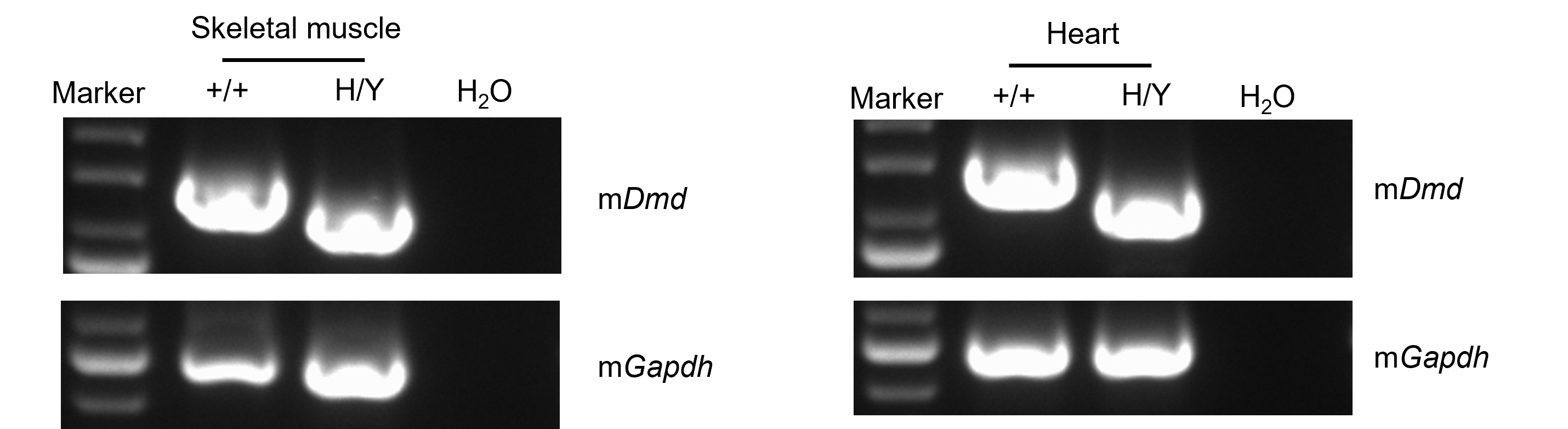
- Validation: The exon 51 and exon 53 from human DMD were confirmed via sequencing in heat and skeletal muscle from homozygous B-hDMD(exon51-53, del52) mice.
- Application: This product is used for pharmacodynamics of Duchenne muscular dystrophy
Targeting Strategy
Gene targeting strategy for B-hDMD(exon51-53, del52) mice. The exon 51, exon 52 and exon 53 of mouse Dmd are replaced by exon 51 and exon 53 of human DMD in B-hDMD(exon51-53, del52) mice. The human exon 51 is flanked by ~2kb of human intron 50 and human intron 51 sequences, while human exon 53 is flanked by ~2kb of human intron 52 and human intron 53 sequences.
mRNA Expression Analysis
Strain specific analysis of DMD mRNA expression in wild-type C57BL/6JNifdc mice and B-hDMD(exon51-53, del52) mice by RT-PCR. Heart and skeletal muscle RNA were isolated from wild-type C57BL/6JNifdc mice (+/+) and homozygous B-hDMD(exon51-53, del52) mice (H/Y), then cDNA libraries were synthesized by reverse transcription, followed by PCR with mouse Dmd primers. The transcripts in homozygous mice are shorter than those in wild-type mice, and the sequences were confirmed via Sanger sequencing, demonstrating the successful exon splicing in B-hDMD(exon51-53, del52) mice.
Protein Expression Analysis
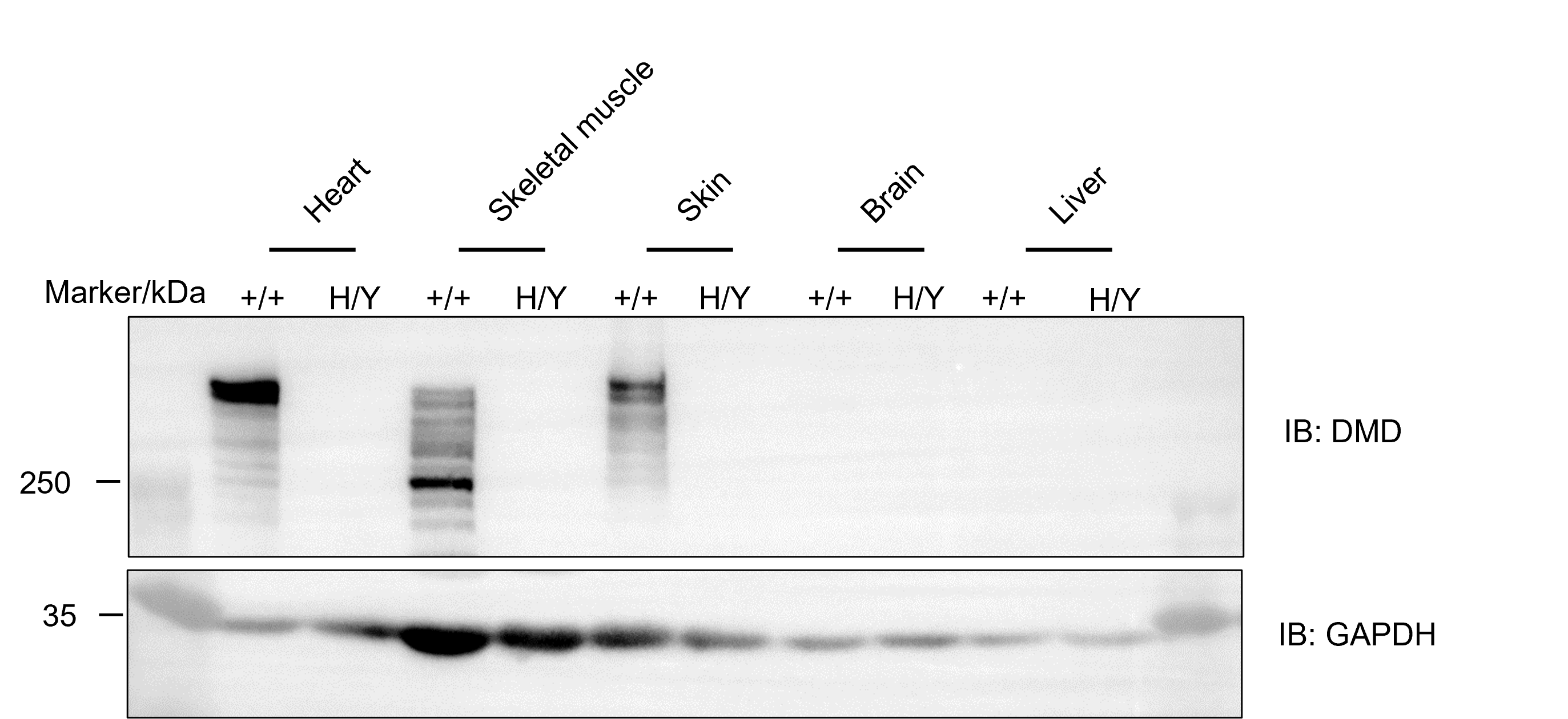
Western blot analysis of DMD protein expression in wild-type C57BL/6JNifdc mice and homozygous B-hDMD(exon51-53, del52) mice. Various tissue lysates were collected from wild-type C57BL/6JNifdc mice (+/+) and homozygous B-hDMD(exon51-53, del52) mice (H/Y), and then analyzed by western blot with anti-Dystrophin antibody (Sigma-Aldrich, MAB1692). 40 μg total proteins were loaded for western blotting analysis. DMD was detected in heart, skeletal muscle and skin from wild-type mice, but not in homozygous B-hDMD(exon51-53, del52) mice.
* When publishing results obtained using this animal model, please acknowledge the source as follows: The animal model [B-hDMD(exon51-53, del52) mice] (Cat# 114172) was purchased from Biocytogen.