Description
- LEPR (Leptin receptor), also known as ObR (obese gene receptor), is a member of the cytokine receptor family. It mediates the actions of leptin, a multifunctional hormone primarily produced by adipose tissue, which plays critical roles in food intake, energy metabolism, angiogenesis, reproduction, hematopoiesis, bone metabolism, and immune function.
- LEP (Leptin), encodes a protein secreted into the bloodstream by white adipocytes, which plays a critical role in regulating energy homeostasis. Once in circulation, leptin binds to its specific receptors in the brain, triggering downstream signaling pathways that suppress appetite and enhance energy expenditure
- Gene editing strategy: The exons 3-17 of the mouse Lepr gene that encode the extracellular domain is replaced by human counterparts in B-hLEPR, Lep KO mice. The genomic region of the mouse Lepr gene that encodes the signal peptide, cytoplasmic portion, and transmembrane domain is retained. The promoter, 5’UTR and 3’UTR of the mouse gene are also retained. The chimeric LEPR expression is driven by the endogenous mouse Lepr promoter, while mouse Lepr gene transcription and translation will be disrupted. The exons 2-3 of the mouse Lep gene were knocked out in B-hLEPR, Lep KO mice. As a result, the mouse LEP protein is not expressed anymore.
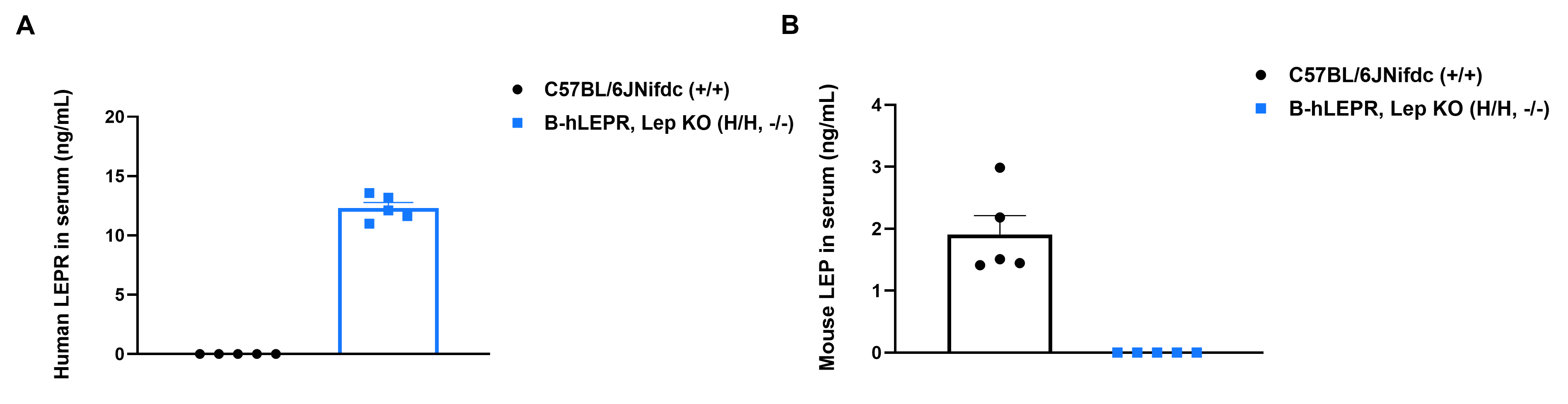
- Protein Expression Analysis: Human LEPR was exclusively detectable in homozygous B-hLEPR, Lep KO mice, but not in wild-type C57BL/6JNifdc mice. Mouse LEP was exclusively detectable in wild-type mice, but not detectable in homozygous B-hLEPR, Lep KO mice.
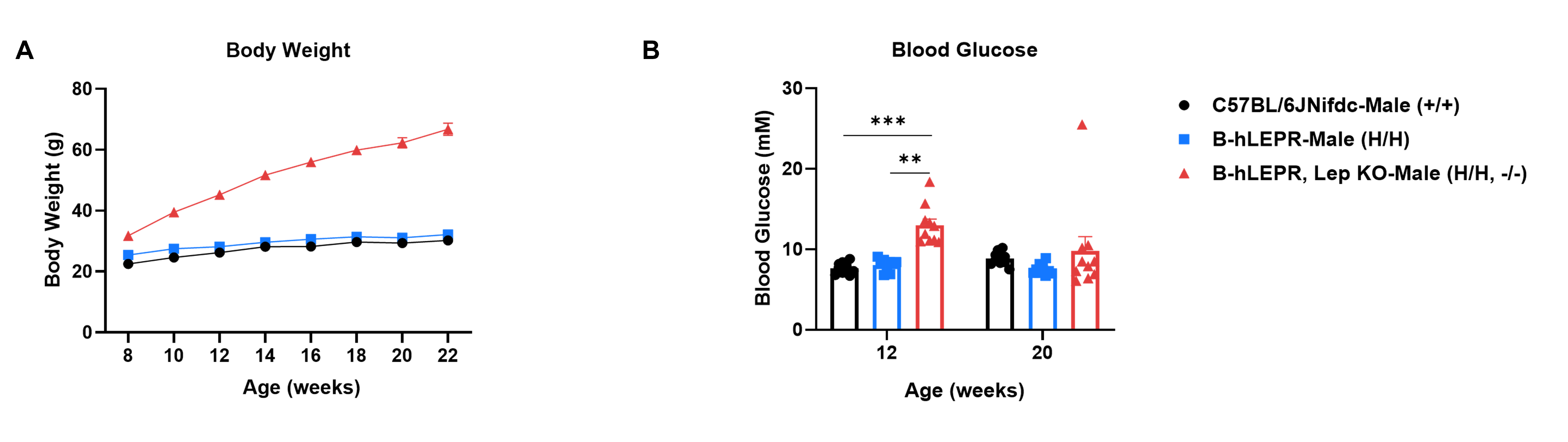
- Body weight analysis: The body weight of homozygous B-hLEPR, Lep KO mice was continuously higher than that of the wild-type C57BL/6JNifdc mice.
- Note: The B-hLEPR, Lep KO mice were developed on the C57BL/6 background. Although it functions as a spontaneous obesity model, the concomitant hyperglycemia is transient and typically improves as the animals age.
- Application: This product is used for pharmacodynamics and safety evaluation of obesity
Targeting Strategy
Gene targeting strategy for B-hLEPR, Lep KO mice. The exons 3-17 of the mouse Lepr gene that encode the extracellular domain were replaced by human counterparts in B-hLEPR, Lep KO mice. The genomic region of the mouse Lepr gene that encodes the signal peptide, cytoplasmic portion, and transmembrane domain is retained. The promoter, 5’UTR, and 3’UTR of the mouse gene are also retained. The chimeric LEPR expression is driven by the endogenous mouse Lepr promoter, while mouse Lepr gene transcription and translation will be disrupted. The exons 2-3 of the mouse Lep gene were knocked out in B-hLEPR, Lep KO mice. As a result, the mouse LEP protein is not expressed anymore.
Protein Expression Analysis in Serum
Human LEPR and mouse LEP expression analysis in wild-type C57BL/6JNifdc mice and homozygous B-hLEPR, Lep KO mice by ELISA. Serum was collected from wild-type C57BL/6JNifdc mice (+/+) (male, n=5, 7-week-old) and homozygous B-hLEPR, Lep KO mice (H/H, -/-) (male, n=5, 7-week-old). Expression level of human LEPR and mouse LEP was analyzed by ELISA (anti-mouse LEP ELISA kit: Abcam, ab199082; anti-human LEPR ELISA kit: Abcam, ab282876). (A) Human LEPR was exclusively detectable in homozygous B-hLEPR, Lep KO mice. (B) Mouse LEP was exclusively detectable in wild-type mice, but not detectable in homozygous B-hLEPR, Lep KO mice. Values are expressed as mean ± SEM.
Model Validation and Analysis
Body weight and Blood Glucose of B-hLEPR, Lep KO mice. The body weight and blood glucose of wild-type C57BL/6JNifdc mice (+/+) (male, n=10), B-hLEPR mice (H/H) (male, n=10), and homozygous B-hLEPR, Lep KO mice (H/H, -/-) (male, n=10) were monitored at different ages. (A) The body weight at different ages. (B) The blood glucose levels at different ages. Significance was determined by the two-way ANOVA. *p<0.05, **p<0.01, ***p<0.001. Values are expressed as mean ± SEM.
Note: The B-hLEPR, Lep KO mouse was developed on the C57BL/6 background. Although it functions as a spontaneous obesity model, the concomitant hyperglycemia is transient and typically improves as the animals age.
* When publishing results obtained using this animal model, please acknowledge the source as follows: The animal model [B-hLEPR, Lep KO mice] (Cat# 114626) was purchased from Biocytogen.