Description
SCN10A: A pivotal therapeutic target for analgesic drug development
- Gene Information: The sodium voltage-gated channel alpha subunit 10 (SCN10A) gene encodes the Nav1.8 sodium channel protein, which is crucial for pain signal transmission in peripheral sensory neurons.
- Protein Expression: The NaV1.8 sodium channels are predominantly expressed in dorsal root ganglion (DRG) and trigeminal ganglion neurons, which are primarily nociceptive. The NaV1.8 channels display stringent tissue specificity, with barely detectable expression in the central nervous system, cardiac and skeletal muscle.
- Signaling Pathway: Under physiological conditions, Nav1.8 maintains moderate activity to support physiological nociceptive defense. During tissue injury and inflammation, Nav1.8 is upregulated with a decreased activation threshold and enhanced aberrant firing, which directly induces pain hypersensitivity and spontaneous pain.
- Therapeutic Inhibition: Suzetrigine produces analgesia through highly selective Nav1.8 blockade, interrupting peripheral nociceptive signaling to mitigate pain before signals are relayed to the brain. As a peripherally acting agent, its mechanism differs from opioids, which trigger central euphoria and stimulatory effects.
Targeting Strategy
SCN10A
- The exons 2-28 of mouse Scn10a gene that encode the whole molecule (ATG to STOP codon) were replaced by human counterparts in B-hSCN10A mice. The promoter, 5’UTR and 3’UTR region of the mouse gene are retained.
- The human SCN10A expression is driven by endogenous mouse Scn10a promoter, while mouse Scn10a gene transcription and translation will be disrupted.
mRNA Expression Analysis
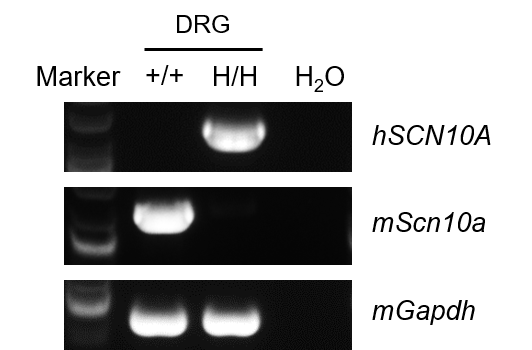
- Human SCN10A mRNA is exclusively detectable in dorsal root ganglia (DRG) of homozygous B-hSCN10A mice, but not in wild-type C57BL/6 mice.
Strain-specific SCN10A expression analysis in wild-type C57BL/6JNifdc mice and homozygous B-hSCN10A mice. Dorsal root ganglia (DRG) RNA was isolated from wild-type C57BL/6JNifdc mice (+/+) and homozygous B-hSCN10A mice (H/H), then cDNA libraries were synthesized by reverse transcription, followed by PCR with mouse or human SCN10A primers. Human SCN10A mRNA was detectable only in homozygous B-hSCN10A mice but not in wild-type mice.
Protein Expression Analysis
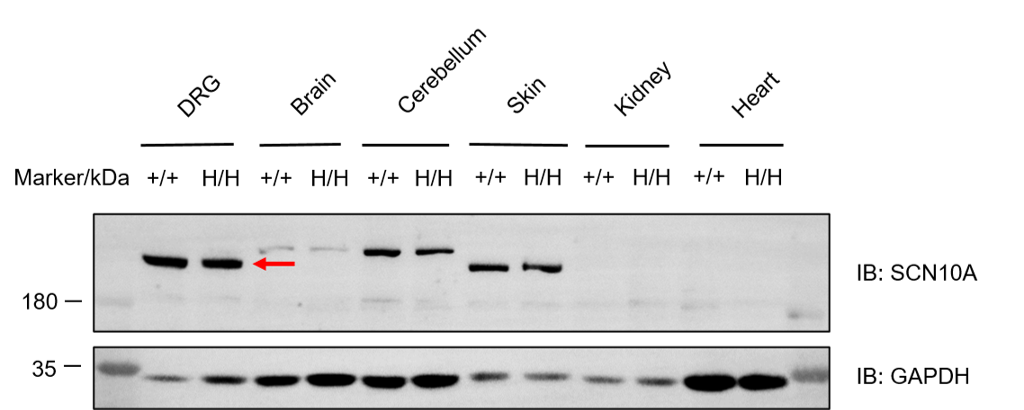
- SCN10A protein was detectable in DRG, cerebellum and skin from homozygous B-hSCN10A mice and wild-type C57BL/6JNifdc.
Protein expression analysis of SCN10A in homozygous B-hSCN10A mice. Various tissue lysates were collected from wild-type C57BL/6JNifdc mice (+/+) and homozygous B-hSCN10A mice (H/H), and then analyzed by western blot with anti-SCN10A antibody. 40 μg total protein was loaded for western blotting analysis. SCN10A protein was detectable in DRG, cerebellum and skin from homozygous B-hSCN10A mice and wild-type C57BL/6 mice, as the antibody was cross-reactive between human and mouse.
In Vivo Efficacy of Suzetrigine Analog in CFA-induced Inflammatory Pain Model
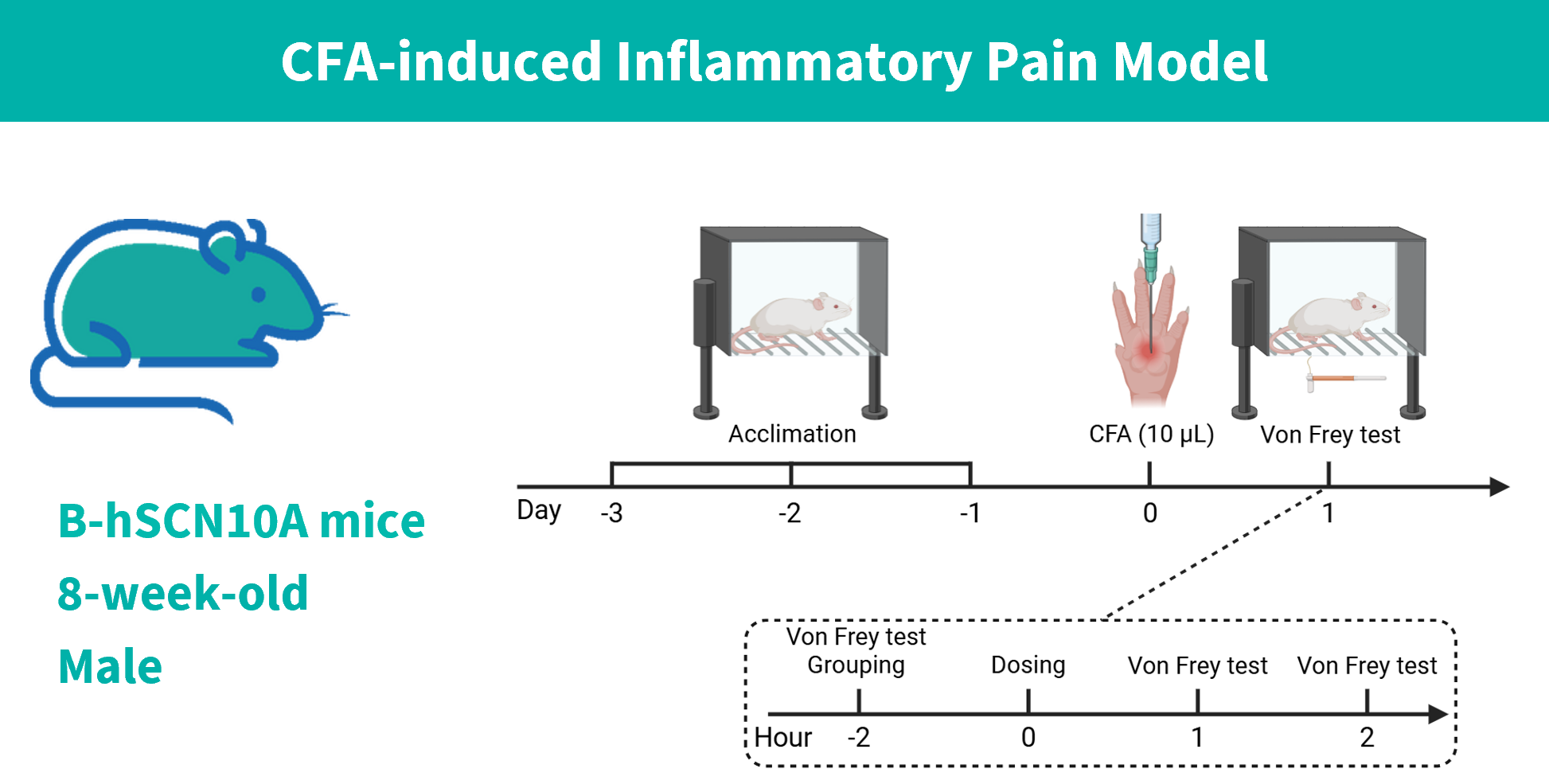
Experimental schedule for the CFA-induced Inflammatory Pain Model and in vivo efficacy of Suzetrigine analog in wild-type mice and B-hSCN10A mice. The mice underwent a 3-day acclimation period in test cages. Mice received subcutaneous CFA injection in the hind paws on Day 0 to establish an inflammatory pain model induced by CFA. Pain thresholds were measured with the Von Frey test 2 h before compound administration. Suzetrigine Analog was orally administered, and follow-up Von Frey threshold measurements were performed at 1 h and 2 h after dosing.

CFA-induced inflammatory pain and analgesic effects of Suzetrigine analog in wild-type mice and B-hSCN10A mice. In wild-type mice and B-hSCN10A mice, intraplantar CFA injection markedly reduced mechanical pain thresholds. In wild-type mice, VX-548 at 1 mpk didn’t alleviate CFA-induced inflammatory pain. In B-hSCN10A mice, VX-548 at 1 mpk significantly alleviated inflammatory pain with an analgesic effect lasting up to 2 h. B-hSCN10A mice provide a powerful preclinical model for in vivo evaluation of the efficacy of targeted human SCN10A analgesic drugs. **P < 0.01, ***P < 0.001.
* When publishing results obtained using this animal model, please acknowledge the source as follows: The animal model [B-hSCN10A mice] (Cat# 113423) was purchased from Biocytogen.