Description
CEACAM5: CEACAM5 is a tumor-associated antigen involved in cancer progression and a target for cancer therapy.
- Gene Information: CEACAM5 (Carcinoembryonic Antigen-Related Cell Adhesion Molecule 5), also known as CEA, is a glycosylphosphatidylinositol (GPI)-anchored cell surface glycoprotein encoded on human chromosome 19. It is a well-established tumor-associated antigen in multiple epithelial cancers.
- Protein Expression: CEACAM5 is normally expressed on gastrointestinal epithelial cells and is highly overexpressed in colorectal, gastric, pancreatic, and other epithelial tumors. Elevated CEACAM5 expression is associated with tumor progression and poor prognosis.
- Signaling Pathway: CEACAM5 regulates cell adhesion and influences signaling pathways involved in cell survival, proliferation, invasion, and metastasis. Its abnormal expression contributes to tumor development and immune evasion.
- Model application: Targeting CEACAM5 with monoclonal antibodies, ADCs, bispecific antibodies, and T-cell engagers can selectively eliminate CEACAM5-positive tumor cells and enhance anti-tumor activity.
Targeting strategy
CEACAM5
- The full coding sequences of human CEACAM5 gene, including the promoter, 5’UTR and 3’UTR are inserted into mouse Hipp11 (H11) locus in B-hCEACAM5 mice.
mRNA Expression by RT-PCR
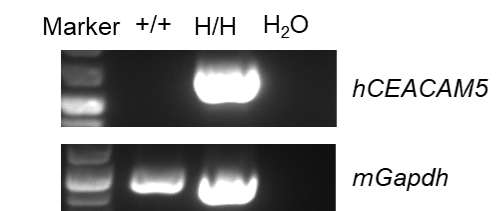
- Human CEACAM5 mRNA was detectable only in homozygous B-hCEACAM5 mice, but not in wild-type mice.
mRNA CEACAM5 were detectable in B-hCEACAM5 mice by RT-PCR and sequencing. Colon tissues were isolated from wild-type C57BL/6JNifdc mice (+/+) and homozygous B-hCEACAM5 mice (H/H). Primers were designed to detect the human CEACAM5. Human CEACAM5 mRNA was detectable in B-hCEACAM5 mice, but not in wild-type mice. Sequencing of the PCR products confirmed that the amplified sequences were consistent with database reference sequences.
CEACAM5 Protein Expression
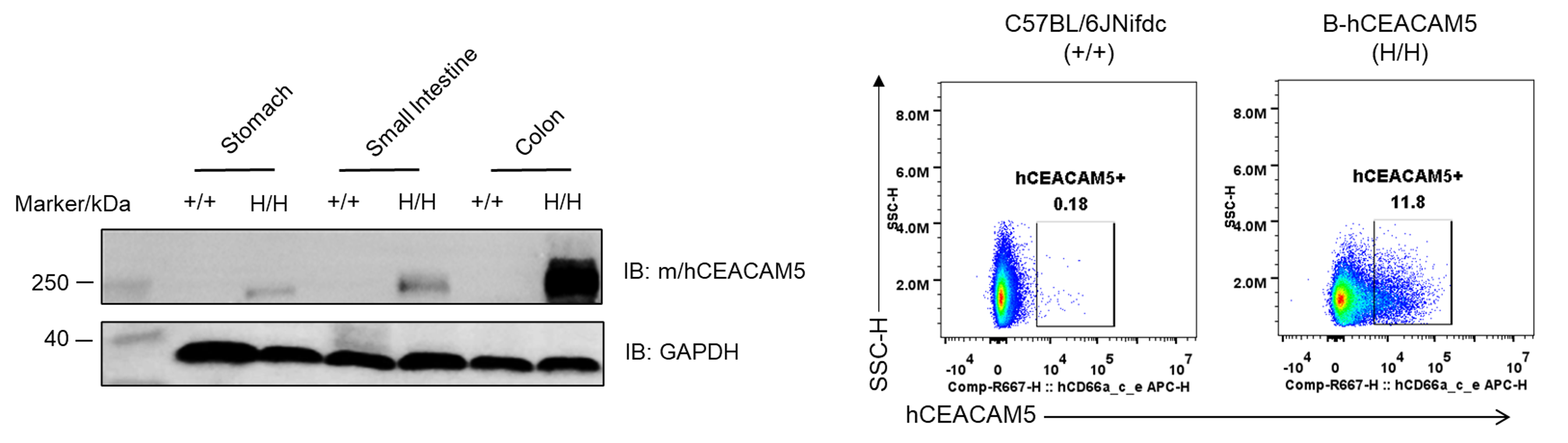
- WB results: Human CEACAM5 were detected in stomach, small intestine and colon tissues in homozygous mice but not wild-type C57BL/6JNifdc mice.
- FACS results: Human CEACAM5 was exclusively detectable in colon of homozygous B-hCEACAM5 mice but not in wild-type mice.
Western blot and FACS analysis of CEACAM5 protein expression in homozygous B-hCEACAM5 mice. Various tissue lysates were collected from wild-type C57BL/6JNifdc mice (+/+) and homozygous B-hCEACAM5 mice (H/H), and then analyzed by western blot with anti-CEACAM5 antibody (Invitrogen, PA5-88533) and flow cytometry with species-specific anti-human CD66a/c/e Antibody (Biolegend, 342308).
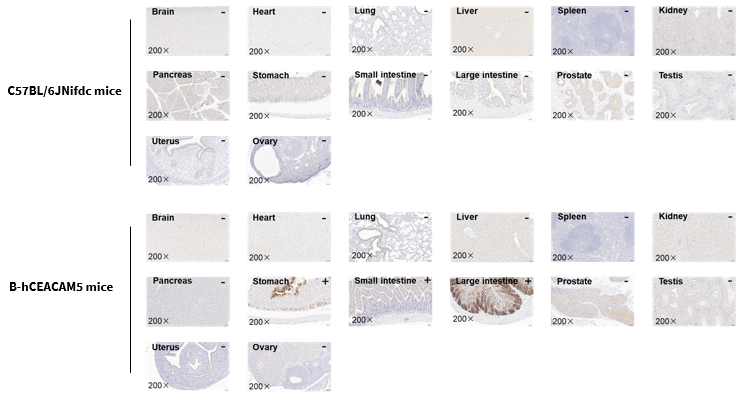
- Human CEACAM5 was detected in the stomach, small intestine and large intestine of B-hCEACAM5 mice.
Immunohistochemical (IHC) analysis of CEACAM5 protein expression in wild-type mice and B-hCEACAM5 mice. Major tissues were collected from wild-type mice and homozygous B-hCEACAM5 mice and analyzed by IHC with anti-CEACAM5 antibody (Abcam, ab133633).
* When publishing results obtained using this animal model, please acknowledge the source as follows: The animal model [B-hCEACAM5 mice] (Cat# 114278) was purchased from Biocytogen.