Description
ACVR1C/ALK7: A key member of the TGF-β superfamily.
- Gene Information: ACVR1C (Activin receptor-like kinase 7, ALK7) belongs to the TGF-β superfamily type I receptors, comprising an extracellular ligand-binding domain, a single transmembrane helix, and intracellular GS and kinase domains.
- Protein Expression: ALK7 is highly abundant in both white and brown fat, where it regulates lipid storage and energy homeostasis.
- Signaling Pathway: ACVR1C signaling operates through two parallel mechanisms: it primarily activates the canonical, Smad2/3-mediated TGF-β pathway, while concurrently triggering non-canonical cascades (including MAPK and PI3K/AKT) under specific cellular conditions. This dual action allows for the integrated regulation of cellular proliferation, differentiation, migration, and metabolism.
- Therapeutic Inhibition: Therapeutics such as ARO-ALK7 utilize RNA interference (RNAi) to selectively silence the ACVR1C gene. By disrupting the translation of the ACVR1C receptor, this approach effectively reduces visceral adiposity while preserving lean muscle mass.
Targeting strategy
ALK7
- The exons 1-9 of the mouse Alk7 gene that encode the whole molecule, including the promoter, 5’UTR, and 3’UTR, were replaced by the exons 1-9 of the human counterparts, including the human promoter, 5’UTR, and human 3’UTR in B-hALK7 mice plus. The human ALK7 expression is driven by the human ALK7 promoter, while the mouse Alk7 gene transcription and translation will be disrupted.
mRNA Expression Analysis
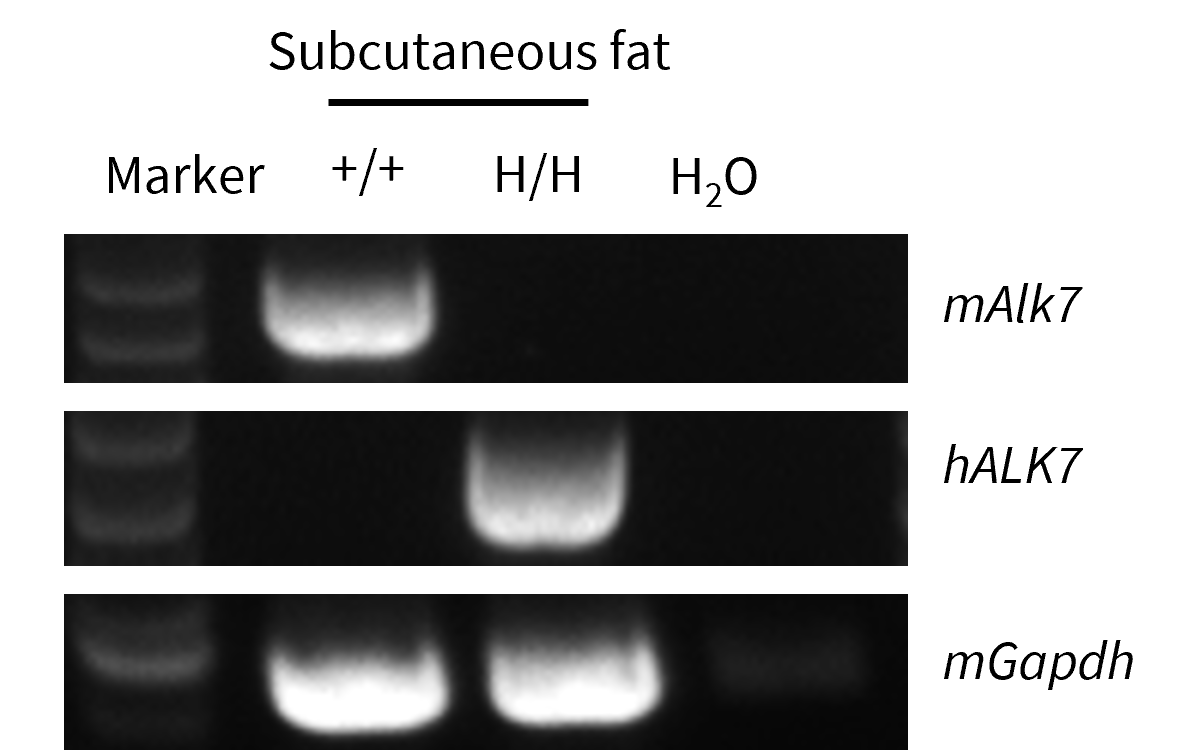
- Mouse Alk7 mRNA was detectable only in wild-type C57BL/6JNifdc mice.
- Human ALK7 mRNA was detectable only in homozygous B-hALK7 mice plus but not in wild-type mice.
Strain specific analysis of ALK7 mRNA expression in wild-type C57BL/6JNifdc mice and B-hALK7 mice plus by RT-PCR. Subcutaneous fat RNA was isolated from wild-type C57BL/6JNifdc mice (+/+) and homozygous B-hALK7 mice plus (H/H), then cDNA libraries were synthesized by reverse transcription, followed by RT-PCR with human ALK7 primers. Mouse Alk7 mRNA was only detectable in wild-type mice. Human ALK7 mRNA was exclusively detectable in B-hALK7 mice plus but not in wild-type mice. Human sequences were confirmed via Sanger Sequencing.
- Human ALK7 mRNA was detectable in homozygous B-hALK7 mice plus from different adipose tissue.
Strain specific analysis of ALK7 mRNA expression in B-hALK7 mice plus by RT-qPCR. Perirenal fat, perigonadal fat, and inguinal subcutaneous fat RNA were isolated from homozygous B-hALK7 mice plus (H/H), then cDNA libraries were synthesized by reverse transcription, followed by RT-qPCR with human ALK7 primers. All results were normalized to the female inguinal subcutaneous fat. Values are expressed as mean ± SEM.
The Inhibitory Efficiency of the Nucleic Acid Drugs Against Human ALK7
- The human ALK7 levels in the treatment group were reduced compared to the control group, demonstrating that B-hALK7 mice plus provide a powerful preclinical model for in vivo evaluation of human ALK7-targeted nucleic acid drugs.
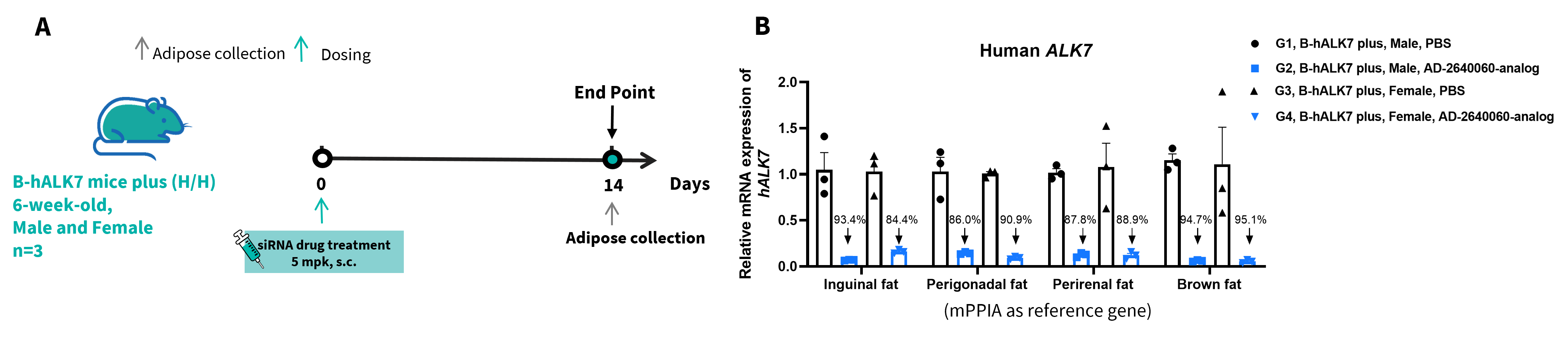
The inhibitory efficiency of the nucleic acid drugs against human ALK7 in homozygous B-hALK7 mice plus. B-hALK7 mice plus (H/H) were randomly divided into G1, G2 (male 6-week-old, n=3/group) and G3, G4 (female 6-week-old, n=3/group). The human ALK7 targeted nucleic acid drugs (synthesized according to patents), and PBS were administered to the mice individually. The nucleic acid drug was administered in the form of a PBS aqueous solution. The mice were sacrificed on day 14, and the adipose tissue was collected to detect the expression level of human ALK7 mRNA by qPCR. (A) The schematic diagram of experimental processing. (B) The expression of human ALK7 mRNA in the adipose tissues. The expression of human ALK7 mRNA was normalized to the mean value of the PBS control within each tissue and each sex. Values are expressed as mean ± SEM.
* When publishing results obtained using this animal model, please acknowledge the source as follows: The animal model [B-hALK7 mice plus] (Cat# 111405) was purchased from Biocytogen.