Description
C6 MOA: C6 participates in the initiation of membrane attack complex (MAC) assembly.
- Gene Information: This gene encodes component C6 of the complement system. C6 serves as the foundational scaffold of the terminal complement complex by specifically binding to C5b and recruiting C7/C8/C9 to assemble the membrane attack complex (MAC) for target cell lysis.
- Protein Expression: It is constitutively expressed mainly in the liver under physiological conditions to maintain the complement level in blood.
- Signaling Pathway: C6 participates in all the pathways of complement, serving as a key component in the complement cascade activation pathway.
- Application : This mouse model can be utilized to evaluate the efficacy of both monoclonal antibodies (mAbs) and nucleic acid therapeutics (RNAi / ASO).
Key Advantages
- Complete Human protein:The full human C6 gene was knock in humanized mice .
- Normal Phenotypes:No obvious abnormal phenotypes have been observed during the feeding and maintenance of these mice.
- Suitable for small nucleic acid drugs:This mouse carries the human 3'UTR sequence.
Key Applications
- Efficacy & Safety Evaluation:Supports efficacy and safety assessment of anti-hC6 antibodies and small nucleic acid drugs.
- Novel Therapeutic Screening:Support the discovery, screening, and optimization of new treatment strategies, leveraging a relevant humanized models for translational research.
Targeting strategy
- The exons 1~18 of mouse C6 gene were replaced by human exons 1~18 (with 3’UTR) that encode the whole molecule in B-hC6 mice.
- The promoter and 5’UTR region of the mouse gene are retained.
- The human C6 protein expression is driven by endogenous mouse C6 promoter.
mRNA expression analysis
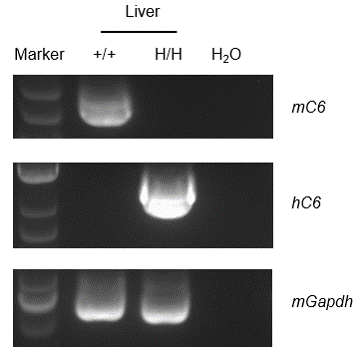
Human C6 mRNA was detectable only in homozygous B-hC6 mice but not in wild-type mice.
Species specific analysis of C6 gene expression in wild-type C57BL/6JNifdc mice and homozygous humanized B-hC6 mice by RT-PCR. Liver was collected from wild-type C57BL/6JNifdc mice (+/+) and homozygous B-hC6 mice (H/H). Mouse C6 mRNA was detectable in wild-type C57BL/6JNifdc mice. Human C6 mRNA was exclusively detectable in homozygous B-hC6 mice but not in wild-type C57BL/6 mice.
Protein expression analysis
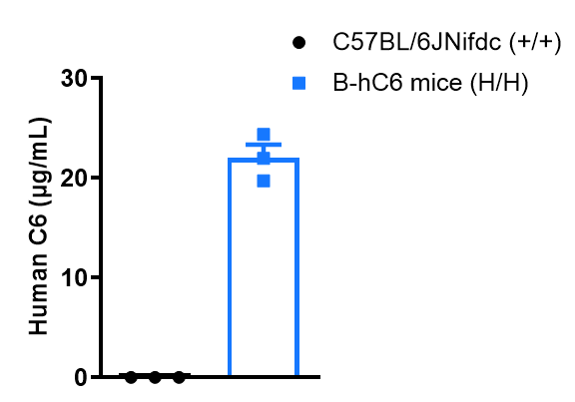
Human C6 was detected in homozygous B-hC6 mice, but not in wild-type mice.
Strain specific C6 expression analysis in wild-type C57BL/6JNifdc mice and homozygous humanized B-hC6 mice by ELISA.
Serum was collected from wild-type C57BL/6JNifdc mice (+/+) (male, n=3, 8-week-old) and homozygous B-hC6 mice (H/H) (male, n=3, 8-week-old). Expression level of human C6 were analyzed by ELISA (human C6 ELISA kit: Novus Biologicals, NBP2-60558). Human C6 was exclusively detectable in homozygous B-hC6 mice (n=3). Values are expressed as mean ± SEM.
* When publishing results obtained using this animal model, please acknowledge the source as follows: The animal model [B-hC6 mice] (Cat# 113021) was purchased from Biocytogen.