
C57BL/6-Dmdtm1(Dmd Exon51-53 del; DMD Exon51, Exon53 ins)Bcgen Tfrctm1(TFRC)Bcgen/Bcgen • 115038
DMD: Mutations in this gene lead to severe, progressive muscle-wastingdisorders.
DMD
TFR1
Note: B-hDMD(exon51-53, del52)/hTFR1 mice were obtained by mating B-hDMD(exon51-53, del52) mice (114172) and B-hTFR1 mice (110861).
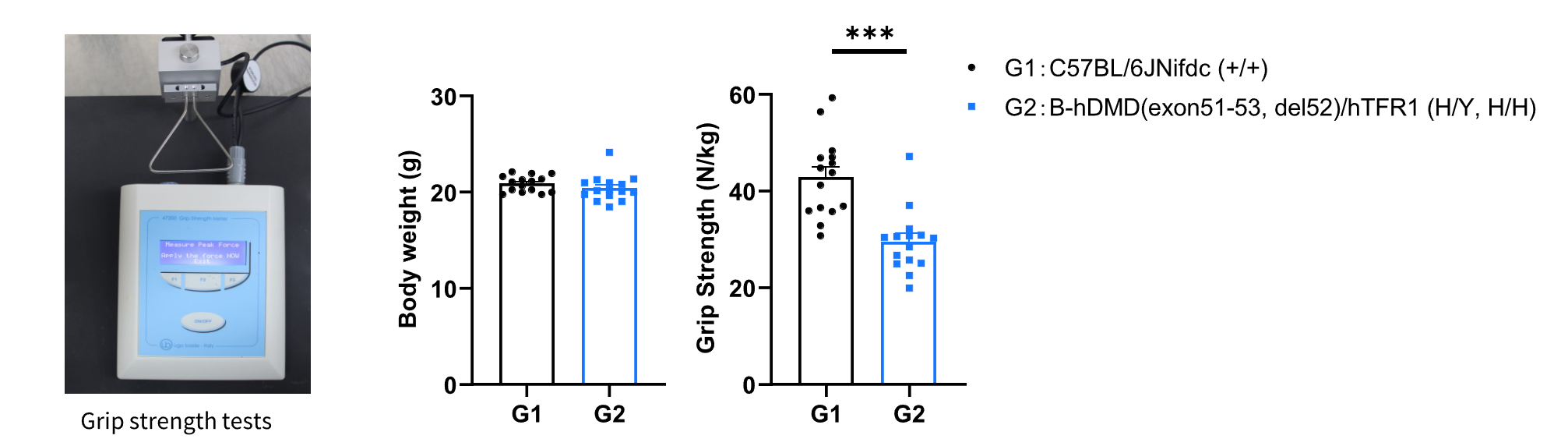
Behavioral performance in wild-type C57BL/6JNifdc and hemizygous B-hDMD(exon51-53, del52)/hTFR1 mice. Grip strength tests were conducted to assay the behavioral performance in wild-type C57BL/6JNifdc and hemizygous B-hDMD(exon51-53, del52)/hTFR1 mice (male, 6-week-old, n=15). Grip strength produced by forelimb in hemizygous B-hDMD(exon51-53, del52)/hTFR1 mice was significant weaker than that in wild-type control mice. All grip strength measurements are normalized to the individual animal’s body weight. Values are expressed as mean ± SEM. Significance was determined by unpaired t test. *P < 0.05, P < 0.01, ***P < 0.001.
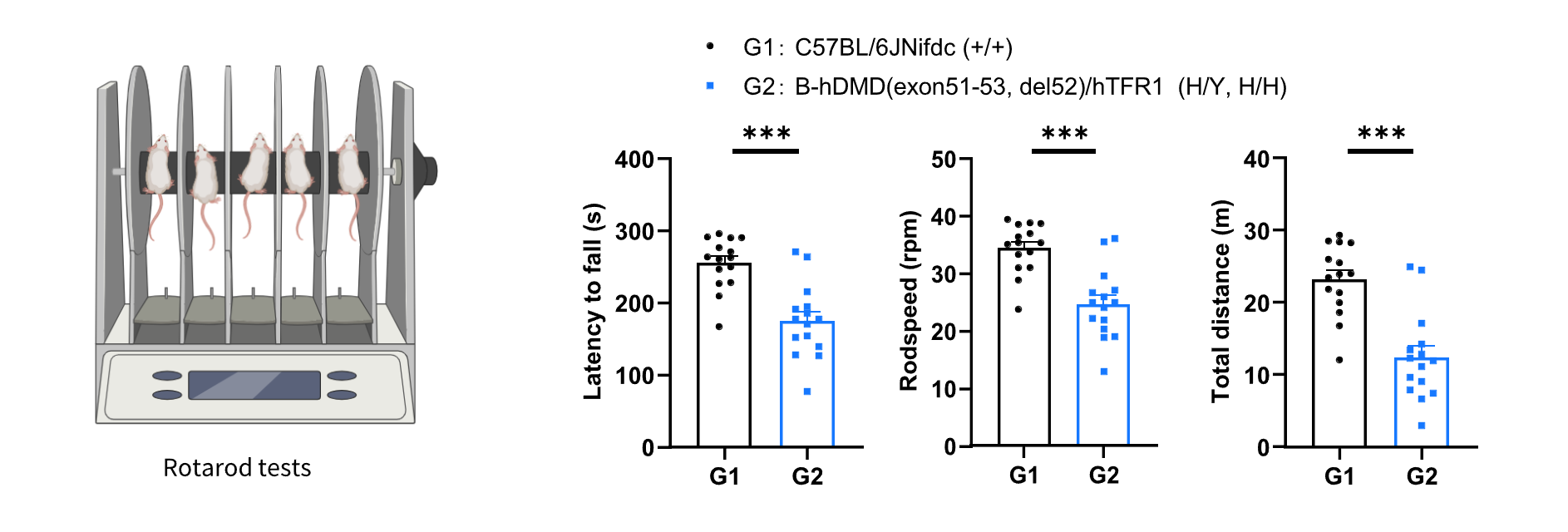
Behavioral performance in wild-type C57BL/6JNifdc and hemizygous B-hDMD(exon51-53, del52)/hTFR1 mice. Rotarod tests were conducted to assay the behavioral performance in wild-type C57BL/6JNifdc and hemizygous B-hDMD(exon51-53, del52)/hTFR1 mice (male, 6-week-old, n=15). Rotarod tests were performed to assay the motor coordination. The latency to fall, rod speed and total distance were significantly decreased in hemizygous B-hDMD(exon51-53, del52)/hTFR1 mice, showing the impairment of motor coordination and balance. Values are expressed as mean ± SEM. Significance was determined by unpaired t test. *P < 0.05, P < 0.01, ***P < 0.001.