Description
IL-18, originally identified as interferon-γ (IFN-γ)-inducing factor (IGIF), exhibits a paradoxical dual role in tumor immunity
- Gene Information: The IL18R receptor complex is encoded by two distinct genes located on human chromosome 2q12.1: IL18R1 (encoding the α ligand-binding chain) and IL18RAP (encoding the β accessory protein). Belonging to the IL-1 receptor family, genetic variations within these genes are strongly associated with susceptibility to various autoimmune and inflammatory diseases.
- Protein Expression: These receptor proteins are predominantly expressed on the surface of immune cells, including NK cells, Th1 cells, and macrophages. While the IL-18Rα subunit binds the IL-18 cytokine with low affinity, the recruitment of the IL-18Rβ subunit is absolutely essential to form a high-affinity functional complex that bridges innate and adaptive immune responses.
- Signaling Pathway: Upon IL-18 binding, the α and β subunits form a complex that brings their intracellular TIR domains together to recruit the adaptor protein MyD88. This triggers a downstream cascade involving IRAK and TRAF6, ultimately activating transcription factors like NF-κB and AP-1 to drive the robust production of IFN-γ and other inflammatory cytokines.
- Therapeutic Inhibition: Because overactivation of the IL-18/IL-18R axis drives severe autoinflammatory conditions, blocking this pathway is a critical clinical target. Therapeutic strategies include using recombinant IL-18 Binding Protein (IL-18BP) as a natural decoy or deploying neutralizing monoclonal antibodies against IL-18 or its receptor subunits to halt inflammation and prevent tissue damage.
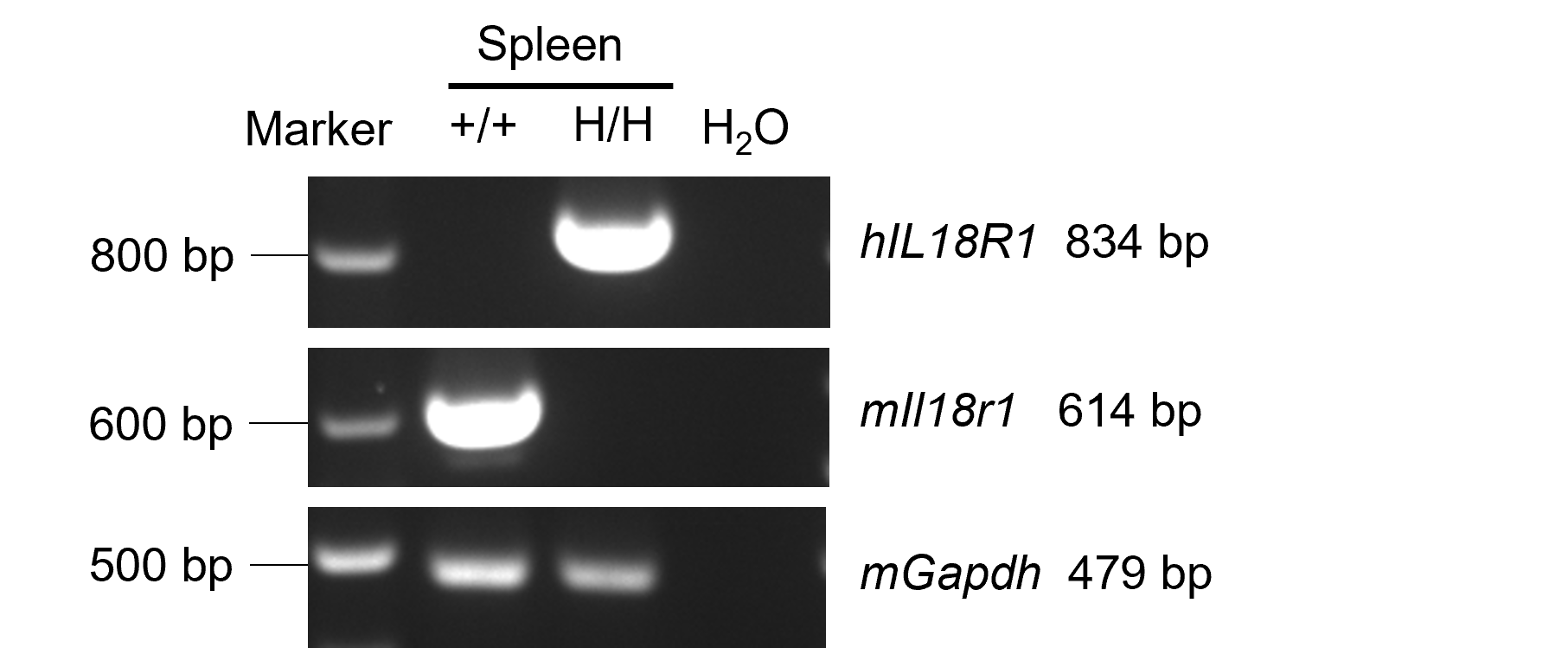
mRNA Expression in Spleen
- Human IL18R1 mRNA was exclusively detectable in homozygous B-hIL18RA plus/hIL18RB mice but not in wild-type mice.
- Mouse Il18r1 mRNA was only detectable in wild-type mice.
Strain specific analysis of IL18RA mRNA expression in wild-type C57BL/6JNifdc mice and B-hIL18RA plus/hIL18RB mice by RT-PCR. Spleen RNA were isolated from wild-type C57BL/6JNifdc mice (+/+) and homozygous B-hIL18RA plus/hIL18RB mice (H/H), then cDNA libraries were synthesized by reverse transcription, followed by PCR with mouse or human IL18RA primers.
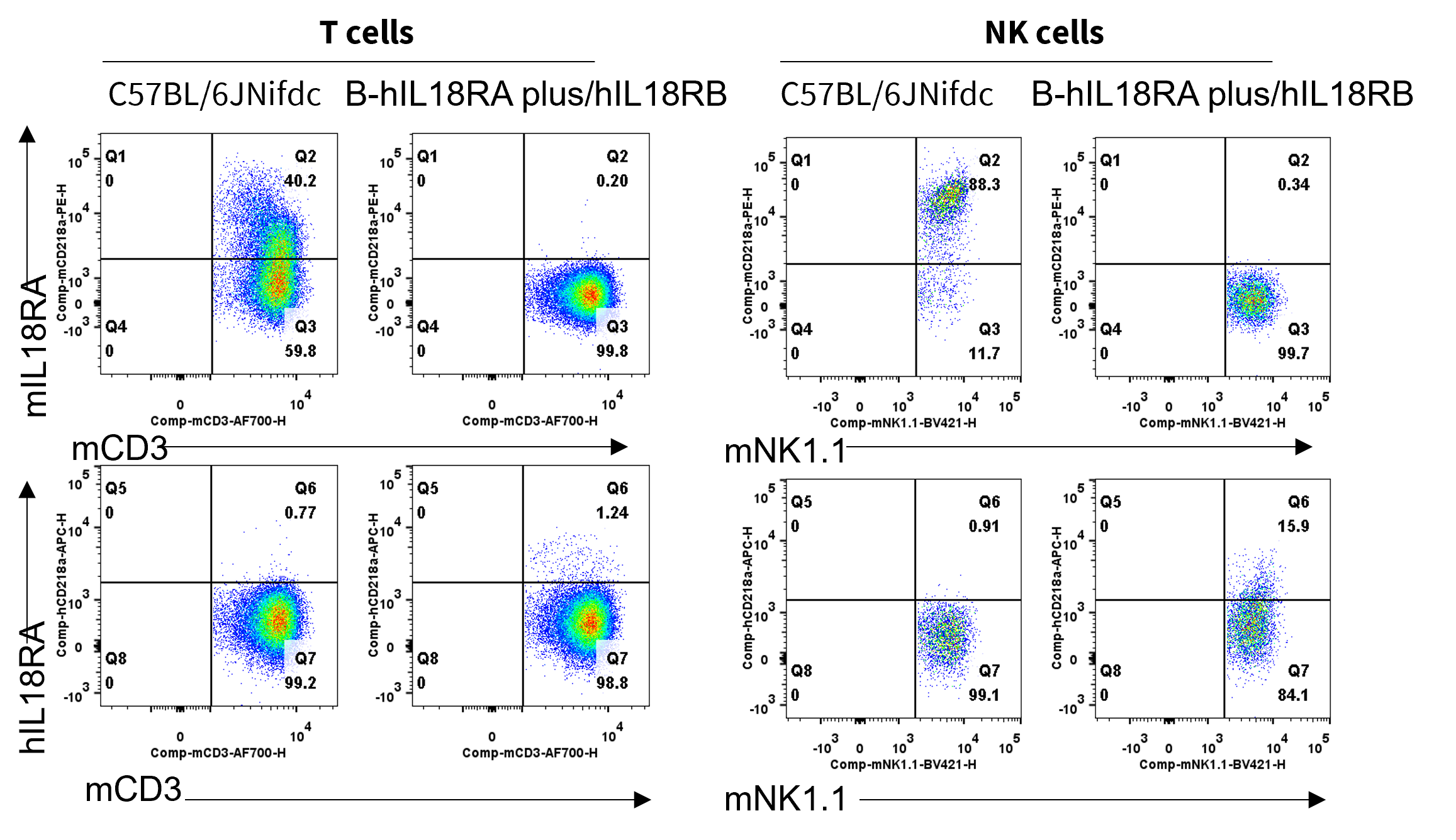
IL18RA Protein Expression in Spleen
- Mouse IL18RA was detected in T cells and NK cells from wild-type mice.
- In homozygous B-hIL18RA plus/hIL18RB mice, human IL18RA expression was exclusively detected in NK cells, albeit at a low level, while its expression in T cells remained debatable.
Mouse and human IL18RA expression analysis in splenocytes. Splenocytes were collected from wild-type C57BL/6JNifdc mice (male, 7-week-old, n = 1) and homozygous B-hIL18RA plus/hIL18RB mice (male, 7-week-old, n = 1). IL18RA expression on T cells and NK cells were analyzed by flow cytometry using species-specific anti-IL18RA antibodies (anti-human IL18RA antibody, BioLegend, 313813; anti-mouse IL18RA antibody, BioLegend, 157903).
IL-12 and IL-18 Synergistically Induce IFN-γ in Splenocytes
- An increase in IFN-γ was observed in C57BL/6 splenocytes specifically in response to the combination of murine IL-12 and murine IL-18.
- Conversely, splenocytes from humanized mice exhibited a robust IFN-γ response primarily to stimulation with murine IL-12 and human IL-18.
Interleukin-18 (IL-18) synergizes with mIL-12 to induce interferon-γ (IFN-γ) production in splenocytes from wild-type C57BL/6 and homozygous B-hIL18RA plus/hIL18RB mice. Splenocyte suspensions were prepared from both mouse strains (female, 14-week-old, n=3 per group) and stimulated for 72 hours with murine IL-12 in combination with a range of concentrations of either murine or human IL-18. Mouse IFN-γ levels secreted by splenocytes were measured by ELISA.
- An increase in IFN-γ was observed in C57BL/6 splenocytes specifically in response to the combination of murine IL-12 and murine IL-18.
- Conversely, splenocytes from humanized mice exhibited a robust IFN-γ response primarily to stimulation with murine IL-12 and human IL-18.
Interleukin-18 (IL-18) synergizes with mIL-12 to induce interferon-γ (IFN-γ) production in splenocytes from wild-type C57BL/6 and homozygous B-hIL18RA plus/hIL18RB mice. Splenocyte suspensions were prepared from both mouse strains (female, 14-week-old, n=3 per group) and stimulated for 72 hours with murine IL-12 in combination with a range of concentrations of either murine or human IL-18. Mouse IFN-γ levels secreted by splenocytes were measured by ELISA.
* When publishing results obtained using this animal model, please acknowledge the source as follows: The animal model [B-hIL18RA plus/hIL18RB mice] (Cat# 113098) was purchased from Biocytogen.