Description
IL7/IL7R: a master regulator of lymphocyte development, homeostasis, and peripheral T-cell survival
- Gene Information: Interleukin-7 receptor subunit alpha (IL7R) is a protein-coding gene located on chromosome 5p13.2. It encodes a cell surface cytokine receptor that binds interleukin-7 (IL7) and supports lymphocyte development.
- Protein Expression: IL-7R is expressed in early thymocytes, T cells, pre-B cells, BM macrophages, and other immune cells, with particularly high expression in T cells. IL7 could be produced locally by intestinal epithelial and epithelial goblet cells.
- Signaling Pathway: The binding of IL7 to IL7R could activate intracellular JAK1/JAK3 kinases, which in turn induces STAT5 phosphorylation and nuclear translocation as well as PI3K-Akt pathway activation, thereby precisely driving the development, differentiation, homeostatic expansion, and long-term survival of T cells, B cells, and innate lymphoid cells by upregulating anti-apoptotic proteins (such as Bcl-2) and optimizing cellular energy metabolism.
- Therapeutic Inhibition: In cancer therapy, strategies mainly focus on activating or amplifying IL7/IL7R signaling to reverse T-cell exhaustion and enhance anti-tumor immunity, whereas in autoimmune disease treatment, blocking overactive IL7/IL7R signaling suppresses the survival and expansion of autoreactive T cells to treat autoimmune disorders.
Targeting strategy
IL7
- The CDS region of human IL7 gene was inserted after the exon 3 of the mouse Il7 gene in B-hIL7/hIL7R mice.
IL7R
- The exons 1-6 of mouse Il7r gene that encode the extracellular region were replaced by human IL7R exons 1-6 in B-hIL7/hIL7R mice.
mRNA Expression Analysis in Spleen
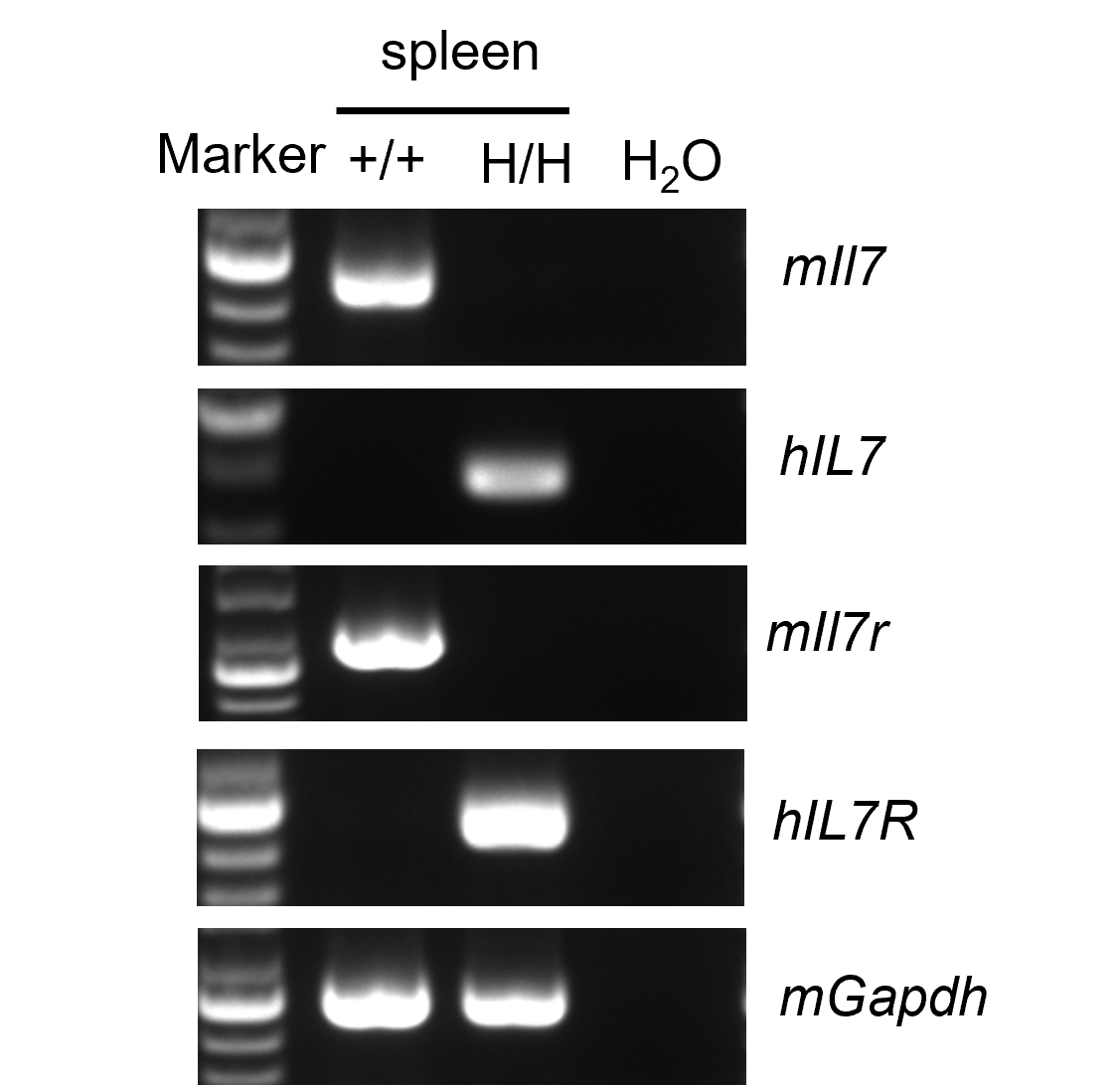
- Human IL7 and IL7R mRNA were exclusively detectable in homozygous B-hIL7/hIL7R mice but not in wild-type mice.
Strain specific analysis of IL7 and IL7R mRNA expression in wild-type C57BL/6JNifdc mice and homozygous B-hIL7/IL7R mice by RT-PCR. Spleen RNA was isolated from wild-type C57BL/6JNifdc mice (+/+) and homozygous B-hIL7/IL7R mice (H/H;H/H), then cDNA libraries were synthesized by reverse transcription, followed by PCR with mouse or human IL7 and IL7R primers. Mouse Il7 and Il7r mRNA were only detectable in wild-type C57BL/6JNifdc mice. Human IL7 and IL7R mRNA were exclusively detectable in homozygous B-hIL7/IL7R mice but not in wild-type mice.
IL7 Protein Expression Analysis in Serum
- Human IL7 was only detectable in homozygous B-hIL7/IL7R mice but not in wild-type C57BL/6JNifdc mice.
Strain specific IL7 expression analysis in homozygous B-hIL7/IL7R mice by ELISA. Serum were collected from wild-type C57BL/6JNifdc mice (+/+) and homozygous B-hIL7/IL7R mice (H/H;H/H) stimulated with poly(I:C) in vivo. Expression level of mouse and human IL7 was analyzed by ELISA (Mouse IL-7 ELISA Kit, proteintech, KE10060; Human IL7 ELISA Kit , abcam, ab270218). Mouse IL7 was detectable in wild-type C57BL/6JNifdc mice and B-hIL7/IL7R mice, which indicated the kit may have cross-reactivity. Human IL7 was exclusively detectable in homozygous B-hIL7/IL7R mice, but not in wild-type C57BL/6JNifdc mice. Values are expressed as mean ± SEM. ND: not detectable.
IL7R Protein Expression Analysis in Spleen
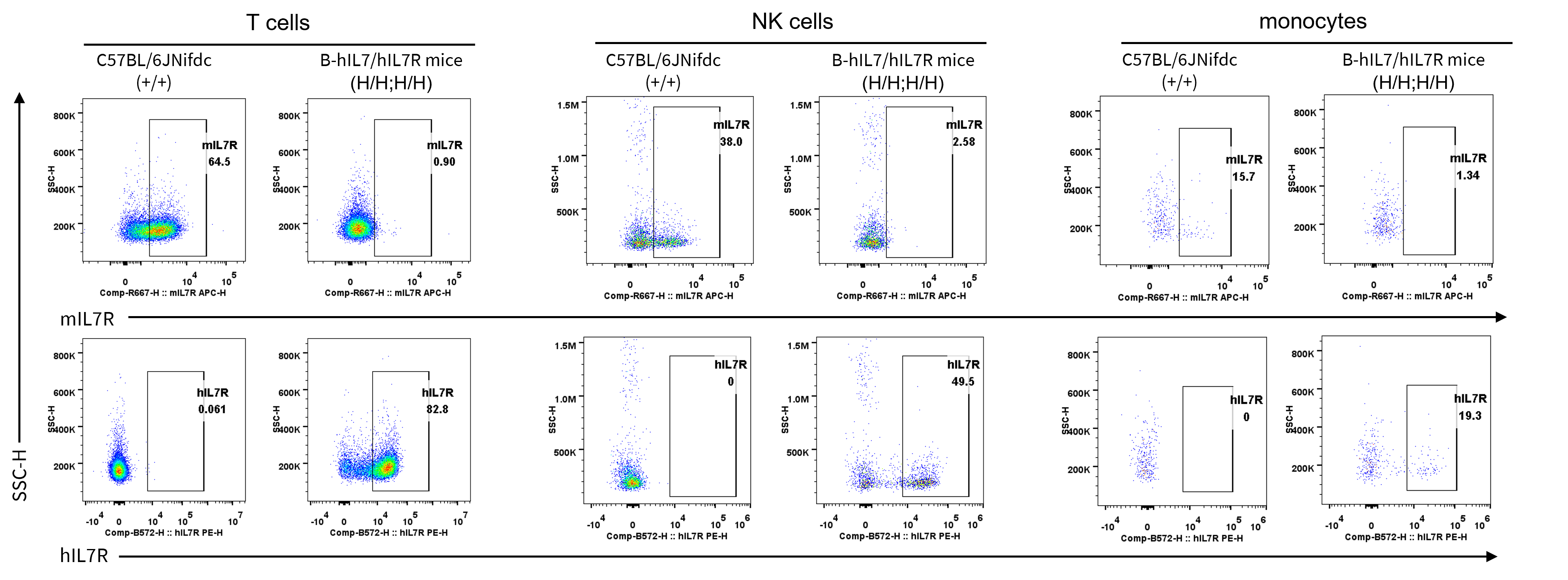
- Human IL7R was only detectable in homozygous B-hIL7/IL7R mice but not in wild-type C57BL/6JNifdc mice.
Strain specific IL7R expression analysis in homozygous B-hIL7/hIL7R mice by flow cytometry. Splenocytes were collected from wild-type C57BL/6JNifdc mice (+/+) and homozygous B-hIL7/hIL7R mice (H/H;H/H), protein expression was analyzed by flow cytometry with species-specific anti-mouse IL7R antibody (Biolegend, 135011) and anti-human IL7R antibody (Biolegend, 351303). Mouse IL7R was detectable in wild-type C57BL/6JNifdc mice. Human IL7R was detectable in homozygous B-hIL7/hIL7R mice.
* When publishing results obtained using this animal model, please acknowledge the source as follows: The animal model [B-hIL7/hIL7R mice] (Cat# 114249) was purchased from Biocytogen.