Description
MYOC: a major causative gene for autosomal dominant hereditary glaucoma
- Gene Information: The MYOC gene encodes myocilin (also known as TIGR), a secreted glycoprotein composed of 504 amino acids (approximately 55 kDa). It contains an N-terminal coiled-coil domain and a C-terminal olfactomedin (OLF) domain and can form multimers.
- Protein Expression: Myocilin is highly expressed in tissues such as the trabecular meshwork, retina, and muscle.
- Signaling Pathway: As an extracellular matrix protein, it participates in various physiological processes, including cell adhesion, migration, cytoskeletal regulation, and Wnt signaling modulation.
- Pathogenic Mechanism: Heterozygous mutations in the MYOC gene (inherited in an autosomal dominant manner) lead to misfolding of the OLF domain, resulting in ER retention and impaired secretion of the protein. This causes ER stress and cytotoxicity, ultimately leading to trabecular meshwork dysfunction, reduced aqueous humor outflow, and elevated intraocular pressure. It is a primary cause of juvenile open-angle glaucoma.
- Research Significance: Myocilin is a central molecule in the study of glaucoma pathogenesis and serves as an important model for protein misfolding disorders. It holds significant value for clinical diagnosis and represents a potential therapeutic target.
Targeting strategy
- The Exon 1 of mouse Myoc gene were replaced by human MYOC exons 1-3 in B-hMYOC mice.
- The promoter and 5’UTR region of the mouse gene were also replaced. The human MYOC expression is driven by endogenous human MYOC promoter, while mouse Myoc gene transcription and translation will be disrupted.
MYOC Protein Expression Analysis
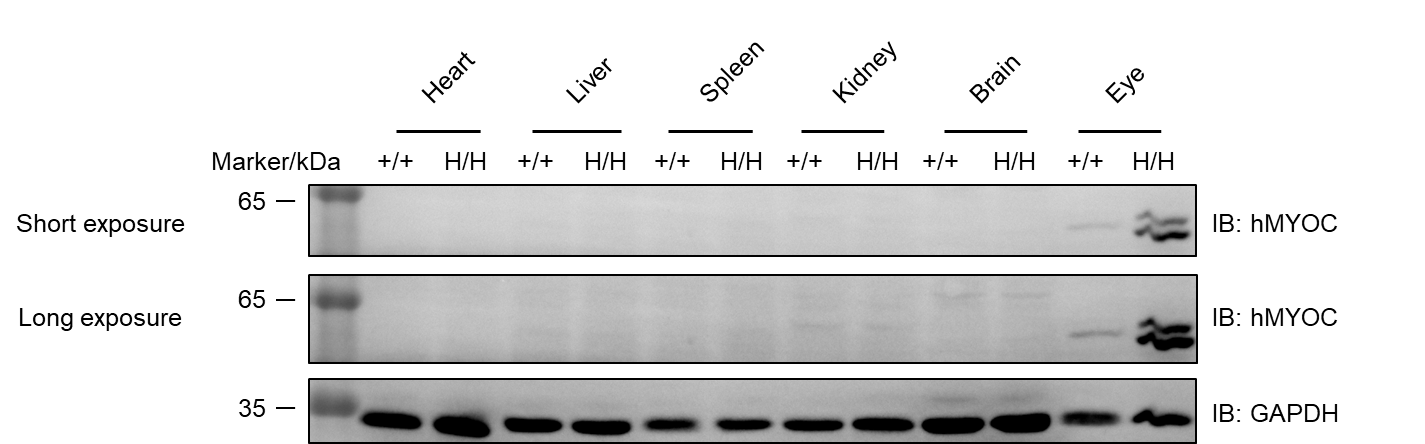
- hMYOC was detected in the eye of homozygous B-hMYOC mice.
Western blot analysis of MYOC protein expression in homozygous B-hMYOC mice. Various tissue lysates were collected from wild-type C57BL/6JNifdc mice (+/+) and homozygous B-hMYOC mice (H/H), and then analyzed by western blot with species-specific anti-Myocilin antibody (R&D, AF2537-SP). 40 μg total proteins were loaded for western blotting analysis.
MYOC mRNA Expression by RT-PCR
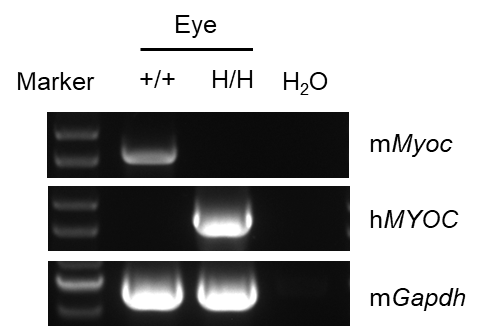
- Mouse Myoc mRNA was only detectable in wild-type mice.
- Human MYOC mRNA was detectable only in homozygous B-hMYOC mice but not in wild-type mice.
Strain specific analysis of MYOC mRNA expression in wild-type C57BL/6JNifdc mice and B-hMYOC mice by RT-PCR. Eye RNA were isolated from wild-type C57BL/6JNifdc mice (+/+) and homozygous B-hMYOC mice (H/H), then cDNA libraries were synthesized by reverse transcription, followed by PCR with mouse Myoc and human MYOC primers.
* When publishing results obtained using this animal model, please acknowledge the source as follows: The animal model [B-hMYOC mice] (Cat# 114244) was purchased from Biocytogen.