Description
PLSCR1: A pivotal multifunctional target for modulating innate immunity, inflammation, and oncogenic signaling
- Gene Information: PLSCR1 (Phospholipid Scramblase 1) is a single-pass transmembrane protein that is highly inducible by type I interferons.
- Protein Expression: PLSCR1 is constitutively expressed at low levels across tissues but is dramatically upregulated by interferons and pro-inflammatory cytokines. It is overexpressed in activated immune cells, endothelial cells, and multiple human malignancies, serving as a prominent biomarker for inflammation and cancer.
- Signaling Pathway: Upon activation and phosphorylation by Src or EGFR kinases, PLSCR1 translocates between the plasma membrane and nucleus. It interacts with key signaling partners, such as STAT3 and EGFR, modulating downstream cell proliferation, antiviral immune responses, and apoptosis via phosphatidylserine exposure.
- Therapeutic Inhibition: PLSCR1 is emerging as a compelling target for oncology, viral infections, and autoimmune disorders. Modulating PLSCR1 with targeted antibodies or small molecules can effectively inhibit tumor growth, attenuate pathological hyperinflammation, and restore normal cellular signaling homeostasis.
Targeting Strategy
PLSCR1
- Exons 2-9 of mouse Plscr1 gene that encode the whole molecule (ATG to STOP codon), including 3’UTR were replaced by human counterparts in B-hPLSCR1 mice.
- The promoter and 5’UTR region of the mouse gene are retained. The human PLSCR1 expression is driven by endogenous mouse Plscr1 promoter,while mouse Plscr1 gene transcription and translation will be disrupted.
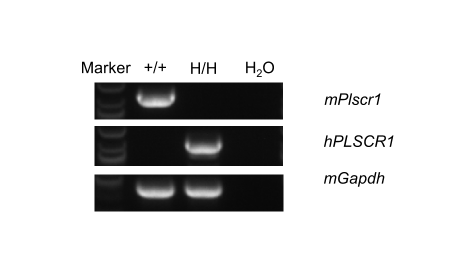
PLSCR1 mRNA Expression by RT-PCR
Strain-specific analysis of PLSCR1 mRNA expression in wild-type C57BL/6JNifdc mice and homozygous B-hPLSCR1 mice by RT-PCR. Lung RNA was isolated from wild-type C57BL/6JNifdc mice (+/+) and homozygous B-hPLSCR1 mice (H/H). cDNA libraries were synthesized by reverse transcription, followed by PCR with mouse or human PLSCR1 primers. Sequencing of the PCR products confirmed that the amplified sequences were consistent with database reference sequences.
* When publishing results obtained using this animal model, please acknowledge the source as follows: The animal model [B-hPLSCR1 mice] (Cat# 113417) was purchased from Biocytogen.