B-hOX40 mice

C57BL/6-Tnfrsf4tm1(TNFRSF4)Bcgen/Bcgen • 110014

B-hOSM/hOSMR mice
B-hOX40 mice(C)

B-hOX40 mice

Catalog Number: 110014
Strain Name: C57BL/6-Tnfrsf4tm1(TNFRSF4)Bcgen/Bcgen
Strain Background: C57BL/6
NCBI gene ID: 22163 (Human)
Aliases: Ox40; ACT35; CD134; Ly-70; Txgp1; TXGP1L
---
Licensing option available
B-hOX40 mice

on this page

  • Description
  • Targeting strategy
  • Phenotypic analysis
  • Efficacy

Posters

View All

    Publication

      Description

      OX40: Therapeutic strategies for the costimulatory molecule OX40 in T-cell-mediated immunity

      • Gene Information: Tumor necrosis factor receptor superfamily member 4 (TNFRSF4, also known as OX40) is a protein-coding gene located on chromosome 1p36.33. OX40L is a 50 kDa member of the TNF superfamily and is also known as OX40L receptor and CD134.
      • Protein Expression: OX40 is a type 1 transmembrane glycoprotein. While costimulatory receptors like CD28 and CD27 are constitutively present on T cells, OX40 is not expressed during the naive state. Rather, OX40 is transiently induced by signaling following TCR engagement upon antigen encounter. The expression levels of OX40 culminate 48–72 hours post-activation, manifesting not only in activated CD4+ and CD8+ T cells but also in neutrophils, NK, and NKT cells.
      • Signaling Pathway: The OX40L–OX40 signaling axis drives persistent activation and proliferation of effector T cells and effector memory T cells, while remaining quiescent in naive T cells and resting memory T cells. Engagement of OX40 with its ligand OX40L promotes the differentiation of both Th1 and Th2 effector cells.
      • Therapeutic Inhibition: Agonist anti-OX40 mAbs activate T cells, and their anti-tumor efficacy is significantly enhanced when combined with checkpoint blockades, cytokines, chemotherapy, or radiotherapy.
      Targeting strategy

      OX40

      • The exons 1-5 of mouse OX40 gene that  encode the extracellular domain were replaced by human OX40 exons 1-5 in B-hOX40 mice.
      • The endogenous mouse promoter, 5′UTR, and 3′UTR regions are retained, allowing human OX40 expression to be driven by the native mouse Ox40 promoter, while endogenous mouse Ox40 transcription and translation are abolished.
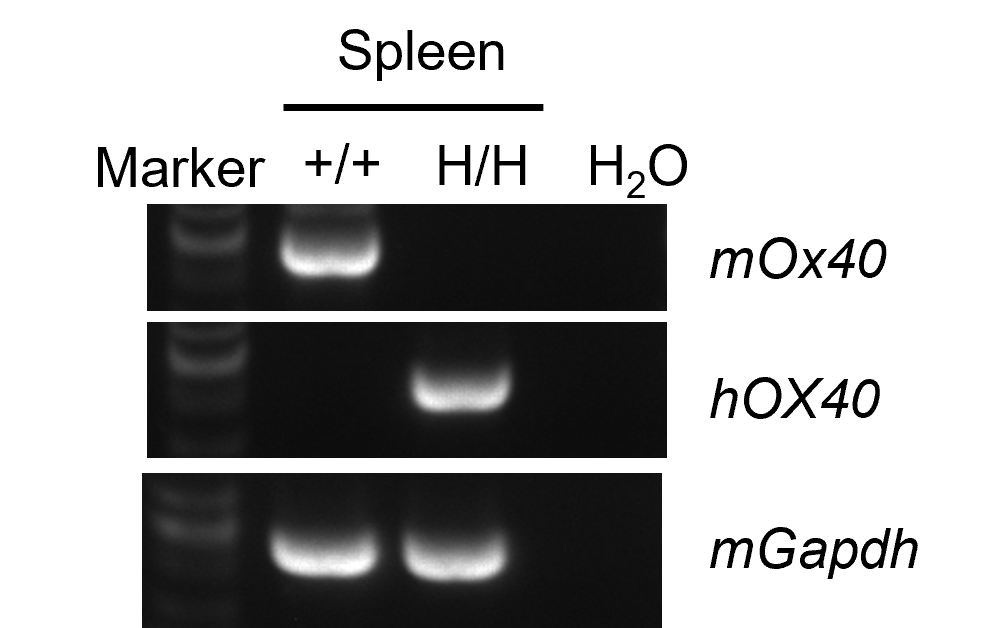
      Human OX40 mRNA Expression by RT-PCR
      • Human OX40 mRNA were specifically and correctly expressed in B-hOX40 mice.

      Strain specific analysis of OX40 mRNA expression in wild-type C57BL/6JNifdc mice and homozygous B-hOX40 mice by RT-PCR. Spleen RNA was isolated from wild-type C57BL/6JNifdc mice (+/+) and homozygous B-hOX40 mice (H/H), then cDNA libraries were synthesized by reverse transcription, followed by PCR with mouse or human OX40 primers. Mouse OX40 mRNA was only detectable in wild-type mice Human OX40 mRNA was exclusively detectable in homozygous B-hOX40 mice but not in wild-type mice.
      OX40 Protein Expression in Spleen
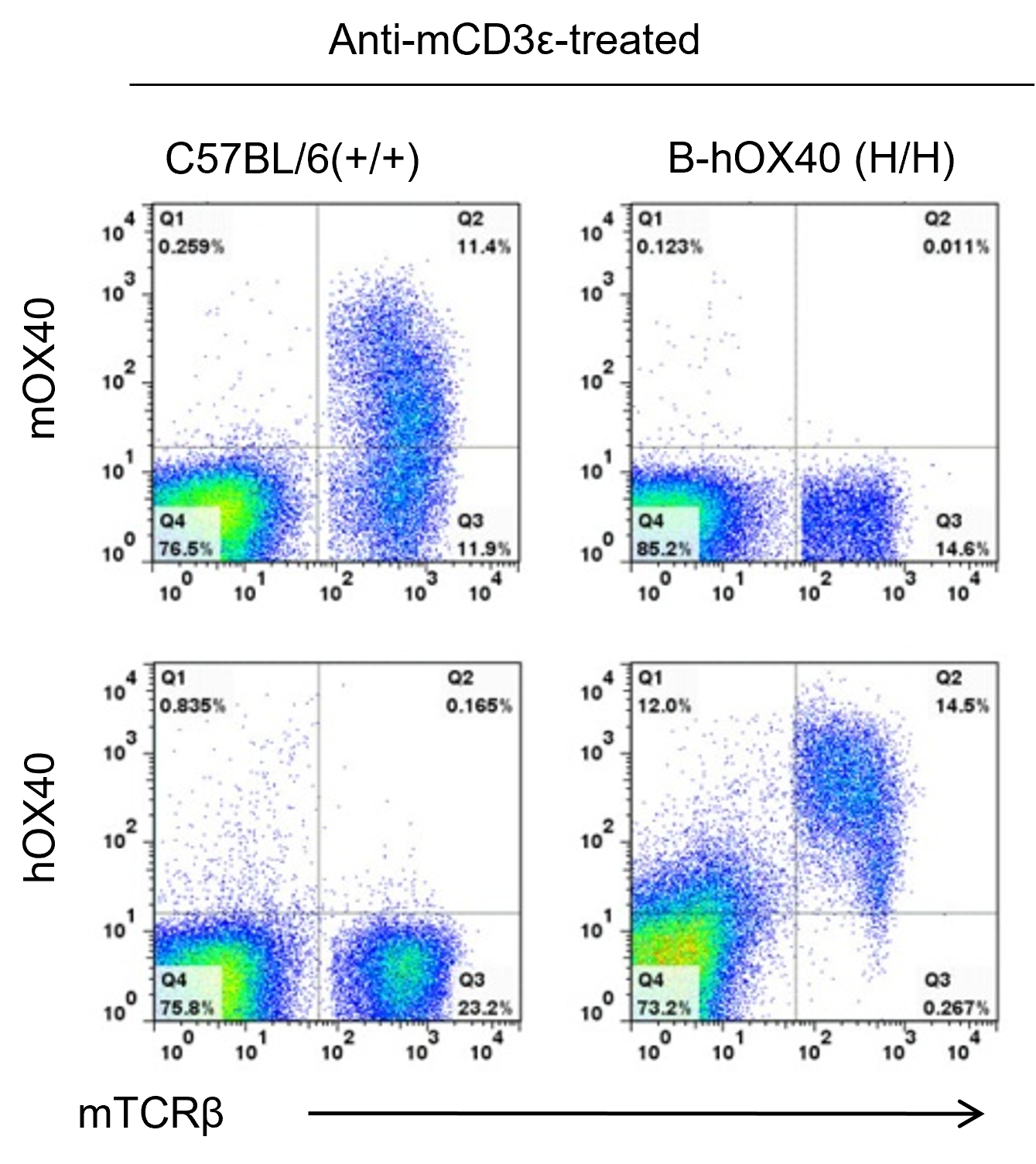
      • Mouse OX40 was detected on T cells populations in wild-type C57BL/6 mice.
      • Human OX40 was detected on T cells populations in B-hOX40 mice, but not in wild-type C57BL/6 mice.

      Strain specific OX40 expression analysis in homozygous B-hOX40 mice by flow cytometry. Splenocytes were collected from wild-type(WT) C57BL/6 mice and homozygous B-hOX40 (H/H) mice stimulated with anti-CD3ε in vivo (7.5 μg/mice), and analyzed by flow cytometry with species-specific anti-OX40 antibody. Mouse OX40 was exclusively detected in WT mice. Human OX40 was exclusively detected in homozygous B-hOX40 but not WT mice.

      In Vivo Efficacy of Anti-Human OX40 Antibody

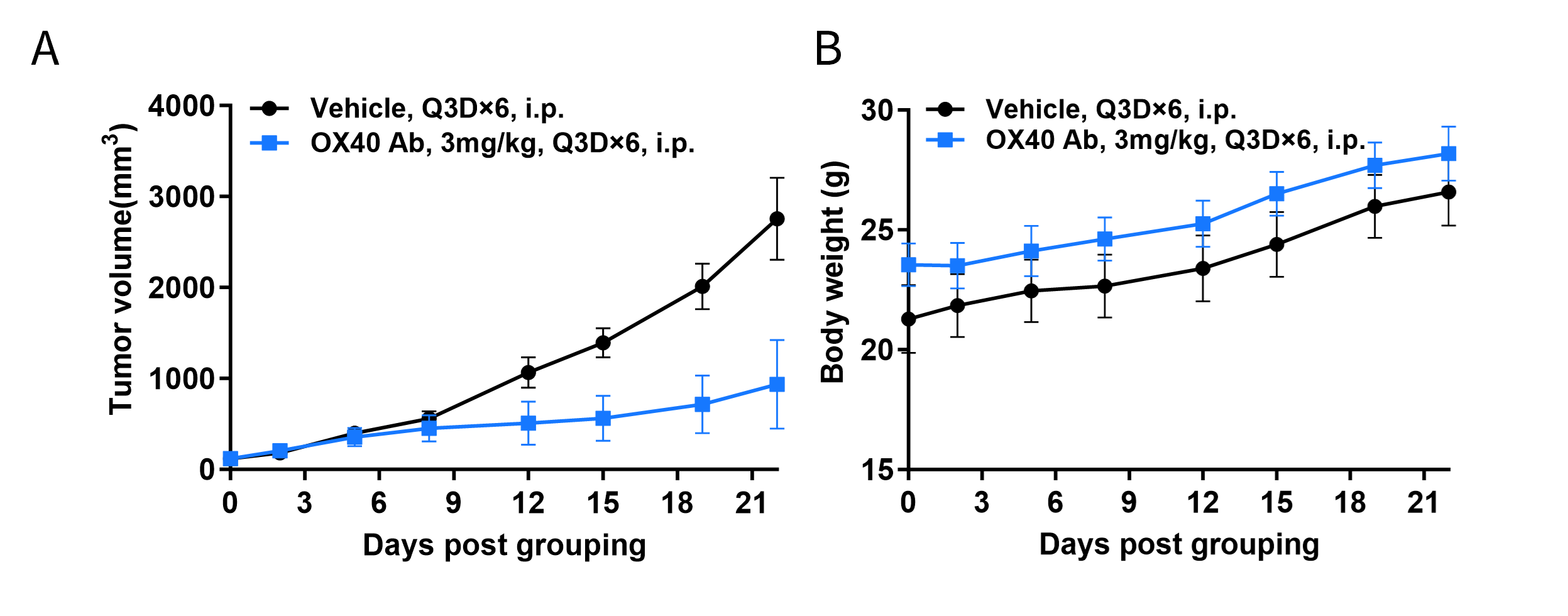
      Antitumor activity of anti-human OX40 antibody in B-hOX40 mice. (A) Anti-human OX40 antibody inhibited MC38 tumor growth in B-hOX40 mice. Murine colon cancer MC38 cells (5x10⁵) were subcutaneously implanted into homozygous B-hOX40 mice (male, 4-6 week-old, n=5). Mice were grouped when tumor volume reached approximately 100 mm3, at which time they were treated with anti-human OX40 antibody and schedules indicated in panel. (B) Body weight changes during treatment. As shown in panel A, anti-human OX40 antibody was efficacious in controlling tumor growth in B-hOX40 mice, demonstrating that the B-hOX40 mice provide a powerful preclinical model for in vivo evaluation of anti-human OX40 antibodies. Values are expressed as mean ± SEM.
      In Vivo Efficacy of MOXR0916 Analog

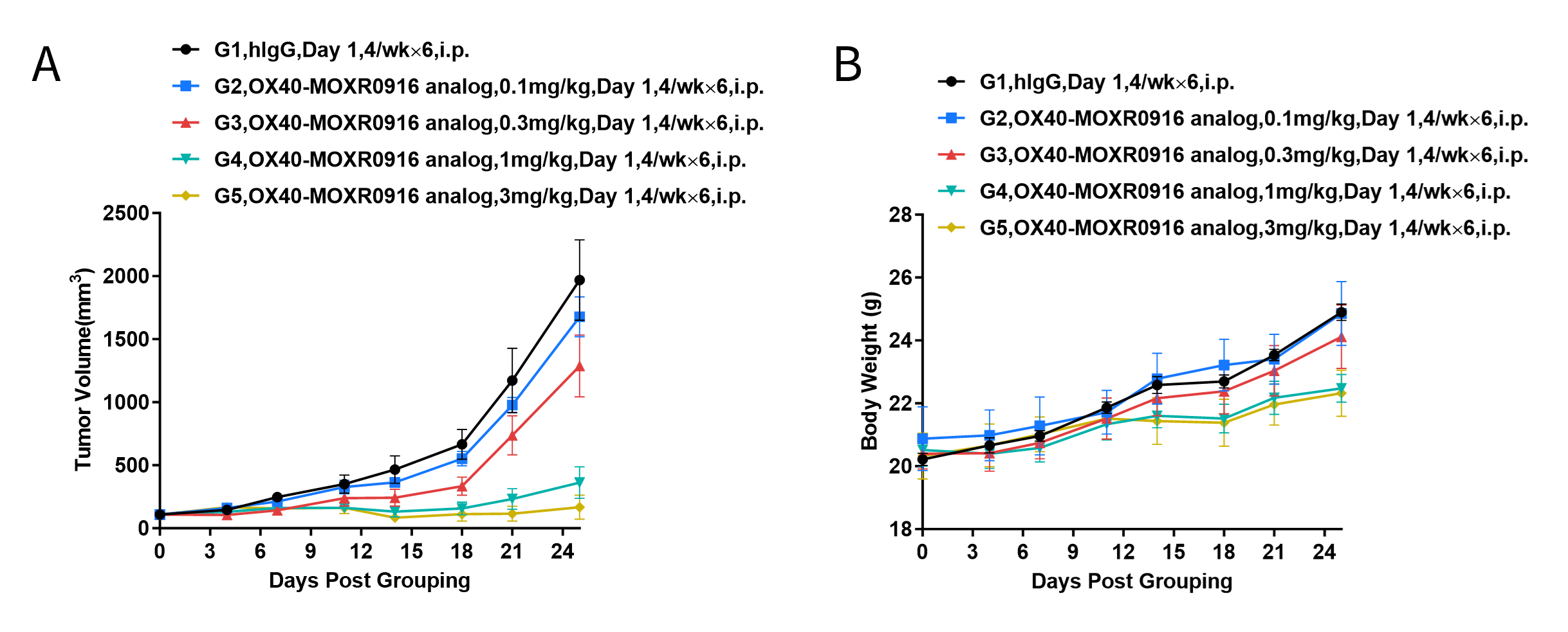
      Antitumor activity of anti-human OX40 antibody in B-hOX40 mice. (A) Anti-human OX40 antibody inhibited MC38 tumor growth in B-hOX40 mice. Murine colon cancer MC38 cells (5ⅹ105) were subcutaneously implanted into homozygous B-hOX40 mice (female, 4-6 week-old, n=6). Mice were grouped when tumor volume reached approximately 150±50 mm3, at which time they were treated with anti-human OX40 antibody with different doses and schedules indicated in panel. (B) Body weight changes during treatment. As shown in panel A, anti-human OX40 antibody MOXR0916 analog (in house) was efficacious in controlling tumor growth in B-hOX40 mice, demonstrating that the B-hOX40 mice provide a powerful preclinical model for in vivo evaluation of anti-human OX40 antibodies. Values are expressed as mean ± SEM.

      * When publishing results obtained using this animal model, please acknowledge the source as follows: The animal model [B-hOX40 mice] (Cat# 110014) was purchased from Biocytogen.