Description
ABCB4: Loss-of –function mutations in Abcb4 lead to hereditary hepatobiliary disorders
- Gene Information: ATP-binding cassette subfamily B member 4 (ABCB4, also known as MDR3) is located on human chromosome 7 with 28 exons. It belongs to the ATP-binding cassette transporter superfamily.
- Protein Expression: ABCB4 is predominantly expressed in hepatocytes and biliary epithelial cells.
- Signaling Pathway: The ABCB4 is a transmembrane transporter protein that moves phospholipids from the inner to the outer leaflet of the canalicular membrane in liver cells. This process is crucial for forming healthy bile and protects hepatocytes from toxic damage induced by bile salts. Functional impairment of ABCB4 results in decreased secretion of phospholipids, increased concentration of bile salts, and potentially induce hepatic pathologies.
- Therapeutic Application: ABCB4 serves as a core therapeutic target for inherited liver diseases, Current therapeutic strategies include bile acid modulators, gene therapy and anti-fibrotic small-molecule drugs.
Targeting strategy
ABCB4
- The exons 2~28 of mouse Abcb4 gene were depleted in B-Abcb4 KO mice(C).
mRNA Expression by RT-PCR
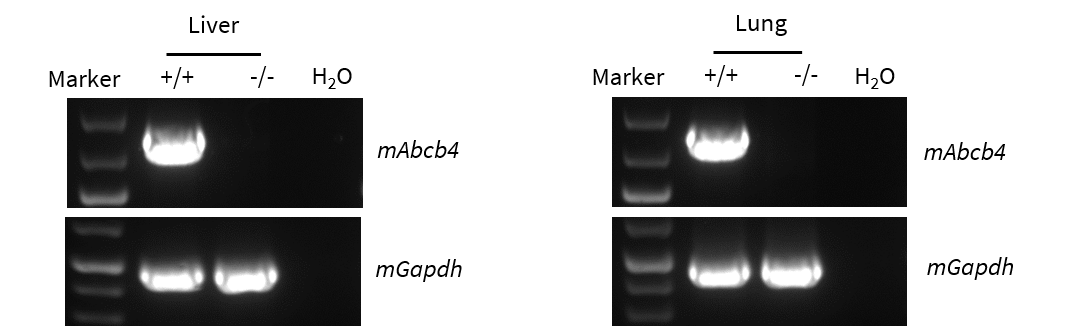
- Mouse Abcb4 mRNA was only detectable in wild-type BALB/cCrSlcNifdc mice, but not in homozygous B-Abcb4 KO mice(C).
Mouse Abcb4 mRNA expression in wild-type BALB/cCrSlcNifdc mice and B-Abcb4 KO mice(C) by RT-PCR. Liver and lung RNA were isolated from wild-type BALB/cCrSlcNifdc mice (+/+) and homozygous B-Abcb4 KO mice(C) (-/-), then cDNA libraries were synthesized by reverse transcription, followed by PCR with mouse Abcb4 primer. Mouse Abcb4 mRNA was only detectable in wild-type BALB/cCrSlcNifdc mice, but not in homozygous B-Abcb4 KO mice(C).
Hematoxylin and Eosin Staining
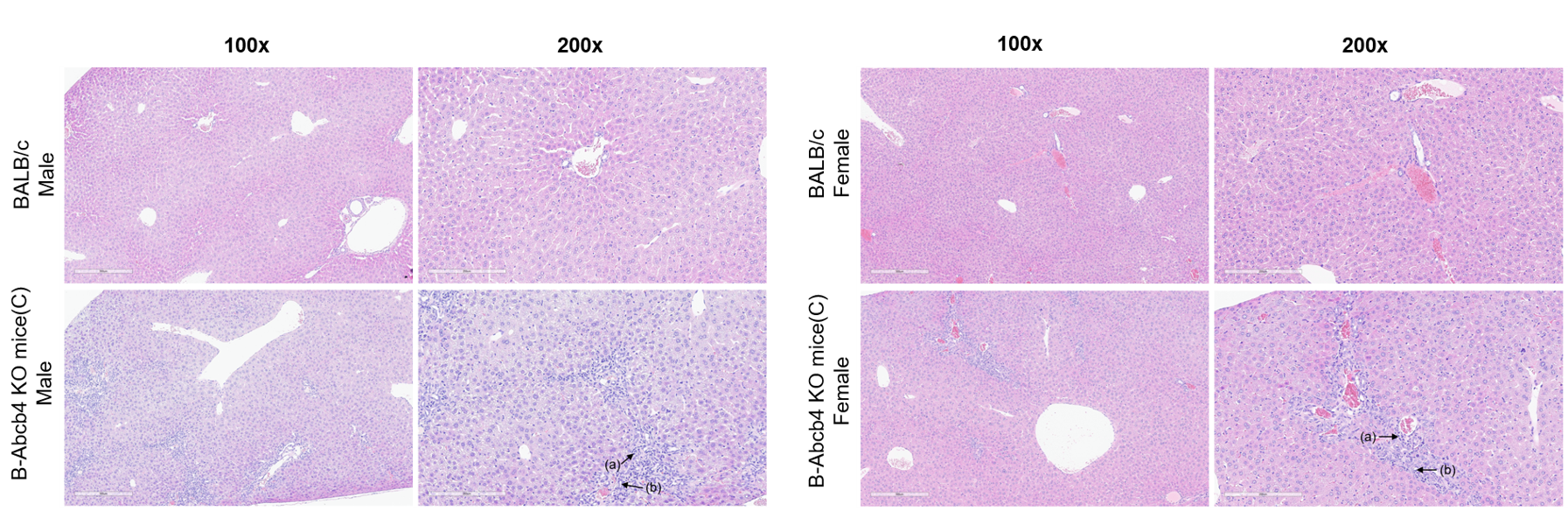
- Proliferation of intrahepatic bile ducts, thickening of the duct walls, and a small amount of inflammatory cell infiltration could be observed in homozygous B-Abcb4 KO mice(C).
Hematoxylin and Eosin staining of B-Abcb4 KO mice(C). Liver tissues from wild-type BALB/cCrSlcNifdc mice and homozygous B-Abcb4 KO mice(C) (n=3, Male, 6-week-old; n=2, Female, 6-week-old) were collected and analyzed for Hematoxylin and Eosin (H&E) staining. There were no abnormal changes in the livers of wild-type BALB/cCrSlcNifdc mice, but in the livers of B-Abcb4 KO mice(C), proliferation of intrahepatic bile ducts, thickening of the duct walls, and a small amount of inflammatory cell infiltration could be observed. (a) Bile ducts (b) Inflammatory.
Sirius Red Staining
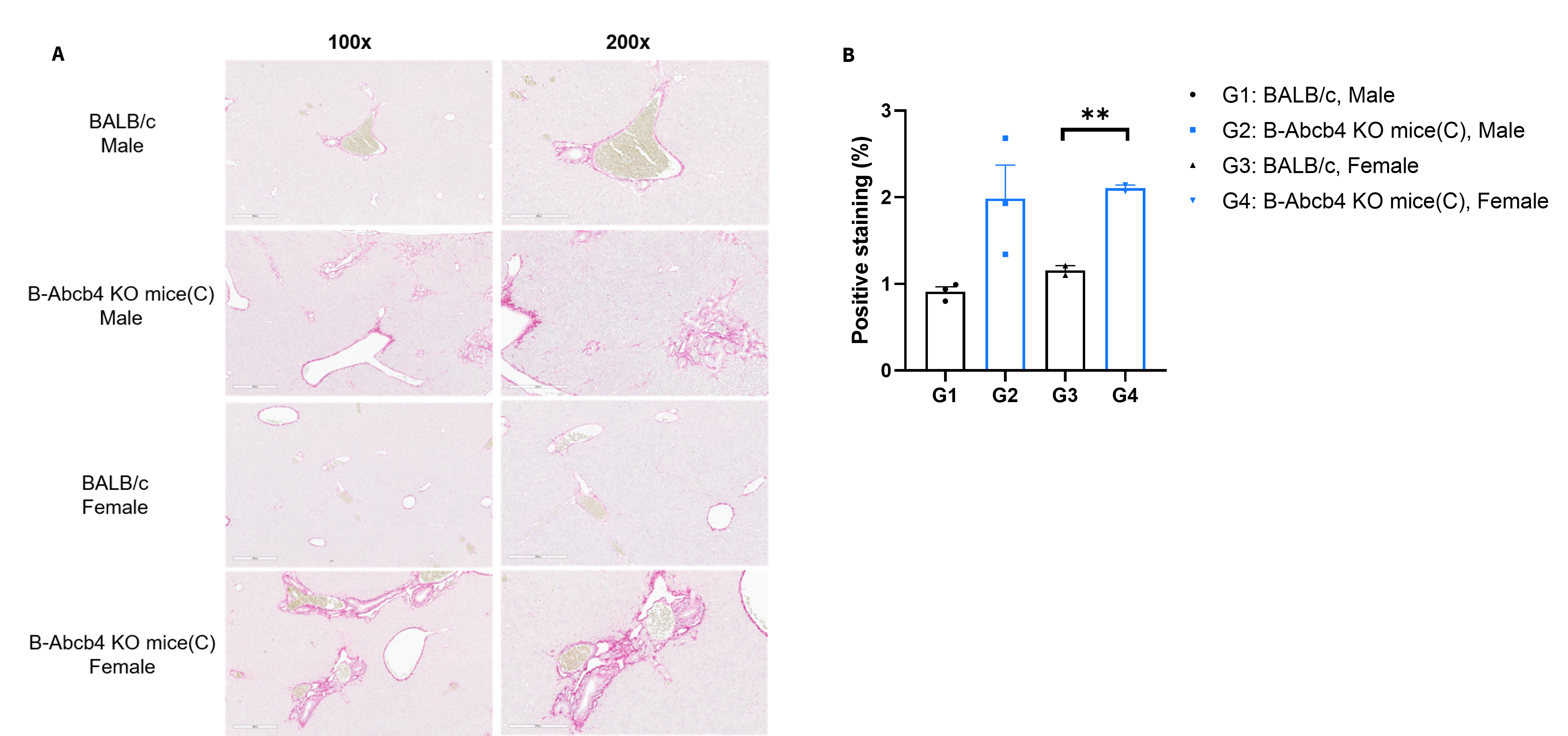
- B-Abcb4 KO mice(C) exhibited a significant increase in the positive signal area for collagen fibers compared to wild-type mice.
Sirius red staining of B-Abcb4 KO mice(C). (A) Representative images of Sirius red staining showed liver fibrosis in wild-type BALB/cCrSlcNifdc mice (+/+) and B-Abcb4 KO mice(C) (-/-) (n=3, Male, 6-week-old; n=2, Female, 6-week-old). (B) Statistic data of Sirius red staining. Values are expressed as mean ± SEM. Significance was determined by unpaired t test. *P < 0.05, **P < 0.01, ***P < 0.001.
Blood Biochemistry Analysis
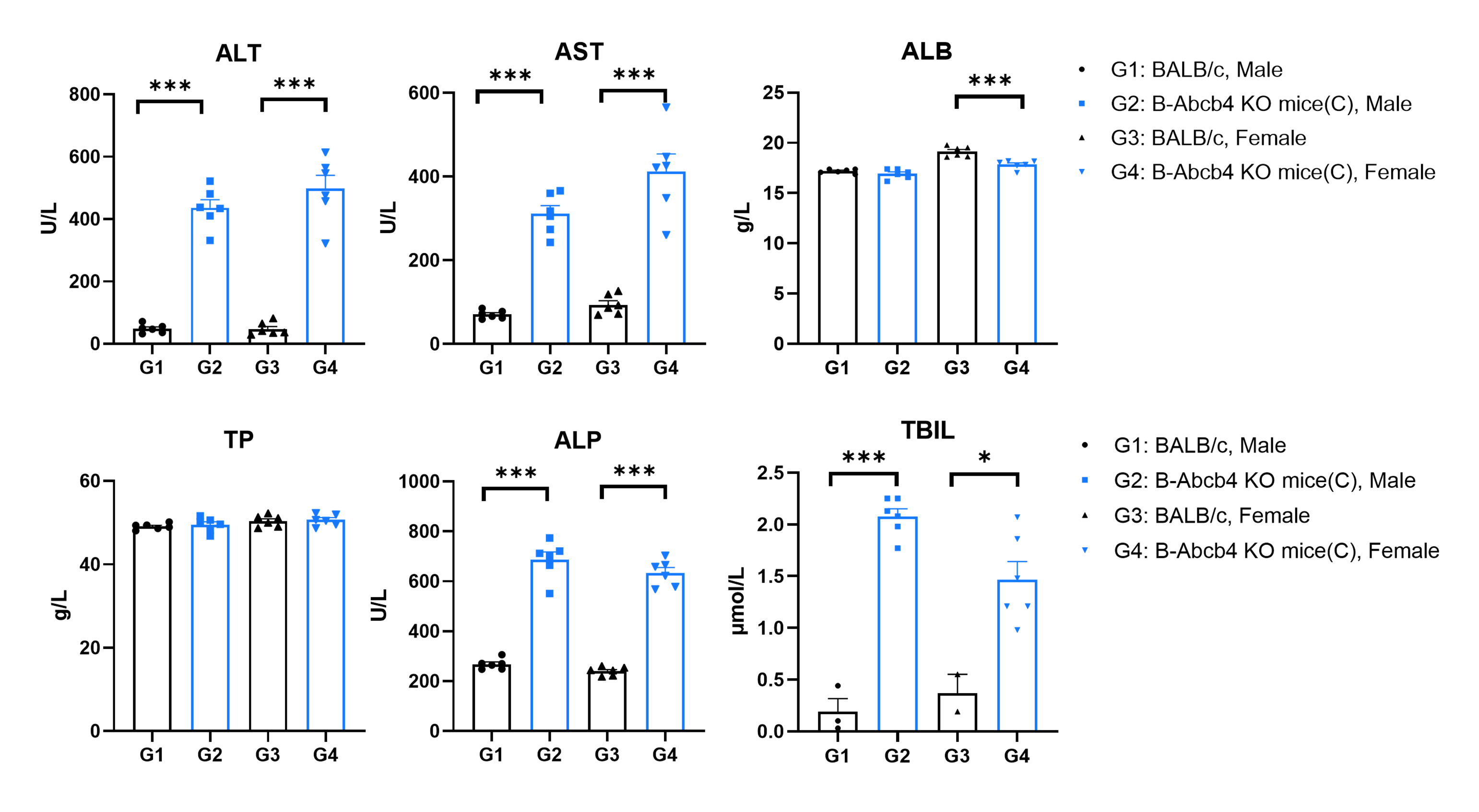
Biochemical analysis of B-Abcb4 KO mice(C). Values are expressed as mean ± SEM. Each group consisted of six 6-week-old mice for blood biochemical analysis. Significance was determined by unpaired t test. *P < 0.05, **P < 0.01, ***P < 0.001.
Total Bile Acid Analysis in Serum
- Serum total bile acid in homozygous B-Abcb4 KO mice(C) were significant higher than those in wild-type mice.
Total bile acid analysis in wild-type BALB/cCrSlcNifdc mice and homozygous B-Abcb4 KO mice(C). Prior to serum collection, wild-type BALB/cCrSlcNifdc mice (+/+) and homozygous B-Abcb4 KO mice(C) (-/-) were fasted for 4 hours (n=10 per sex, 6-week-old). Serum total bile acid in homozygous B-Abcb4 KO mice(C) were significant higher than those in wild-type mice. Values are expressed as mean ± SEM. Significance was determined by unpaired t test. *P < 0.05, **P < 0.01, ***P < 0.001.
* When publishing results obtained using this animal model, please acknowledge the source as follows: The animal model [B-Abcb4 KO mice(C)] (Cat# 112978) was purchased from Biocytogen.