Description
- INHBE encodes a member of the TGF-beta (transforming growth factor-beta) superfamily of proteins. The encoded preproprotein is proteolytically processed to generate an inhibin beta subunit. Inhibins have been implicated in regulating numerous cellular processes including cell proliferation, apoptosis, immune response and hormone secretion. This gene may be upregulated under conditions of endoplasmic reticulum stress, and this protein may inhibit cellular proliferation and growth in the pancreas and liver.
- Gene editing strategy: The exons 1-2 of the mouse Inhbe gene that encode the whole molecule, including promoter, 5’UTR, and 3’UTR, were replaced by human counterparts, including human promoter, 5’UTR, and human 3’UTR in B-hINHBE mice plus. The human INHBE expression is driven by the human INHBE promoter, while the mouse Inhbe gene transcription and translation will be disrupted.
- Validation: Mouse Inhbe mRNA was detectable only in wild-type C57BL/6JNifdc mice. Human INHBE mRNA was detectable only in homozygous B-hINHBE mice plus but not in wild-type mice. INHBE protein was detectable in the serum of homozygous B-hINHBE mice plus and wild-type C57BL/6JNifdc mice, as the antibody cross-recognizes both human and mouse INHBE.
- Application: This mice can be used for preclinical pharmacodynamics studies of obesity-related diseases
Targeting Strategy
Gene targeting strategy for B-hINHBE mice plus. The exons 1-2 of the mouse Inhbe gene that encode the whole molecule, including promoter, 5’UTR, and 3’UTR, were replaced by human counterparts, including human promoter, 5’UTR, and human 3’UTR in B-hINHBE mice plus. The human INHBE expression is driven by the human INHBE promoter, while the mouse Inhbe gene transcription and translation will be disrupted.
mRNA Expression Analysis
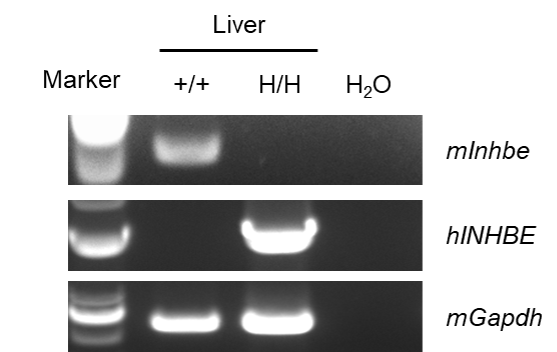
Strain-specific analysis of INHBE mRNA expression in wild-type C57BL/6JNifdc mice and B-hINHBE mice plus by RT-PCR. Liver RNA was isolated from wild-type C57BL/6JNifdc mice (+/+) and homozygous B-hINHBE mice plus (H/H), then cDNA libraries were synthesized by reverse transcription, followed by PCR with mouse or human INHBE primers. Mouse Inhbe mRNA was detectable only in wild-type C57BL/6JNifdc mice. Human INHBE mRNA was detectable only in homozygous B-hINHBE mice plus but not in wild-type mice.
Protein Expression Analysis
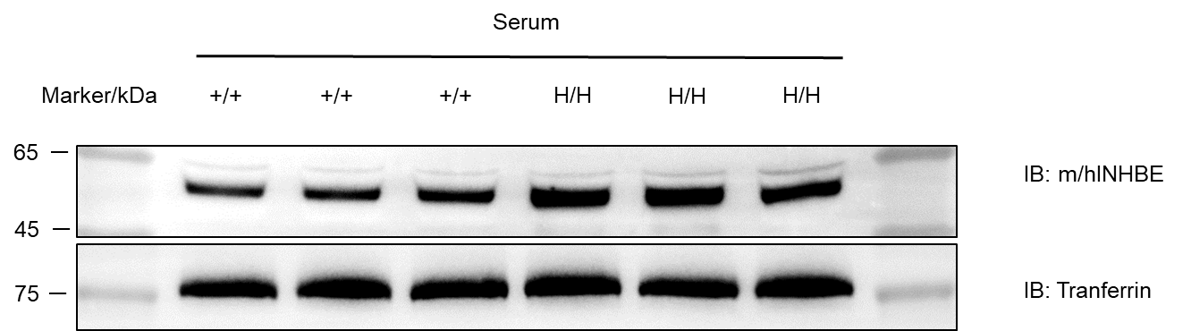
Western blot analysis of INHBE protein expression in homozygous B-hINHBE mice plus. Serum lysates were collected from wild-type C57BL/6JNifdc mice (+/+) and homozygous B-hINHBE mice plus (H/H), and then analyzed by western blot with anti-INHBE antibody (Abcam, ab103167). 40 μg (for INHBE) or 12 μg (for Transferrin) total proteins were loaded for western blotting analysis. INHBE was detected in the serum of wild-type mice and homozygous B-hINHBE mice plus, as the antibody cross-recognizes both human and mouse INHBE.
mRNA Expression Analysis
Relative mRNA levels of human INHBE in B-hINHBE mice by qPCR. Liver RNA was isolated from homozygous B-hINHBE mice plus (H/H) (10-week-old; male n=2, female n=3), then cDNA libraries were synthesized by reverse transcription, followed by PCR with human INHBE primers. Human INHBE mRNA was detectable in homozygous B-hINHBE mice plus. Values are expressed as mean ± SEM.
Protein Expression Analysis
Activin E expression analysis in homozygous B-hINHBE mice plus by ELISA. Serum was collected from homozygous B-hINHBE mice plus (H/H) (male, 6-week-old, n=5) in the fed or fasting state, and analyzed by ELISA. Human Activin E protein was detectable in the serum of B-hINHBE mice plus, and its expression level was increased after fasting.
The Inhibitory Efficiency of the Nucleic Acid Drugs Against Human INHBE
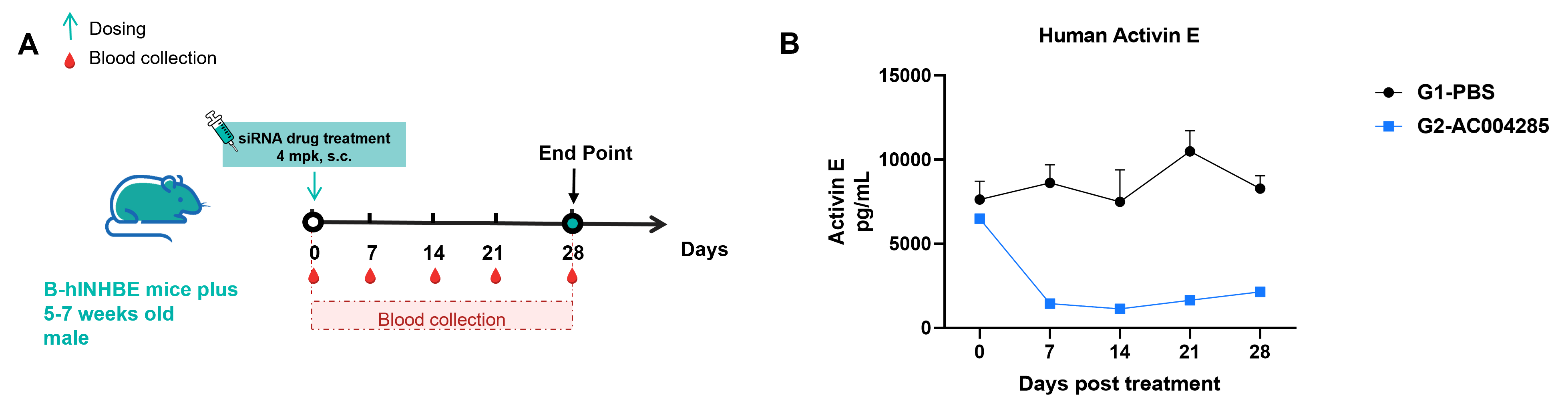
The inhibitory efficiency of the nucleic acid drugs against human INHBE in B-hINHBE mice plus. B-hINHBE mice plus were randomly divided into two groups (Male, 5-7 weeks old, n=4/group). The human INHBE targeted nucleic acid drugs (provided by a client), and PBS were administered to the mice individually. The serum was collected after 6 hours of fasting to detect the expression level of human Activin E by ELISA. (A) The schematic diagram of experimental processing. (B) The expression of human Activin E in the serum on days 0, 7, 14, 21, and 28. The human Activin E expression in the siRNA group was significantly reduced compared to the control group. Values are expressed as mean ± SEM.
* When publishing results obtained using this animal model, please acknowledge the source as follows: The animal model [B-hINHBE mice plus] (Cat# 113644) was purchased from Biocytogen.