Targeting strategy
TFR1 humanization (B-hTFR1 mice):
- The extracellular domain of the mouse Tfr1 gene (exons 4–19) is replaced with the corresponding human sequence.
FcRn humanization (B-hFcRn mice):
- The human full-length FCGRT cDNA was inserted into the Fcgrt exon 2 of wild-type mice.
Protein Expression Analysis of TFR1
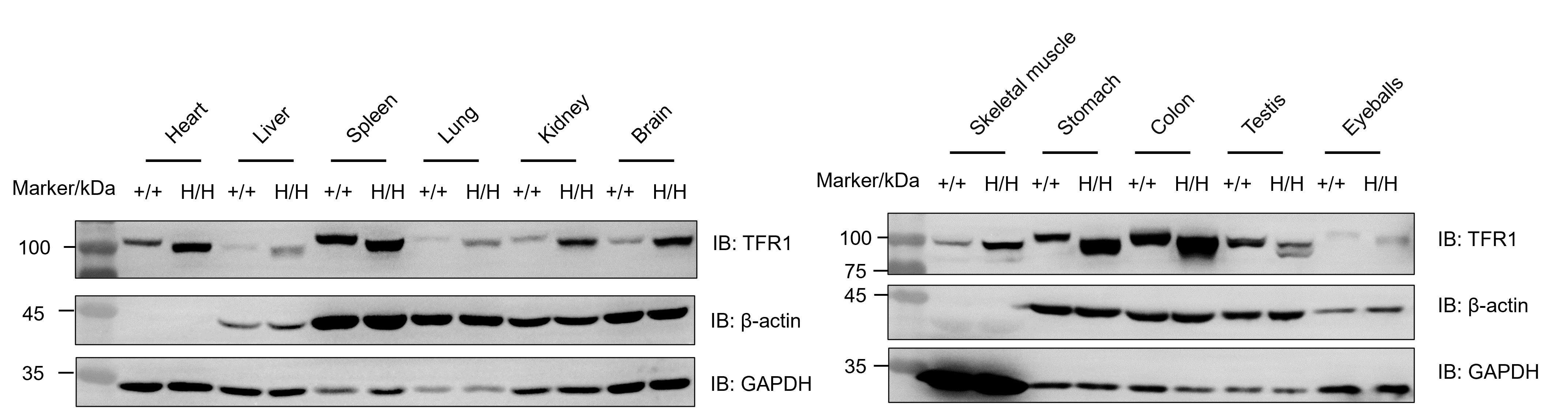
- TFR1 was detected in heart, liver, spleen, lung, kidney, brain, skeletal muscle, stomach, colon, testis and eyeballs from both wild-type C57BL/6JNifdc mice and homozygous B-hTFR1/hFcRn mice, as the antibody was cross-reactive between human and mouse.
Protein expression analysis of TFR1 in homozygous B-hTFR1/hFcRn mice. Various tissue lysates were collected from wild-type C57BL/6JNifdc mice (+/+) and homozygous B-hTFR1/hFcRn mice (H/H), and then analyzed by western blot with anti-transferrin receptor antibody (abcam, ab214039). 40 μg total protein was loaded for western blotting analysis.
Protein Expression Analysis of FcRn
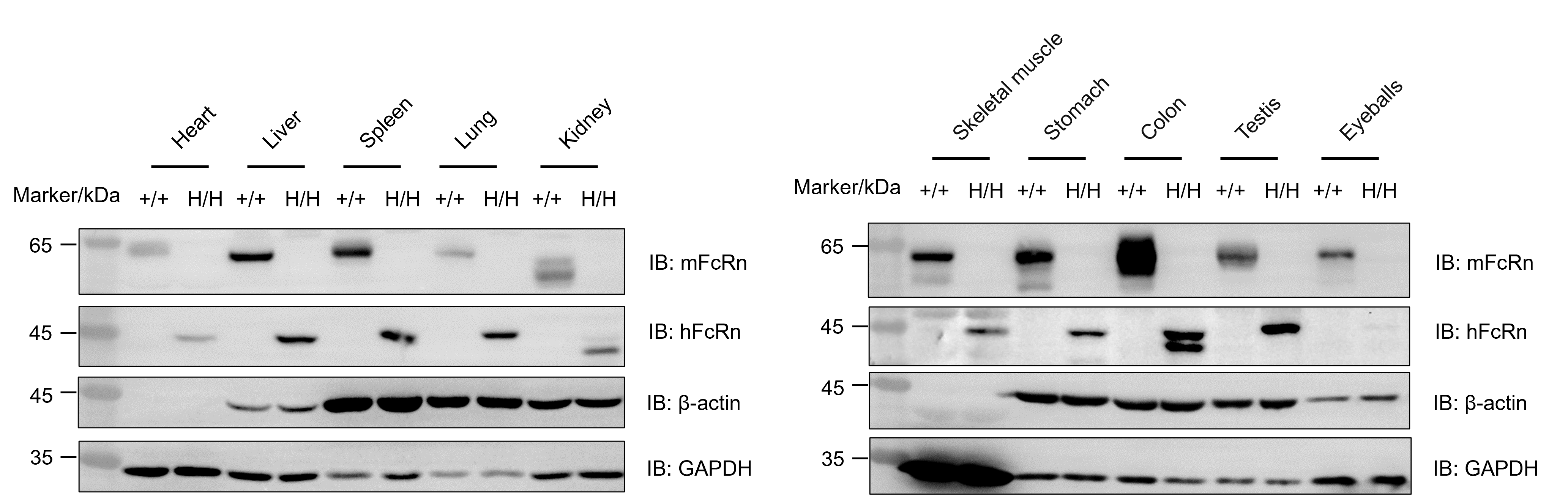
- mFcRn was only detected in wild-type C57BL/6JNifdc mice.
- hFcRn was exclusively detected in heart, liver, spleen, lung, kidney, skeletal muscle, stomach, colon, testis and eyeballs from homozygous B-hTFR1/hFcRn mice.
Protein expression analysis of FcRn in homozygous B-hTFR1/hFcRn mice. Various tissue lysates were collected from wild-type C57BL/6JNifdc mice (+/+) and homozygous B-hTFR1/hFcRn mice (H/H), and then analyzed by western blot with anti-FcRn antibody (mouse FcRn: R&D, AF6775; human FcRn: NOVUS, NBP1-89128). 40 μg total protein was loaded for western blotting analysis.
Functional Analysis of Mouse IgG and Albumin
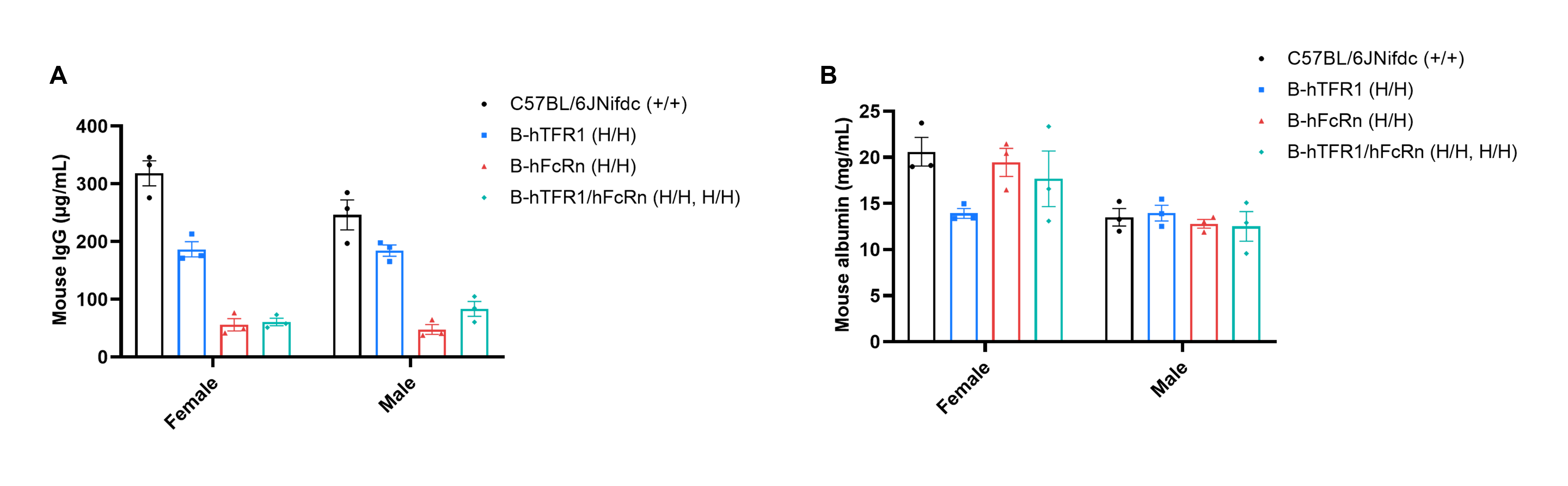
- (A) Mouse total IgG in FcRn humanized mice was lower than that in B-hTFR1 mice and wild-type mice.
- (B) Mouse albumin levels in TFR1 humanized mice and FcRn humanized mice remained comparable with those in wild-type mice
Mouse total IgG and mouse albumin expression in wild-type C57BL/6JNifdc and homozygous B-hTFR1/hFcRn mice. Serum were collected from wild-type C57BL/6JNifdc (+/+) (3 male and 3 female, 7-week-old), homozygous B-hTFR1 mice (H/H), homozygous B-hFcRn mice (H/H) (3 male and 3 female, 7-week-old) and homozygous B-hTFR1/hFcRn mice (H/H, H/H) (3 male and 3 female, 6-week-old), and analyzed by ELISA kit (abcam, ab151276; abcam, ab207620). Values are expressed as mean ± SEM.
Case Study of Multi-Target Humanized Mice Better Reflect the PK of Anti-Human TFR1 Antibodies
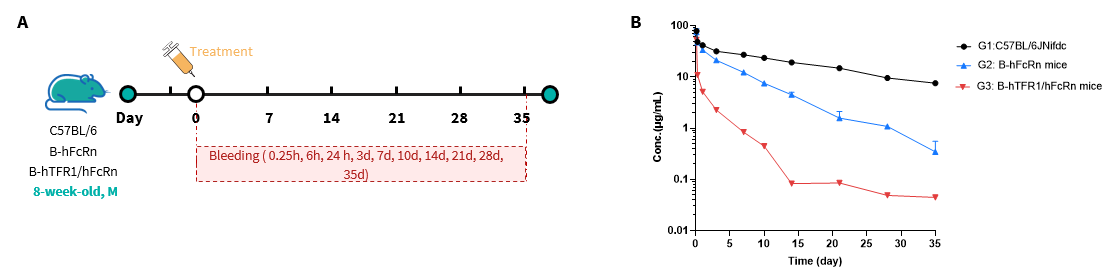
- B-hTFR1/hFcRn mice better reflect in vivo antibody concentration changes compared to wild-type C57BL/6JNifdc and B-hFcRn mice, especially valuable for evaluating the PK of antibodies exhibiting target-mediated drug disposition (TMDD) in a more physiologically relevant context.
Pharmacokinetic (PK) analysis of JR-141 analog in wild-type and humanized TFR1/FcRn mouse strains. (A) Scheme design. Male mice (n = 9 per group) from wild-type C57BL/6 mice (G1), B-hFcRn mice (G2) and B-hTFR1/hFcRn mice (G3) received a single intravenous (i.v.) dose of 3 mg/kg JR-141 analog. Blood samples were collected at 0.25 h, 6 h, 24 h, and on days 3, 7, 10, 14, 21, 28, and 35 post-administration. (B) Serum concentrations of JR-141 analog were measured by ELISA. Compared to wild-type mice (G1), B-hFcRn mice (G2) and B-hTFR1/hFcRn mice (G3) exhibited accelerated clearance.
* When publishing results obtained using this animal model, please acknowledge the source as follows: The animal model [B-hTFR1/hFcRn mice] (Cat# 113777) was purchased from Biocytogen.