you may also like

    BCG036: Next-Gen PD-1/VEGF Bispecific Powered by VEGF VHH Antibody Design

    BCG036: Next-Gen PD-1/VEGF Bispecific Powered by VEGF VHH Antibody Design

    October 07, 2025
    Share on:

    Asset Overview

    BCG036 (PD-1 × VEGFA Bispecific Antibody)

    Biocytogen's BCG036 (PD-1 × VEGFA Bispecific Antibody)

    • Indication: Non-small cell lung cancer (NSCLC) and other solid tumors
    • Development Stage: Currently at the CMC stage; pre-toxicology study completed
    • Collaboration Model: Available for out-licensing or co-development

    Unlike conventional PD-1/VEGF bispecifics, Biocytogen’s BCG036 incorporates a RenNano®-derived VHH single-domain antibody on the VEGF arm, enhancing stability, affinity, and manufacturability. The compact VHH reduces steric hindrance, improves tumor penetration, and preserves PD-1 binding. This unique format offers strong flexibility for combination with ADCs and other therapies, positioning BCG036 as a differentiated contender in the global pipeline.

    Key Features of BCG036 (PD-1 × VEGFA bsAb)

    • Innovative Design: Combines an anti-PD-1 monoclonal antibody with a fully human anti-VEGFA RenNano®-derived VHH (Hu-VHH) for dual immunomodulatory and anti-angiogenic activity.
    • Enhanced Pharmacokinetics: Fc-engineered to extend half-life, improving clinical utility and dosing convenience.
    • Superior VEGFA Binding: The RenNano® Hu-VHH exhibits higher affinity and stronger VEGFA-blocking activity compared to a Bevacizumab (anti-VEGFA mAb) analog.
    • Improved Exposure: Achieves higher and more sustained blood concentrations than the benchmark Ivonescimab (anti PD-1/VEGF bsAb) at equivalent single-dose levels.
    • Potent Efficacy: Demonstrates robust anti-tumor activity in in vivo humanized tumor models.
    • Excellent Safety: Shows a favorable safety profile in pre-toxicology studies with cynomolgus monkeys.
    • Validated Target Strategy: Leverages the clinically validated PD-1 and VEGFA combination to minimize development risk.

    Key Data for BCG036 (PD-1 × VEGFA bsAb)

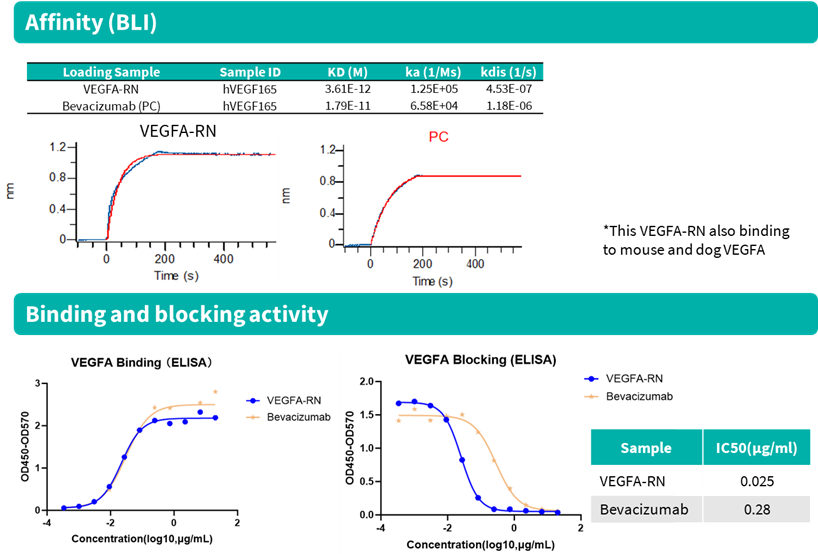
    ▷ RenNano® Anti-VEGFA Hu-VHH Outperforms Bevacizumab Analog

    ▷ RenNano® Anti-VEGFA Hu-VHH Outperforms Bevacizumab Analog

    The fully human anti-VEGFA heavy-chain–only antibody (HCAb), generated using Biocytogen’s proprietary RenNano® platform, exhibited strong binding affinity and demonstrated superior VEGFA-blocking activity compared to a Bevacizumab analog.

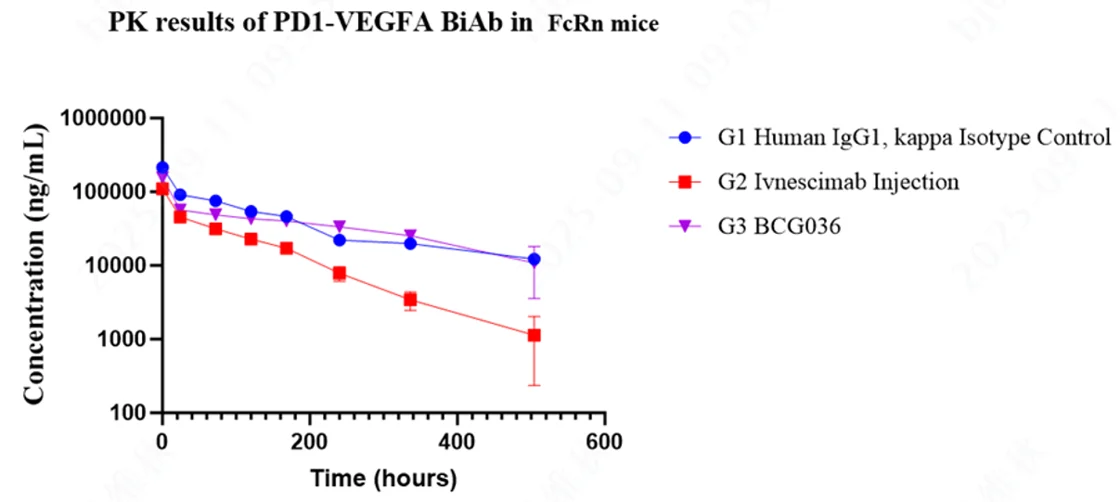
    ▷ BCG036 Exhibits Sustained Exposure vs. Rapid Decline with Ivonescimab

    ▷ BCG036 Exhibits Sustained Exposure vs. Rapid Decline with Ivonescimab

    Under the same single-dose of 5 mpk in humanized FcRn mice, the blood concentration of BCG036 remained relatively high and declined slowly, whereas Ivonescimab exhibited a rapid decrease after approximately 160 hours.

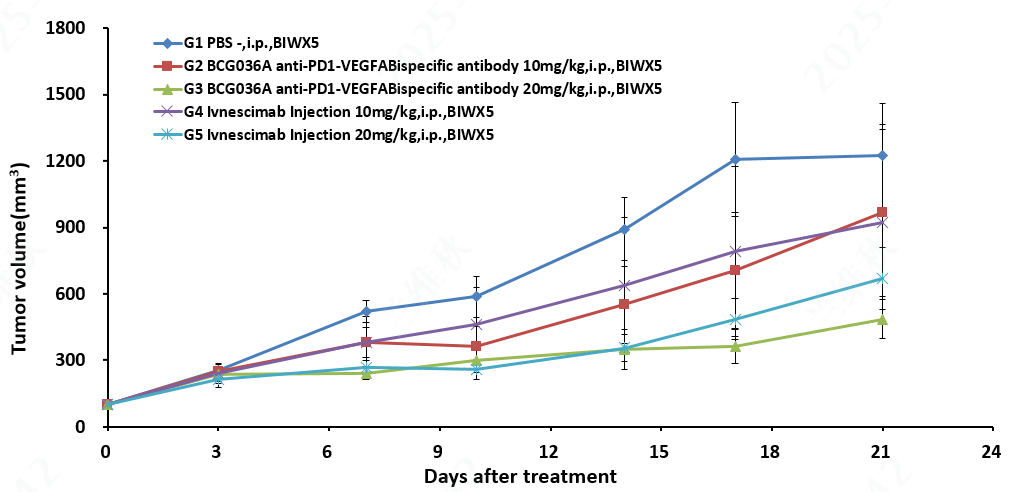
    ▷ BCG036 Demonstrates Superior, Dose-Dependent Tumor Inhibition vs. Ivonescimab

    ▷ BCG036 Demonstrates Superior, Dose-Dependent Tumor Inhibition vs. Ivonescimab

    In PD-1/PD-L1/VEGFA humanized mice inoculated with MC38 tumors, BCG036 exhibited dose-dependent activity. On day 21 post-treatment, the tumor growth inhibition rate of BCG036 (20mg/kg) reached 65.8%, while Ivonescimab (20mg/kg) achieved 49.5%.

    *BCG036 was well tolerated in cynomolgus monkeys when given as a repeat dose of 100 mg/kg.

    Dual PD-1 and VEGF Blockade: A Synergistic Cancer Therapy
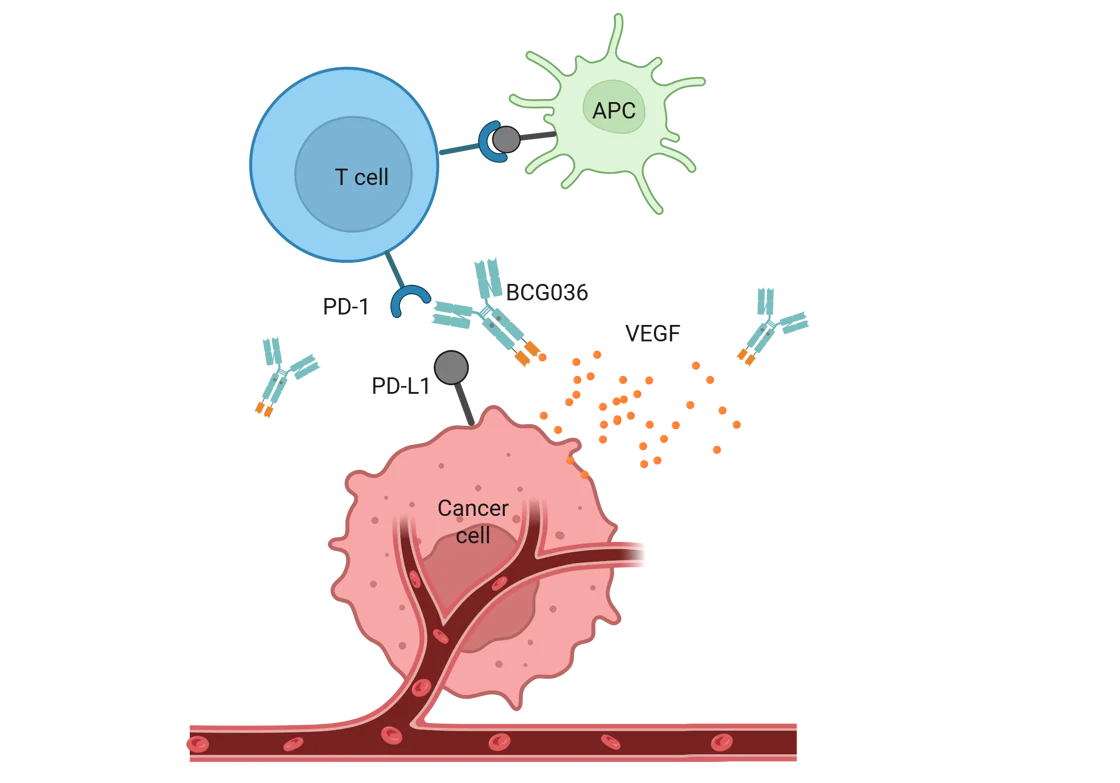
    Dual PD-1 and VEGF Blockade: A Synergistic Cancer Therapy Strategy

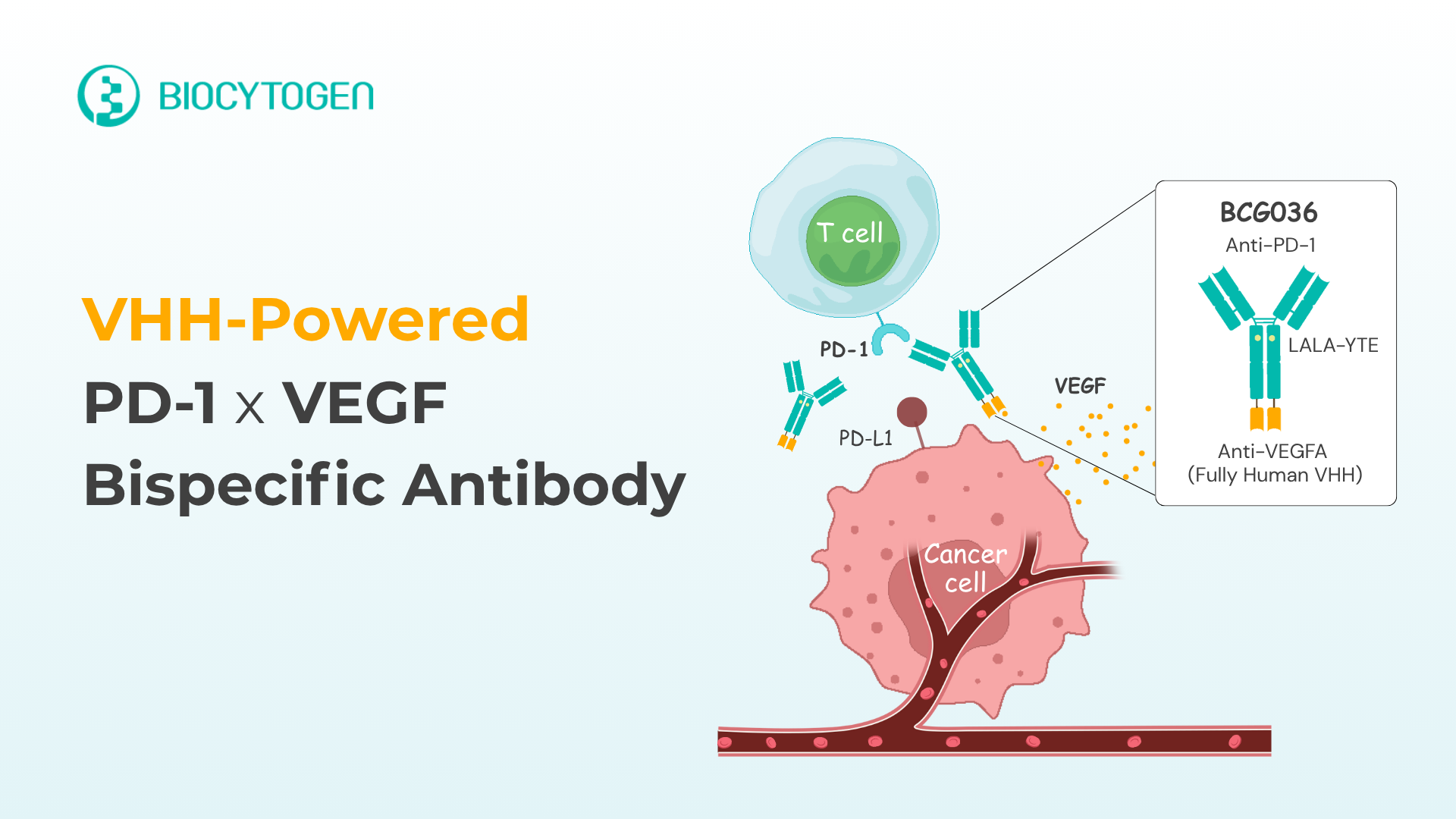
    PD-1 and VEGF are critical pathways exploited by tumors to suppress immune activity and promote angiogenesis. Blocking PD-1 reactivates T cells, restoring their ability to attack tumor cells, while inhibiting VEGF normalizes tumor vasculature and alleviates tumor-induced immunosuppression. Bispecific antibodies such as BCG036 harness this synergy—unleashing a dual mechanism that enhances antitumor immunity.

    This dual-blockade strategy has demonstrated growing clinical success across multiple solid tumors, including non–small cell lung cancer (NSCLC), hepatocellular carcinoma (HCC), renal cell carcinoma (RCC), and gastric cancer. Numerous PD-(L)1 × VEGF bispecific candidates are currently in Phase II or III clinical development. Notable examples include:

    • Akeso’s Ivonescimab (AK112): Approved in China for EGFR-mutated NSCLC after tyrosine kinase inhibitor (TKI) resistance; licensed ex-China to Summit Therapeutics.

    • BioNTech’s PM8002: In Phase III development for triple-negative breast cancer (TNBC).

    • 3SBio’s SSGJ-707: Licensed to Pfizer; currently in Phase III trials for NSCLC.

    • ImmuneOnco’s IMM2510: In Phase II clinical trials.

    • LaNova’s LM-299: In Phase I; globally licensed to Merck.

    Partnering Opportunities

    As the global pipeline of PD-1/VEGF bispecific antibodies continues to expand, Biocytogen is driving innovation with BCG036, a next-generation molecule designed to advance the field of cancer immunotherapy. We welcome potential partners to explore evaluation, licensing, and co-development opportunities and discover how BCG036 can help strengthen your oncology portfolio.

    👉 Contact us today to learn more about partnership opportunities with Biocytogen!

    Frequently Asked Questions (FAQ) on PD-1 × VEGFA Bispecific Antibody

    1. What is Biocytogen’s BCG036 (PD-1 × VEGFA bispecific antibody)?
    BCG036 is a next-generation PD-1 × VEGFA bispecific antibody developed by Biocytogen for non-small cell lung cancer (NSCLC) and other solid tumors. It fuses an anti-PD-1 monoclonal antibody with a RenNano®-derived fully human anti-VEGFA VHH, providing dual immunomodulatory and anti-angiogenic activity with enhanced stability and manufacturability.

    2. How does dual PD-1 and VEGFA blockade enhance anti-tumor immunity?
    The dual blockade strategy reactivates exhausted T cells through PD-1 inhibition and suppresses tumor angiogenesis via VEGFA inhibition. This combination normalizes tumor vasculature, boosts immune cell infiltration, and enhances anti-tumor efficacy across cancers such as NSCLC, HCC, and RCC.

    3. How does BCG036 compare to Ivonescimab and Bevacizumab in preclinical studies?
    BCG036 showed stronger VEGFA binding and longer blood exposure than Ivonescimab and Bevacizumab analogs. In PD-1/PD-L1/VEGFA humanized mouse models, it achieved 65.8% tumor growth inhibition versus 49.5% for Ivonescimab, confirming superior potency and durability, with excellent tolerability in non-human primates.

    4. What differentiates BCG036 from other PD-1/VEGF bispecific antibodies?
    Unlike traditional formats, BCG036 uses a compact RenNano®-derived Hu-VHH domain for VEGF targeting that improves binding affinity, tumor penetration, and manufacturability. Its Fc-engineered backbone extends half-life, enabling flexible combination with ADCs and checkpoint inhibitors, making it a distinctive next-generation bispecific.

    5. Is BCG036 available for licensing or co-development?
    Yes. Biocytogen offers out-licensing and co-development opportunities for BCG036. With a validated PD-1/VEGFA mechanism, robust preclinical data, and RenNano® advantages, BCG036 is ideal for partners seeking to expand immuno-oncology pipelines or develop synergistic combination therapies.