you may also like
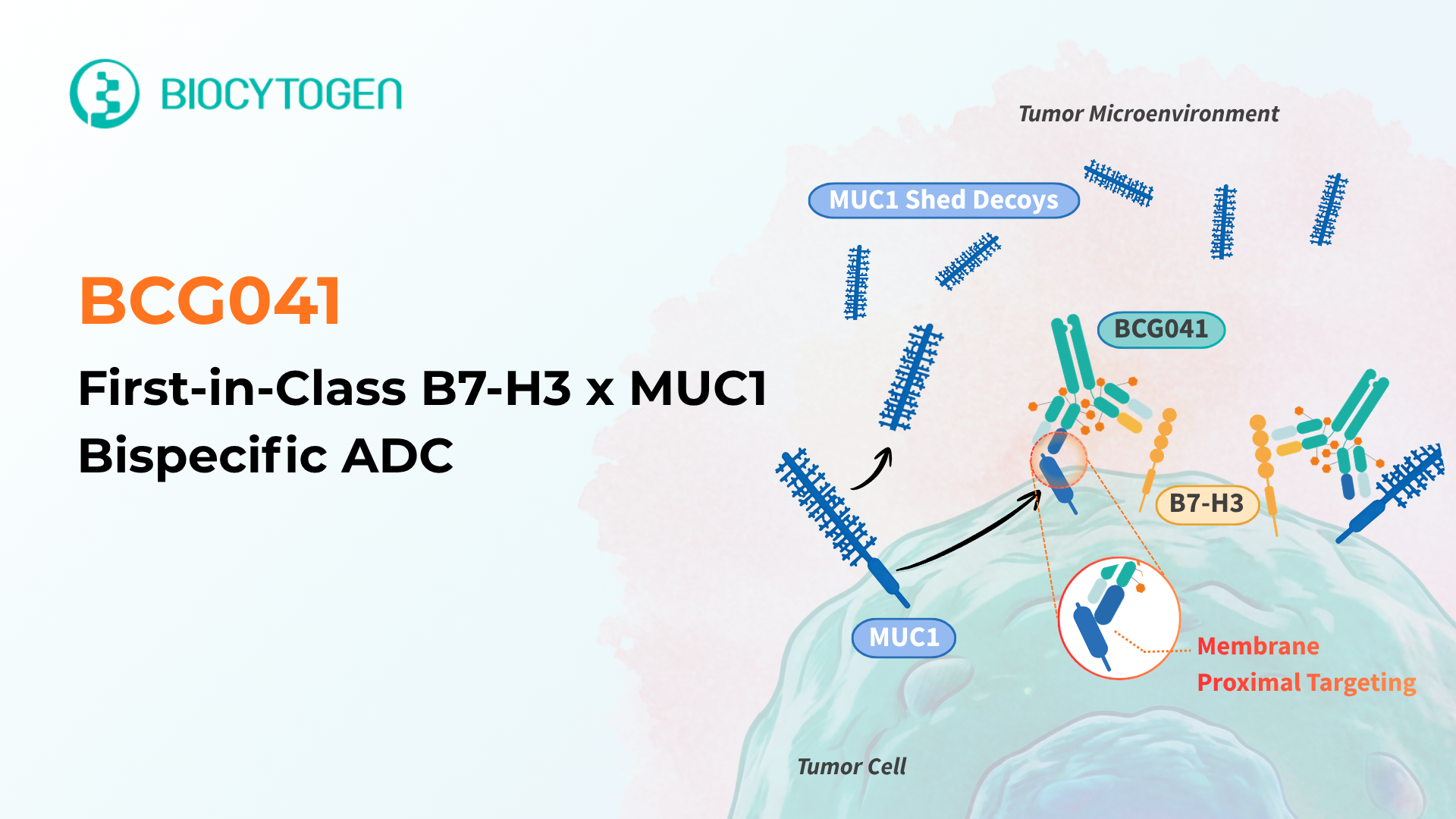
Following a week of major oncology milestones—including strategic platform collaborations with Moonlight Bio, Taisho Pharmaceutical and FDA IND clearance for NEOK Bio’s MUC1-targeting bsADC—Biocytogen continues to validate our platform’s ability to translate discovery assets into clinical reality. Solid tumors present a monumental global challenge, affecting over 10 million patients annually in a therapeutics market projected to exceed $300 billion by 2030. To meet this urgent need, Biocytogen introduces BCG041, a transformative, first-in-class B7-H3 x MUC1 bispecific antibody-drug conjugate (ADC) specifically engineered to enhance tumor targeting and overcome antigen heterogeneity.
B7-H3, a member of the B7 immunoregulatory protein family, is practically undetectable in healthy tissues but heavily upregulated across the majority of solid tumors.
The Good:
The Limit—Monoclonal Limitation: Relying on a single target leaves a dangerous vulnerability. If a fraction of cancer cells downregulates B7-H3, they can survive the treatment and drive an aggressive relapse. Therefore, a secondary anchor is required.
To close the escape route left by B7-H3, a secondary target must be equally prevalent but biologically distinct. Mucin 1 (MUC1) is the perfect candidate. While it acts as a protective glycoprotein in healthy cells, it undergoes a dangerous transformation in cancer, making it an irresistible target due to unique cancerous shifts (Grewal. and Kurzrock. 2025)
The Good:
The Limit— MUC1 “Sink Effect”: Despite decades of promise, MUC1 has remained notoriously difficult to drug. Clinical-stage therapies (e.g. cantuzumab, gatipotuzumab) have historically failed due to the "sink effect"—a process where MUC1 naturally cleaves its extracellular domain, shedding massive amounts of "decoys" into the TME. Traditional antibodies bind to these floating decoys and are neutralized before they can ever reach the cancer cell membrane.
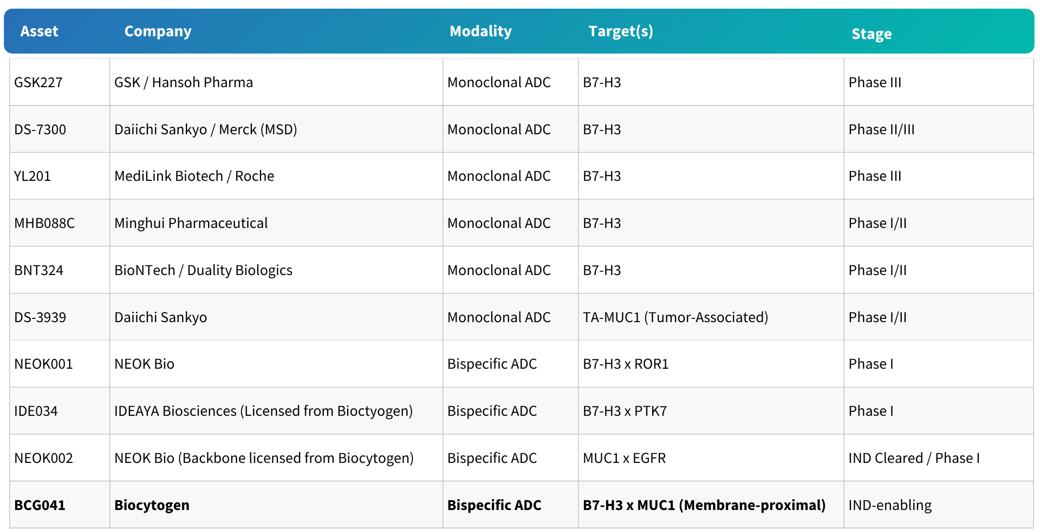
When therapies target a single antigen, the heterogeneous nature of solid tumors allows cancer cells to evade treatment, leading to resistance and relapse. The field urgently needs a solution that can widen the therapeutic window while delivering superior safety and efficacy.
BCG041, a first-in-class B7-H3 x MUC1 bispecific ADC, is designed to address the core failures of previous generations through three key mechanisms:
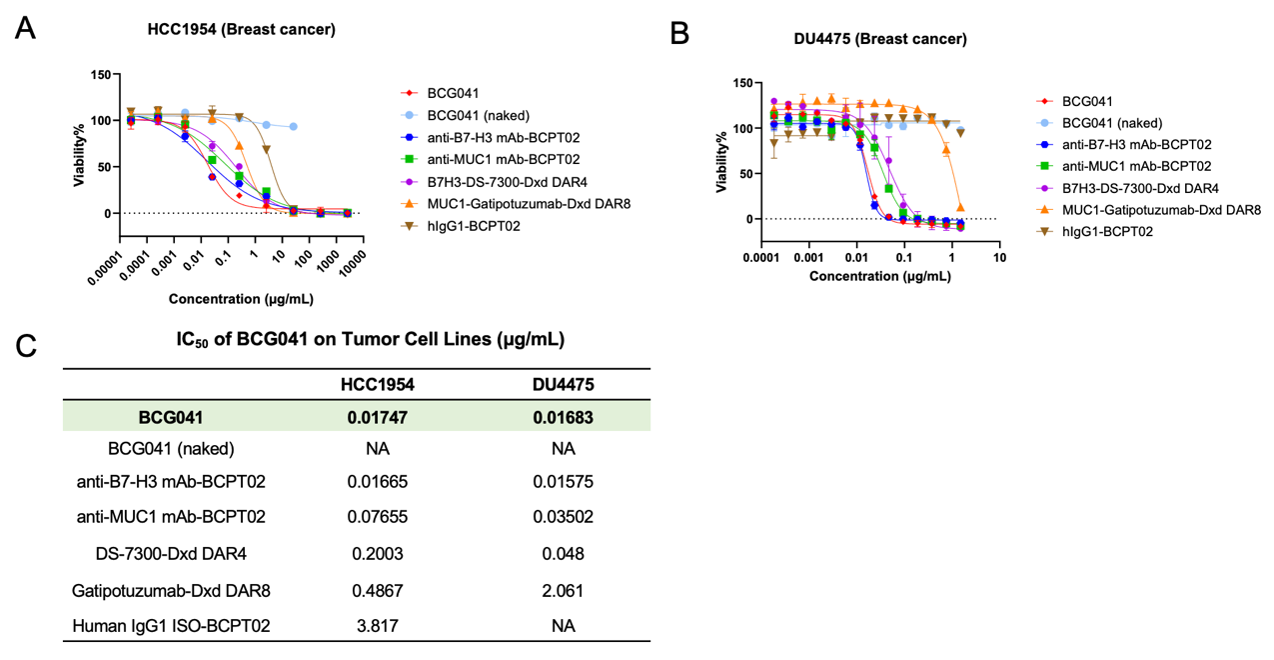
BCG041 demonstrates more robust in vitro cytotoxicity than monospecific clinical-stage benchmarks in B7-H3/MUC1 dual-expressing breast cancer cells. (Benchmark analogs: Phase II/III B7-H3 targeting ADC DS-7300; Phaes I/II MUC1 targeting ADC gatipotuzumab , both by Daiichi Sankyo)
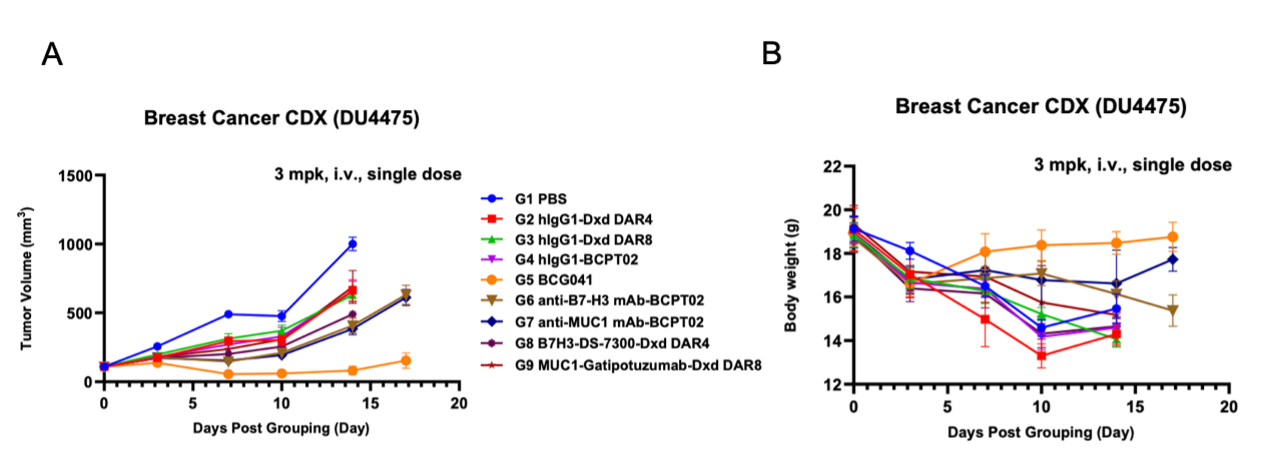
In the cachectic breast cancer model, a single dose of BCG041 (orange line) demonstrates (A) synergistic tumor growth inhibition compared to parental ADCs and benchmark therapies, alongside (B) body weight recovery, indicating a markedly improved therapeutic window and tolerability—an outcome rarely achieved with aggressive oncology treatments.
► Full data package will be released at the upcoming AACR 2026, stay tuned!
Biocytogen is actively seeking strategic partnerships for BCG041. This PCC-stage asset is currently available for licensing and co-development, offering a prime opportunity to bring a breakthrough solid tumor therapy to patients. Connect with Biocytogen at the upcoming AACR meeting (Booth # 3225) to review the full dataset and discuss collaborative opportunities!
BCG041 leverages high co-expression pattern of B7-H3 (a stable tumor anchor) and MUC1 (a potent oncogenic driver) as a dual-anchor system. This compensates for antigen heterogeneity—ensuring tumor engagement even if one target fluctuates. Critically, it overcomes the historical "sink effect" by targeting the membrane-proximal region of MUC1 rather than its easily shed outer portions, ensuring the payload reaches tumor cells instead of being neutralized by floating decoys.
BCG041 is built on Biocytogen’s proprietary RenLite® platform. It utilizes a fully human IgG1κ common-light-chain backbone that delivers high binding affinity and strong developability. This advanced engineering minimizes the risk of chain mispairing, which supports efficient and scalable CMC manufacturing for clinical development.
BCG041 features an optimized, protease-cleavable hydrophilic linker conjugated to BCPT02—a potent Topoisomerase I inhibitor—with a high drug-to-antibody ratio (DAR) of approximately 8. Engaging two targets simultaneously triggers much faster internalization, widening the therapeutic window. Notably, in preclinical cachectic breast cancer models, BCG041 delivered superior antitumor efficacy while promoting unique body weight recovery in diseased mice, indicating a vastly improved tolerability profile compared to aggressive oncology treatments.
Because B7-H3 and MUC1 are widely co-expressed across a multitude of high-prevalence solid tumors, BCG041 is designed for a massive global patient population. Key targeted indications include breast, lung, colorectal, prostate, esophageal, gastric, head and neck, and metastatic ovarian cancers.