you may also like

The Evolving Weight-Loss Landscape
Over the past few years, incretin-based therapies have reshaped the obesity and type 2 diabetes treatment paradigm. What began with injectable GLP-1 receptor agonists has now evolved into multi-agonist and oral formulations that promise broader access, improved patient compliance, and greater metabolic benefits.
The Rise of Oral GLP-1 Therapies
After injectable GLP-1 therapies set new efficacy standards, industry focus is shifting toward oral delivery. Eli Lilly’s Orforglipron — a non-peptide, oral GLP-1R agonist — has demonstrated up to ~1.8% HbA1c reduction and ~12.4% body-weight loss in Phase 3 trials. Meanwhile, Novo Nordisk has submitted its oral semaglutide tablet (“oral Wegovy”) for weight-management indication, reporting ~15% weight loss in a ~64-68-week study. If approved, Novo’s tablet would become the first oral GLP-1 indicated for chronic weight management. Together, these advances are driving a market shift toward daily oral regimens and broader therapy adoption.
The Molecular Targets Driving the Revolution
Modern incretin-based therapies harness three key hormone receptors that work together to regulate glucose metabolism, appetite, and energy balance:
These three receptor pathways form the foundation of next-generation multi-agonist therapies that deliver deeper, more sustained weight-loss and metabolic improvements than single-target drugs.
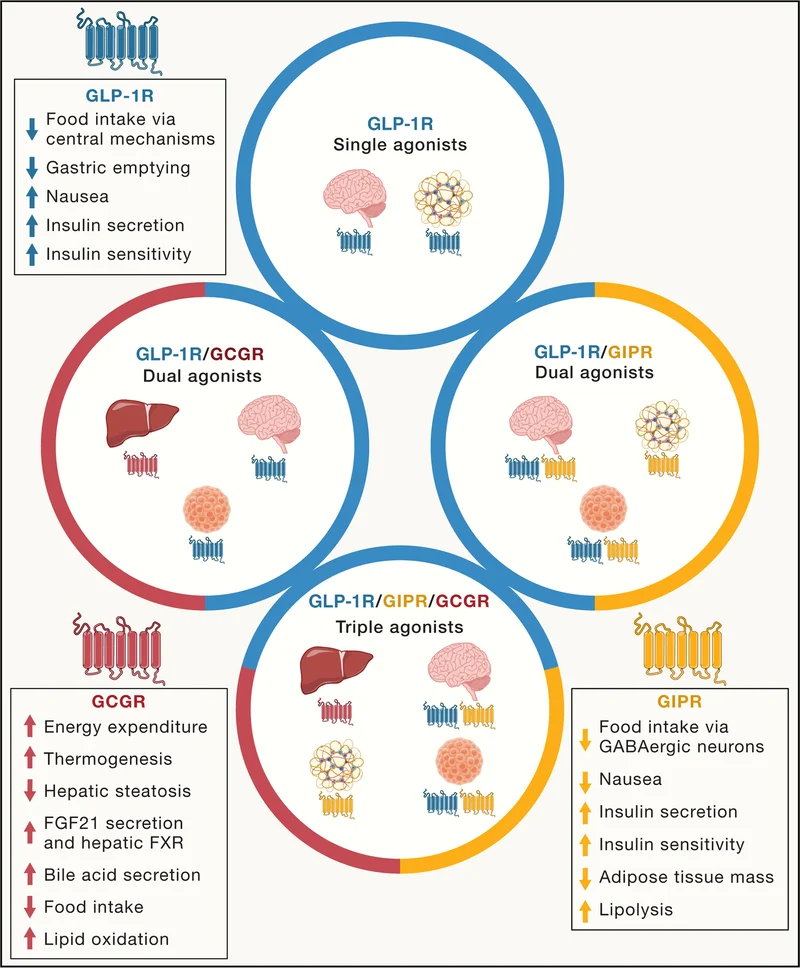 |
Tissue-Specific Actions of GLP-1R-Based Agonists (Kusminski et al. 2024) |
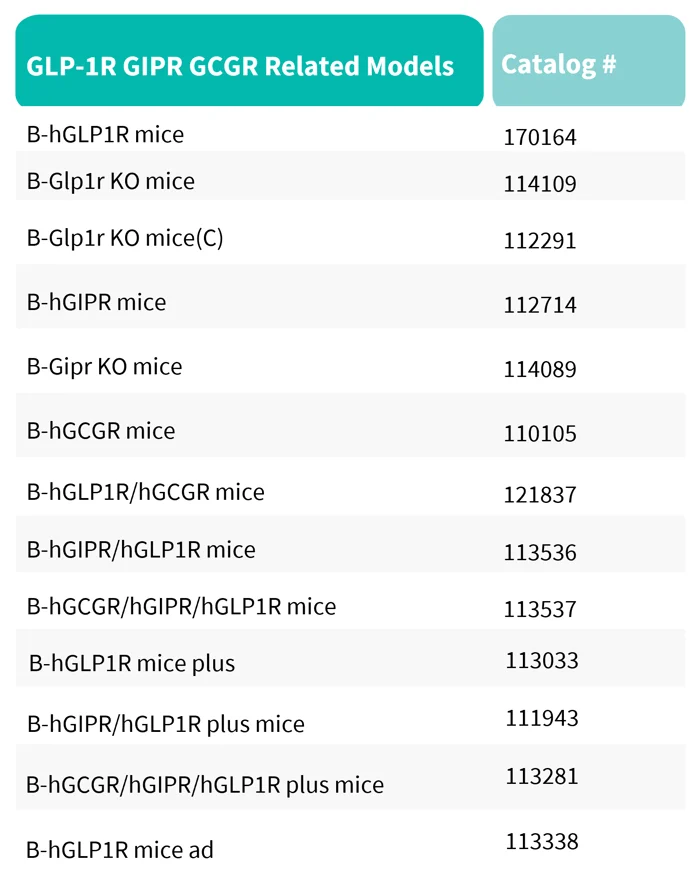
As competition intensifies in the incretin field, robust preclinical models are becoming critical to accurately predict clinical efficacy and safety. Biocytogen’s suite of humanized receptor mouse models offers a powerful translational platform to validate receptor-specific pharmacology and cross-species activity of these advanced molecules in a human-relevant context. |
Featured Mouse Models for Next-Gen Weight Loss Drugs |
 |
|
Case Study 1: Efficacy Evaluation of Orforglipron |
|
Orforglipron Reduces Body Weight in HFD-Induced Humanized GLP-1R Mice |
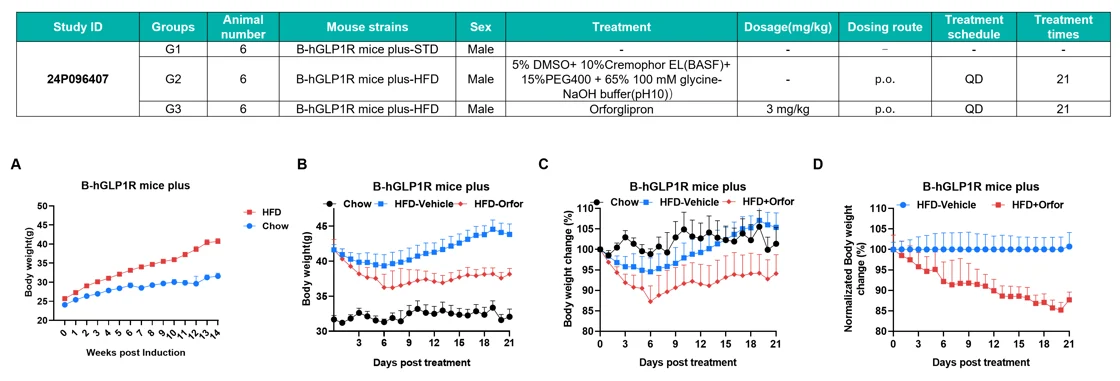 |
B-hGLP1R mice plus were fed a high-fat diet (HFD) to induce obesity, followed by oral Orforglipron treatment. (A) Body-weight change after HFD induction. (B–D) Body-weight change during Orforglipron treatment. Orforglipron treatment led to a significant reduction in body weight compared with controls. Mean ± SEM. |
Orforglipron Improves Glucose Tolerance, Reduces Food Intake, and Lowers Adipose Tissue Weight in HFD-Induced Humanized GLP-1R Mice |
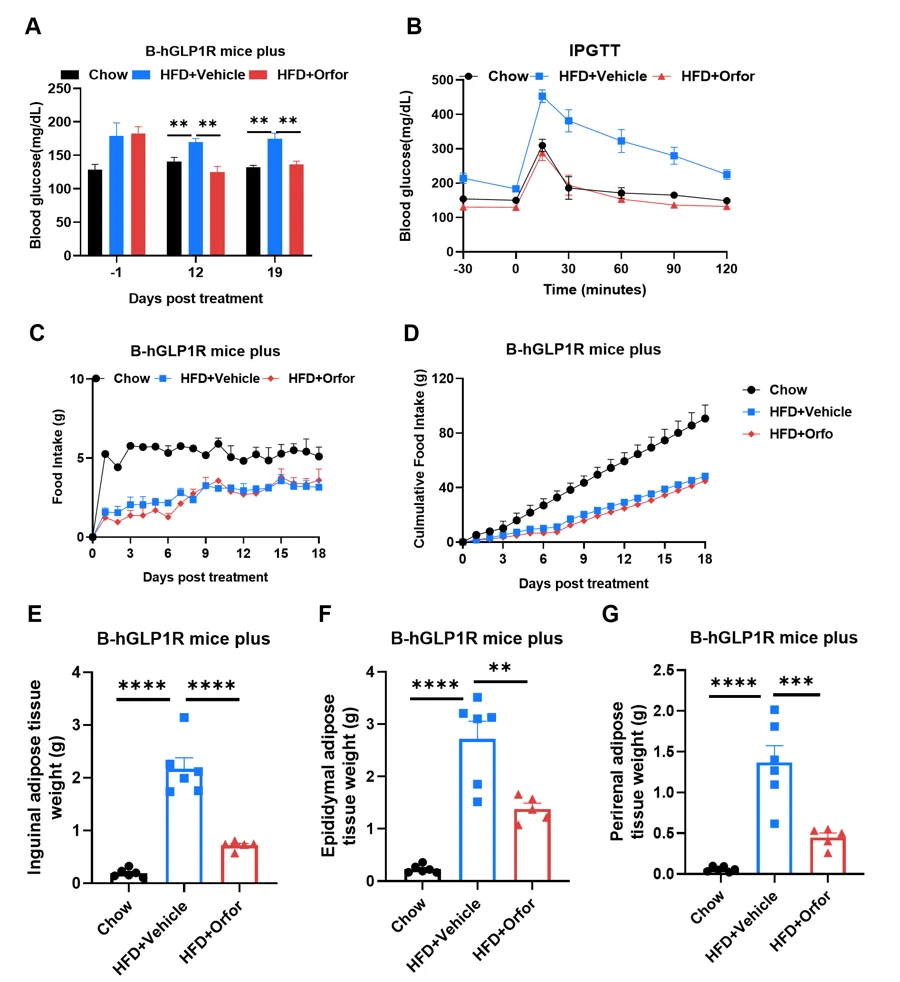 |
B-hGLP1R mice plus were fed a high-fat diet (HFD) to induce obesity, followed by Orforglipron treatment. (A) Blood glucose levels after treatment. (B) Intraperitoneal glucose tolerance test (IPGTT) with 15% D-glucose. (C–D) Food intake following treatment. (E–G) Adipose tissue weights after Orforglipron administration. Orforglipron significantly improved those parameters compared with controls. Mean ± SEM. |
Case Study 2: Comparative Efficacy of Multi-Agonists |
|
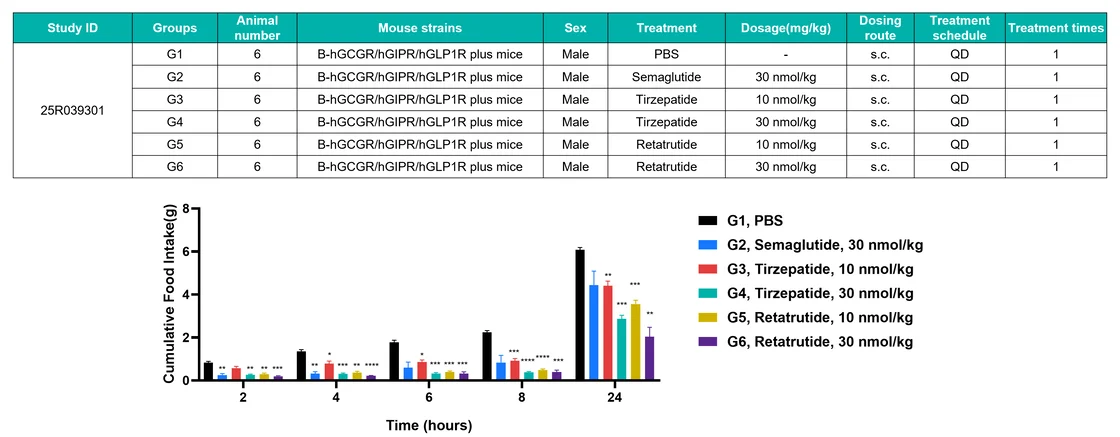 |
Semaglutide, Tirzepatide, and Retatrutide suppress food intake in triple humanized Incretin-receptor mice. B-hGCGR/hGIPR/hGLP1R plus mice (8 weeks old) were grouped by body weight and baseline food intake. After overnight fasting, animals received PBS or test compounds (Semaglutide, Tirzepatide, or Retatrutide) in the morning, and food was provided 15 minutes post-dosing. Remaining food was measured at 2, 4, 6, 8, and 24 hours post-dose. Mean ± SEM.
The convergence of oral bioavailability and multi-receptor agonism is redefining the landscape of obesity and diabetes therapeutics. As the field advances, humanized preclinical systems that allow drug evaluation against human targets—such as GCGR/GIPR/GLP1R humanized mouse models—will play a pivotal role in bridging the gap between mechanistic discovery and clinical translation. Contact Biocytogen today to learn how our humanized models and disease models can support your metabolic drug discovery programs and accelerate translational success!
Frequently Asked Questions (FAQs)1. What are oral GLP-1 therapies and how do they help with weight loss?Oral GLP-1 therapies activate GLP-1 receptors to boost insulin secretion, slow gastric emptying, and reduce appetite, leading to weight loss and improved glucose control. Unlike injectables like semaglutide or tirzepatide, oral drugs such as Orforglipron offer convenient, daily dosing options. 2. What makes Orforglipron unique among GLP-1 drugs?Orforglipron, developed by Eli Lilly, is the first non-peptide oral GLP-1 agonist, achieving up to 1.8% HbA1c reduction and 10–12% body-weight loss in Phase 3 trials. Its oral small-molecule design improves accessibility and patient compliance compared to injectables. 3. How do incretin-based multi-agonists like tirzepatide and retatrutide work?Incretin-based multi-agonists, such as tirzepatide and retatrutide, target two or more receptors among GLP-1, GIP, and GCGR to enhance insulin secretion, improve fat metabolism, and increase energy expenditure—ultimately achieving greater weight loss and metabolic improvement. 4. Why are humanized mouse models important in GLP-1 research?Humanized receptor mouse models express the human targets of these drug candidates, enabling in vivo efficacy and safety evaluation and helping researchers better predict the clinical performance of new obesity and diabetes therapies.
Reference:Kusminski, Christine M., et al. "Transforming obesity: The advancement of multi-receptor drugs." Cell 187.15 (2024): 3829-3853. |