
NA • 322424

Origin: The MC38 cell line is derived from C57BL/6 murine colon adenocarcinoma cells. The cell line is a commonly used murine model for colorectal carcinoma.
Background Information: HLA-A belongs to the HLA class I heavy chain paralogues. This class I molecule is a heterodimer consisting of a heavy chain and a light chain (beta-2 microglobulin). The heavy chain is anchored in the membrane. Class I molecules play a central role in the immune system by presenting peptides derived from the endoplasmic reticulum lumen so that they can be recognized by cytotoxic T cells. MAGEA2 is a member of the MAGEA gene family. The MAGEA genes are clustered at chromosomal location Xq28. They have been implicated in some hereditary disorders, such as dyskeratosis congenita.
Gene targeting strategy: The B2m gene (Exon2 to Exon3) of mouse were replaced by the sequence encompassing the human B2M CDS, HLA-A*0201 gene that included leader sequence, α1 and α2 domains ligated to a fragment of the murine H-2Db gene containing the α3, transmembrane and cytoplasmic domains and human MAGEA2 CDS. Human HLA-A2.1 is highly expressed on the surface of B-HLA-A2.1/hMAGEA2 MC38. Human MAGEA2 is detectable by western blot.
Tumorigenicity: Confirmed in B-HLA-A2.1 mice.
Application: The B-HLA-A2.1/hMAGEA2 MC38 tumor model can be used for preclinical evaluation of cancer vaccines and TCR mimics.
Notes:

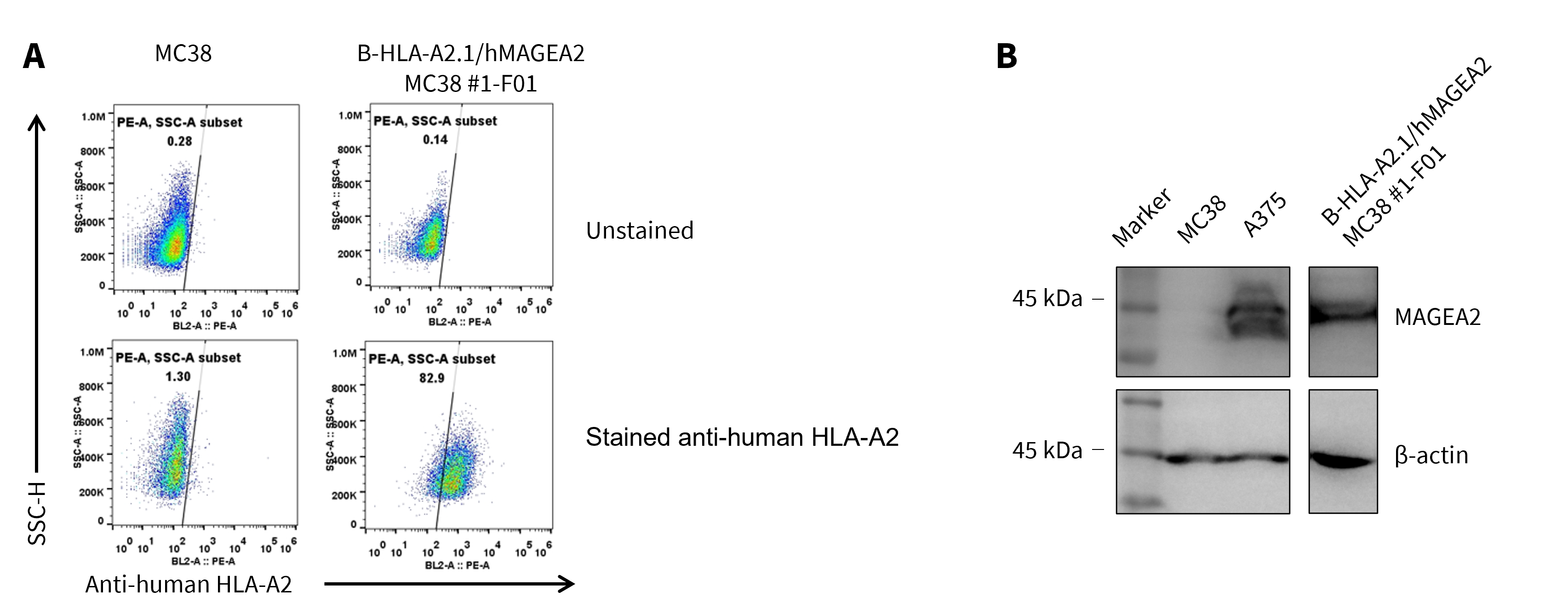
HLA-A2.1 and MAGEA2 expression analysis in B-HLA-A2.1/hMAGEA2 MC38 by flow cytometry and western blot, respectively. Single cell suspensions from wild-type MC38 and B-HLA-A2.1/hMAGEA2 MC38 #1-F01 cultures were stained with anti-human HLA-A2 antibody (Biolegend, 343306) and anti-MAGEA2 (abcam, ab223162), respectively. (A) Human HLA-A2 was detected on the surface of B-HLA-A2.1/hMAGEA2 MC38 cells but not wild-type MC38 cells. (B) Human MAGEA2 was detected in the B-HLA-A2.1/hMAGEA2 MC38 cells but not wild-type MC38 cells.


Subcutaneous tumor growth of B-HLA-A2.1/hMAGEA2 MC38 cells. B-HLA-A2.1/hMAGEA2 MC38 cells (1×10⁶) and wild-type MC38 cells (5×10⁵) were subcutaneously implanted into B-HLA-A2.1 mice (female, 9-week-old, n=6). Tumor volume and body weight were measured twice a week. (A) Average tumor volume. (B) Body weight. Volume was expressed in mm3 using the formula: V=0.5 × long diameter × short diameter2. Results indicate that B-HLA-A2.1/hMAGEA2 MC38 cells were able to establish tumors in vivo and can be used for efficacy studies. Values are expressed as mean ± SEM.
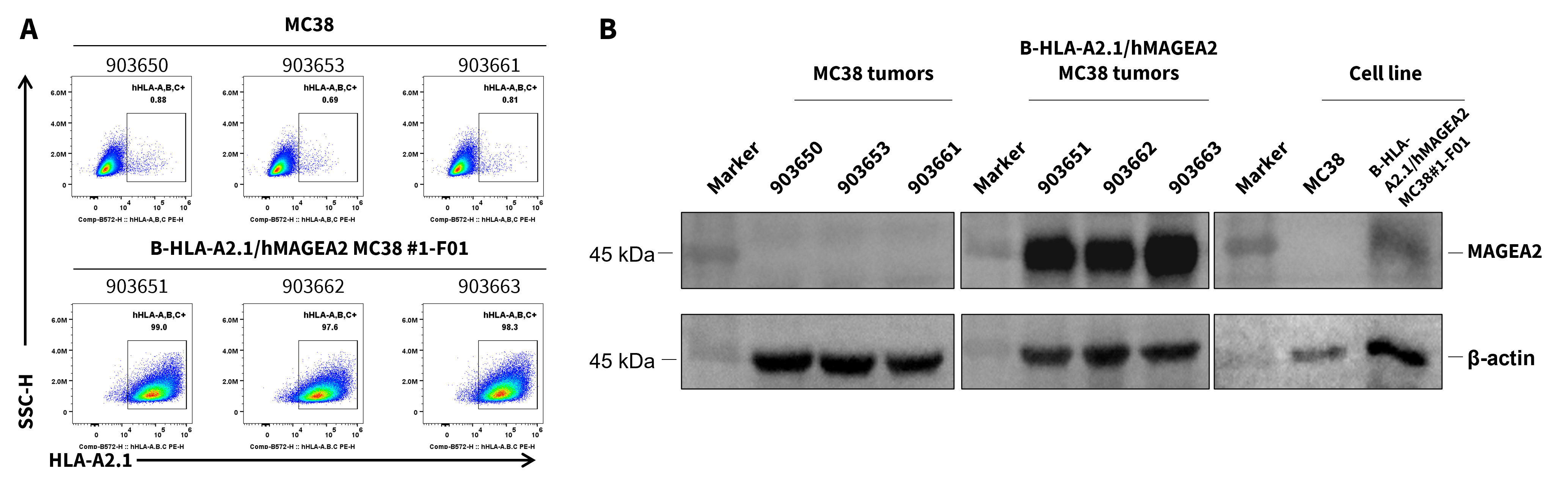
HLA-A2.1 and MAGEA2 expression were evaluated on B-HLA-A2.1/hMAGEA2 MC38 by flow cytometry and western blot, respectively. These cells were subcutaneously transplanted into B-HLA-A2.1 mice (n=6). At the end of the experiment, tumor cells were harvested and analyzed with species-specific anti-HLA-A2 antibody (Biolegend, 311406) and anti-MAGEA2 (abcam, ab223162) expression by flow cytometry and western blot, respectively.