
B-hVEGFA/hPD-L1/hEGFR MC38

NA • 322558

B-hVEGFA/hPD-L1/hEGFR MC38

Product nameB-hVEGFA/hPD-L1/hEGFR MC38
Catalog number322558
Strain nameNA
Strain backgroundC57BL/6
Chromosome5, 19, 11
AliasesVpf, Vegf, L-VEGF; B7h1, Pdl1, Pdcd1l1, Pdcd1lg1; Erbb, Erbb1
TissueColon
DiseaseColon carcinoma

on this page

  • Description
  • Phenotypic analysis
  • Tumorigenicity

Posters

View All

    Publication

      Description
      • Origin: The MC38 cell line is derived from C57BL6 murine colon adenocarcinoma cells. The cell line is a commonly used murine model for colorectal carcinoma.
      • Background Information: VEGFA is the primary mediator of angiogenesis. It stimulates endothelial cell proliferation, migration, and survival, thereby promoting the growth of new blood vessels. Its overexpression is closely associated with tumor progression. PD-L1 is an immune checkpoint protein expressed on the surface of various cells, including tumor cells and immune cells. It binds to PD-1 on T cells, leading to T cell exhaustion, reduced cytokine production, and impaired anti-tumor immunity. Epidermal Growth Factor Receptor (EGFR) is a transmembrane glycoprotein belonging to the receptor tyrosine kinase family. It mainly participates in the processes of cell growth, proliferation, differentiation and survival. EGFR shows abnormal expression or mutation in various types of cancers, such as non-small cell lung cancer, breast cancer, ovarian cancer, colorectal cancer, etc., and thus becomes an important therapeutic target.
      • Gene targeting strategy: The exogenous promoter, human PD-L1 and luciferase coding sequences were inserted to replace part of murine exon 3. The insertion disrupts the endogenous murine Pdl1 gene, resulting in a non-functional transcript. The human VEGFA coding sequence was inserted to replace part of murine exon 1 and all of exons 2-5. The expression cassette containing an exogenous promoter, the extracellular region of human EGFR, and the transmembrane and intracellular regions of mouse Egfr was randomly inserted into the genome.
      • Tumorigenicity: Confirmed in B-hPD-1 plus/hPD-L1/hEGFR mice. Can’t form tumors in wild-type C57BL/6 mice.
      • Application: The B-hVEGFA/hPD-L1/hEGFR MC38 tumor models can be used for preclinical evaluation of monoclonal antibody drugs and bispecific antibody drugs targeting human VEGFA and PD-1/PD-L1, as well as for combination therapy with EGFR-targeting ADC.
      • Notes:

      Inoculated cell lines can be suspended with DMEM stock solution.

      Before implementing the project, it is recommended to perform tumor growth experiments. The recommended cell inoculation amount is between 5E5~1E6.

      In the experiment, it is necessary to ensure that the number of animals inoculated subcutaneously is at least 1.6 times the actual grouping number.

      PD-L1 and EGFR Protein Expression Analysis
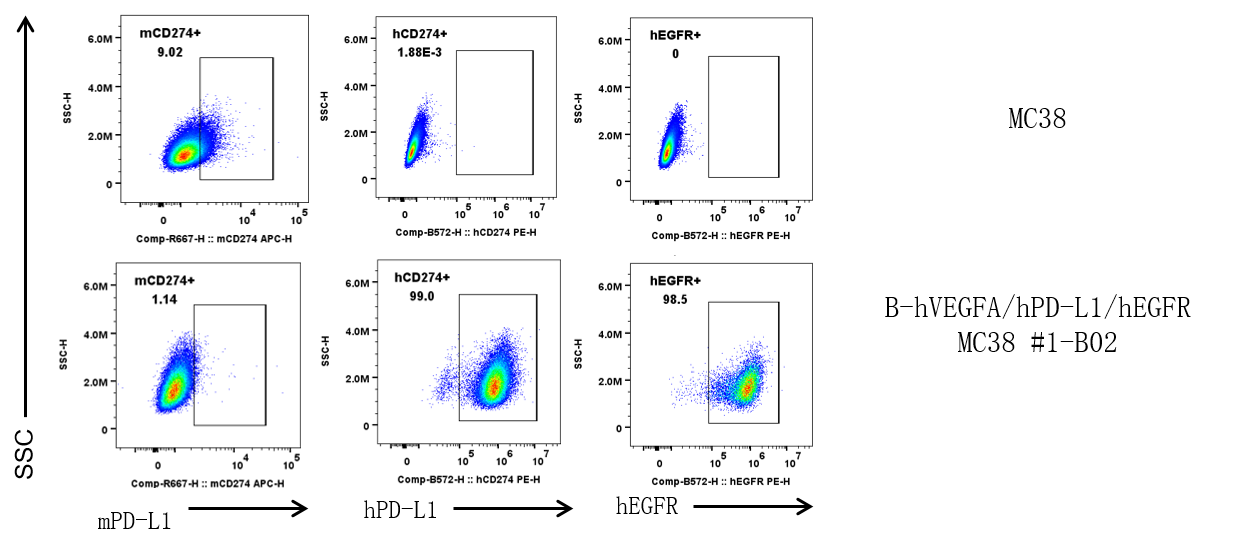
      • Human PD-L1 and EGFR were detected on the surface of B-hVEGFA/hPD-L1/hEGFR MC38 but not wild-type MC38 cells.
      • Mouse PD-L1 was not detected on the surface of B-hVEGFA/hPD-L1/hEGFR MC38.

      PD-L1 and EGFR expression analysis in B-hVEGFA/hPD-L1/hEGFR MC38 by flow cytometry. Single cell suspensions from wild-type MC38 and B-hVEGFA/hPD-L1/hEGFR MC38 #1-B02 cultures were stained with anti-mouse PD-L1 antibody (Biolegend, 124312), anti-human PD-L1 antibody (Biolegend, 329706), and anti-human EGFR antibody (Biolegend, 352904) .

      VEGFA Protein Expression Analysis
      • Human VEGFA was detectable in B-hVEGFA/hPD-L1/hEGFR MC38.
      • Mouse VEGFA was only detectable in MC38.

      VEGFA expression analysis in B-hVEGFA/hPD-L1/hEGFR MC38 by ELISA. Cell culture supernatant collected from MC38 and clone 1-B02 of B-hVEGFA/hPD-L1/hEGFR MC38, and analyzed with mouse VEGF quantikine ELISA Kit (R&D, MMV00) and human VEGF quantikine ELISA Kit (R&D, DVE00). Values are expressed as mean.


      Tumor Growth curve & Body Weight Changes

      Subcutaneous tumor growth of B-hVEGFA/hPD-L1/hEGFR MC38 cells. B-hVEGFA/hPD-L1/hEGFR MC38 (5×10⁵) and wild-type MC38 cells (5×10⁵) were subcutaneously implanted into B-hPD-1 plus/hPD-L1/hEGFR mice (female, 7-9-week-old, n=6). Tumor volume and body weight were measured twice a week. (A) Average tumor volume. (B) Body weight. Volume was expressed in mm3 using the formula: V=0.5 × long diameter × short diameter2. Results indicate that B-hVEGFA/hPD-L1/hEGFR MC38 cells were able to establish tumors in vivo and can be used for efficacy studies. Values are expressed as mean ± SEM.
      PD-L1 Protein Expression Analysis of Tumor Tissue
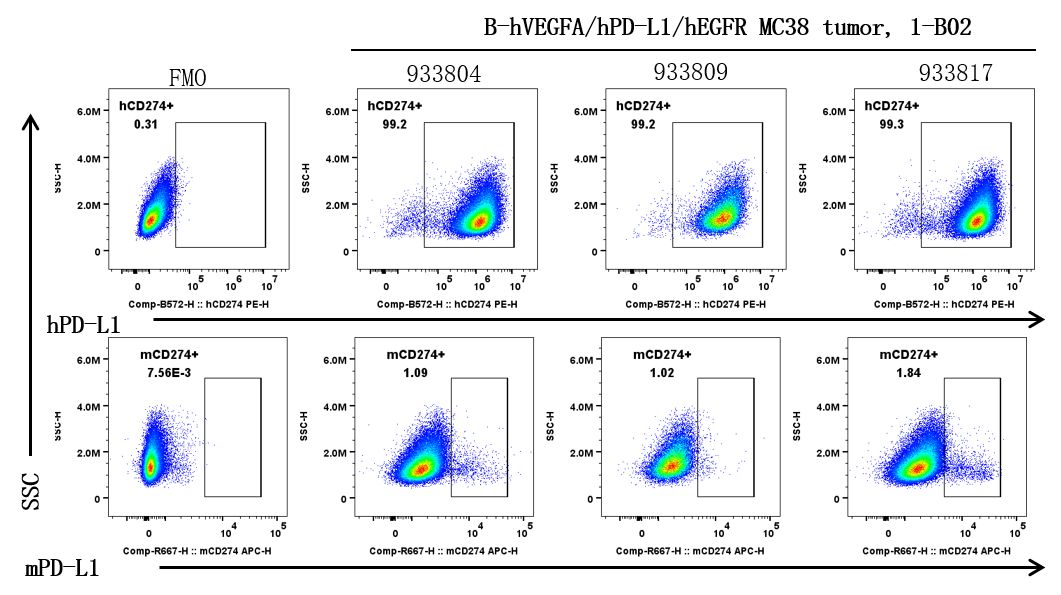
      • Human PD-L1 was detected on the surface of B-hVEGFA/hPD-L1/hEGFR MC38 tumors but not wild-type MC38 cells.

      PD-L1 expression was evaluated​​ on B-hVEGFA/hPD-L1/hEGFR MC38​​ by flow cytometry. ​​These cells​​ were subcutaneously transplanted into B-hPD-1 plus/hPD-L1/hEGFR mice (n=6). At the end of the experiment, tumor cells were harvested and ​​analyzed for both mouse and human PD-L1 expression​​ by flow cytometry. ​​

      EGFR Protein Expression Analysis of Tumor Tissue
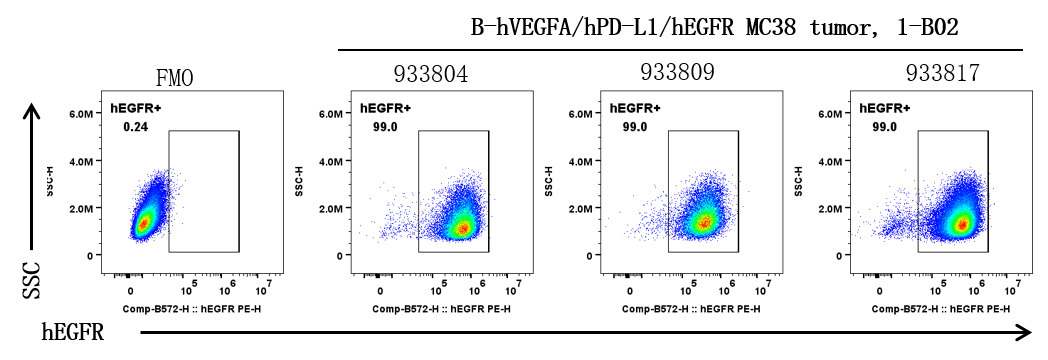
      • Human EGFR was detected on the surface of B-hVEGFA/hPD-L1/hEGFR MC38 tumors.

      EGFR expression was evaluated​​ on B-hVEGFA/hPD-L1/hEGFR MC38​​ by flow cytometry. ​​These cells​​ were subcutaneously transplanted into B-hPD-1 plus/hPD-L1/hEGFR mice (n=6). At the end of the experiment, tumor cells were harvested and ​​analyzed for human EGFR expression​​ by flow cytometry. ​​

      VEGFA Protein Expression Analysis of Tumor Tissue

      ​​Tumor cells were harvested at the end of ​​the​​ experiment and ​​assayed​​ for mouse and human VEGFA expression by ELISA. ​​ Tumor tissue was homogenized in PBS. The homogenate underwent three freeze-thaw cycles in liquid nitrogen, followed by centrifugation. The supernatant was collected, and the total protein concentration was determined by BCA assay and adjusted to 1 mg/mL. VEGFA levels in the tumor lysates samples were measured using the mouse VEGFA quantikine ELISA Kit (R&D, MMV00) and human VEGFA quantikine ELISA Kit (R&D, DVE00) according to the manufacturer's protocols. Values are expressed as mean±SEM.