

B-hTFR1/hCD98HC/hIGF1R plus mice

C57BL/6-Tfrctm1(TFRC)Bcgen Slc3a2tm1(SLC3A2)Bcgen Igf1rtm5(IGF1R)Bcgen/Bcgen • 114637

B-hTFR1/hCD98HC/hFcRn mice
B-hTFR1/hCRBN mice

B-hTFR1/hCD98HC/hIGF1R plus mice

Catalog Number: 114637
Strain Name: C57BL/6-Tfrctm1(TFRC)Bcgen Slc3a2tm1(SLC3A2)Bcgen Igf1rtm5(IGF1R)Bcgen/Bcgen
Strain Background: C57BL/6
NCBI gene ID: 7037,6520,3480 (Human)
Aliases: T9; TR; TFR; p90; CD71; TFR1; TRFR; IMD46; 4F2; CD98; MDU1; 4F2HC; 4T2HC; NACAE; CD98HC; IGFR; CD221; IGFIR; JTK13
---
Licensing option available
B-hTFR1/hCD98HC/hIGF1R plus mice

on this page

  • Description
  • Targeting strategy
  • Phenotypic analysis

Posters

View All

    Publication

      Description

      TFR1: Target for Drug Delivery Across the BBB

      • TfR1: Receptor for transferrin, mediates iron transport via transcytosis, and maintains brain iron homeostasis
      • Highly enriched on brain endothelial cells in the BBB
      • Serves as a target for enhancing drug delivery across the BBB
      CD98HC: Promising Target for Brain Drug Delivery Across Blood Brain Barrier (BBB)
      • Highly expressed on brain endothelial cells, enabling selective engagement for CNS delivery.
      • Facilitates transcytosis, offering a mechanism to transport therapeutic agents across the BBB.
      • Demonstrated potential in preclinical models for enhancing CNS penetration of biologics without compromising BBB integrity.
      IGF1R: A pivotal receptor kinase in proliferation and its targetedtherapeutic blockade
      • Gene Information: Human IGF1R maps to chromosome 15q26.3,containing 21 exons encoding a heterotetrameric receptor precursor.
      • Protein Expression: IGF1R is ubiquitously expressed across mosthuman tissues, highly abundant in brain, lung, epithelium andtumor cells. It maintains low basal levels in mature organs but ismarkedly upregulated in proliferative, fibrotic and malignantlesions for cell survival
      • Signaling Pathway: Upon IGF-1/IGF-2 binding, IGF1R activatesPI3K/Akt and RAS/MAPK cascades, driving cell proliferation, anti-apoptosis and matrix remodeling.
      • Therapeutic Inhibition: Anti-IGF1R neutralizing antibodies, small-molecule kinase inhibitors and IGF ligand traps block receptoractivation to suppress tumor growth and tissue fibrosis. Combinedchemo- or targeted therapy improves efficacy, while drug resistanceremains a key clinical limitation under investigation.
      Targeting Strategy

      TFR1:

      The exons 4 19 of mouse Tfr1 gene that encode extracellular domain are replaced by human counterparts.

      The genomic region of mouse Tfr1 gene that encodes cytoplasmic portion is retained. The promoter, 5’UTR and 3’UTR region of the mouse gene are also retained.

      The chimeric TFR1 expression is driven by endogenous mouse Tfr1 promoter, while mouse Tfr1 gene transcription and translation will be disrupted.

      CD98HC:

      The exons 2 10 of mouse CD98HC gene that encode extracellular domain are replaced by human CD98HC exons 4 12.

      The genomic region of mouse CD98HC gene that encodes cytoplasmic portion is retained. The promoter, 5’UTR and 3’UTR region of the mouse gene are also retained.

      The chimeric CD98HC expression is driven by endogenous mouse CD98HC promoter, while mouse CD98HC gene transcription and translation will be disrupted.

      IGF1R:

      A chimeric CDS that encodes mouse Igf1r signal peptide and human extracellular domain, human transmembrane and mouse cytoplasmic domain, as well as mouse 3’UTR regionwere inserted right after mouse Igf1r exon 2 to replace the exon 2 of mouse Igf1r gene.

      The chimeric IGF1R protein expression will be driven by endogenous mouse Igf1r promoter, while mouse Igf1r gene transcription and translation will be disrupted.

      B-hTFR1/hCD98HC/hIGF1R plus mice were obtained by mating B-hTFR1 mice (110861), B-hCD98HC mice (110983) and B-hIGF1R mice plus (111974).

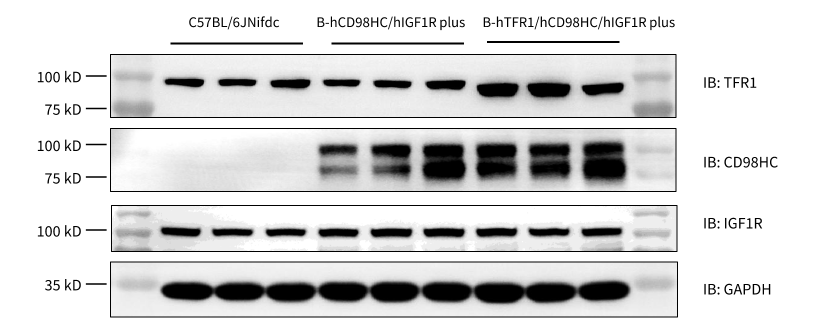
      Protein Expression Analysis in Cortex
      • TFR1 and IGF1R were both detected in wild-type mice and humanized B-hTFR1/hCD98HC/hIGF1R plus mice, as the antibody was cross-reactive between human and mouse. 
      • CD98HC was exclusively detected in humanized B-hCD98HC/hIGF1R plus mice and homozygous B-hTFR1/hCD98HC/hIGF1R plus mice.

      Strain-specific TFR1, CD98HC and IGF1R expression analysis in wild-type C57BL/6JNifdc mice, homozygous B-hCD98HC/hIGF1R plus mice and homozygousB-hTFR1/hCD98HC/hIGF1R plus mice. Cortex lysates were collected from wild-type C57BL/6JNifdc mice (+/+), homozygous B-hCD98HC/hIGF1R plus mice andhomozygous B-hTFR1/hCD98HC/hIGF1R plus mice, and then analyzed by western blot with anti-transferrin receptor antibody (abcam, ab214039), anti-CD98antibody (abcam, ab307587) and anti-IGF1R antibody (CST, 3027). 30 μg total proteins were loaded for western blotting analysis.

      * When publishing results obtained using this animal model, please acknowledge the source as follows: The animal model [B-hTFR1/hCD98HC/hIGF1R plus mice] (Cat# 114637) was purchased from Biocytogen.