Description
- TL1A binds to death receptor 3 (DR3) to provide stimulatory signals for downstream signaling pathways, thereby regulating the proliferation, activation, apoptosis of effector cells, and the production of cytokines and chemokines. Soluble decoy receptor 3 (DcR3) may neutralize the effects of soluble TL1A (sTL1A)/DR3. In addition, DcR3 can inhibit apoptosis, reduce inflammation, and prevent tissue damage by neutralizing LIGHT and FasL.
- LIGHT is a type 2 transmembrane protein and a member of the tumor necrosis factor ligand superfamily, which is upregulated on activated T cells (particularly CD8+ cells). It is a ligand for a variety of proteins, including herpesvirus entry mediator (HVEM), tumor necrosis factor receptor-like-2 ligand, TR2 ligand, tumor necrosis factor ligand superfamily member 14 (TNFSF14), LTβR and has also been shown to bind DcR3 and modulate function. This protein has been shown to play a role in intestinal inflammation and contribute to IgA nephropathy.
- The genome of the mouse Tl1a gene encoding the extracellular domain was replaced with human TL1A counterpart in B-hTL1A/hLIGHT mice. The genome of the mouse LIGHT gene encoding the extracellular domain was replaced with human LIGHT counterpart in B-hTL1A/hLIGHT mice.
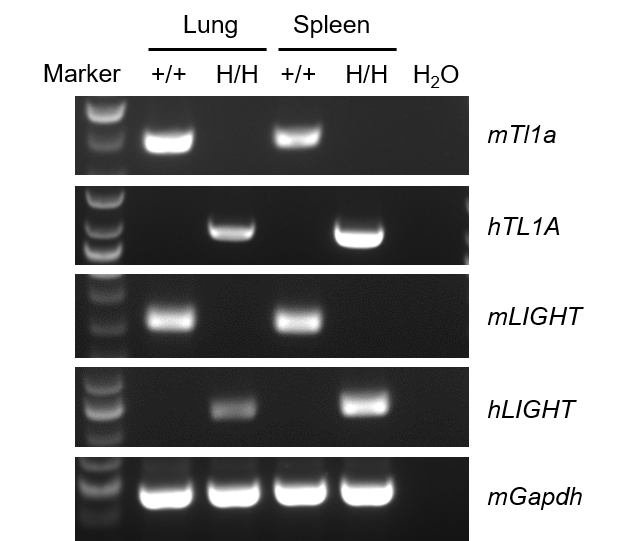
- Mouse Tl1a and LIGHT mRNA were detectable in lung and spleen of wild-type C57BL/6N mice. Human TL1A and LIGHT mRNA were exclusively detectable in lung and spleen of homozygous B-hTL1A/hLIGHT mice but not in wild-type C57BL/6N mice.
- Human TL1A, and LIGHT protein were only detectable in homozygous B-hTL1A/hLIGHT mice.
- This product is used for the evaluation of the pharmacodynamics and safety of anti-human TL1A/LIGHT antibodies in autoimmune diseases such as inflammatory bowel disease.
Targeting strategy
Gene targeting strategy for B-hTL1A/hLIGHT mice.
- The exons 1-4 of mouse Tl1a gene that encode extracellular domain were replaced by human counterparts in B-hTL1A/hLIGHT mice. The genomic region of mouse Tl1a gene that encodes transmembrane domain and cytoplasmic portion was retained. The promoter, 5’UTR and 3’UTR region of the mouse gene were also retained. The chimeric TL1A expression was driven by endogenous mouse Tl1a promoter, while mouse Tl1a gene transcription and translation will be disrupted.
- The exons 1-4 of mouse LIGHT gene that encode extracellular domain were replaced by human counterparts in B-hTL1A/hLIGHT mice. The genomic region of mouse LIGHT gene that encodes transmembrane domain and cytoplasmic portion was retained. The promoter, 5’UTR and 3’UTR region of the mouse gene were also retained. The chimeric LIGHT expression was driven by endogenous mouse LIGHT promoter, while mouse LIGHT gene transcription and translation will be disrupted.
Protein expression analysis-hLIGHT
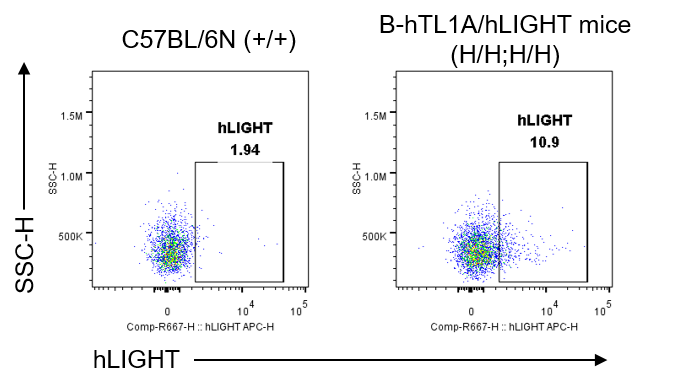
Strain specific LIGHT expression analysis in homozygous B-hTL1A/hLIGHT mice by flow cytometry. Splenocytes were collected from wild-type C57BL/6N mice (+/+) and homozygous B-hTL1A/hLIGHT mice (H/H;H/H) stimulated with anti-mCD3ε, anti-mCD28 and mouse IL-2 in vitro for 24h, and analyzed by flow cytometry with species-specific anti-LIGHT antibody (Biolegend, 318709). Human LIGHT was exclusively detectable on CD8+T cells in homozygous B-hTL1A/hLIGHT mice but not in wild-type C57BL/6N mice.
Protein expression analysis-hTL1A
Strain specific TL1A expression analysis in homozygous B-hTL1A/hLIGHT mice by ELISA. Bone marrow-derived dendritic cells were isolated from wild-type C57BL/6N mice (+/+) and homozygous B-hTL1A/hLIGHT mice (H/H;H/H) and stimulated with 1 μg/mL LPS in vitro for 24 h, then cell supernatants were collected and analyzed by ELISA (anti-human TL1 ELISA kit: R&D, DY1319-05). Human TL1A was exclusively detectable in homozygous B-hTL1A/hLIGHT mice but not in wild-type C57BL/6N mice.
mRNA expression analysis
Strain specific analysis of TL1A/LIGHT mRNA expression in wild-type C57BL/6N mice and B-hTL1A/hLIGHT mice by RT-PCR. Spleen and lung RNA were isolated from wild-type C57BL/6N mice (+/+) and homozygous B-hTL1A/hLIGHT mice (H/H;H/H), then cDNA libraries were synthesized by reverse transcription, followed by PCR with mouse or human TL1A/LIGHT primers. Mouse Tl1a/LIGHT mRNA were only detectable in wild-type mice. Human TL1A/LIGHT mRNA were exclusively detectable in homozygous B-hTL1A/hLIGHT mice but not in wild-type C57BL/6N mice.
Functional analysis
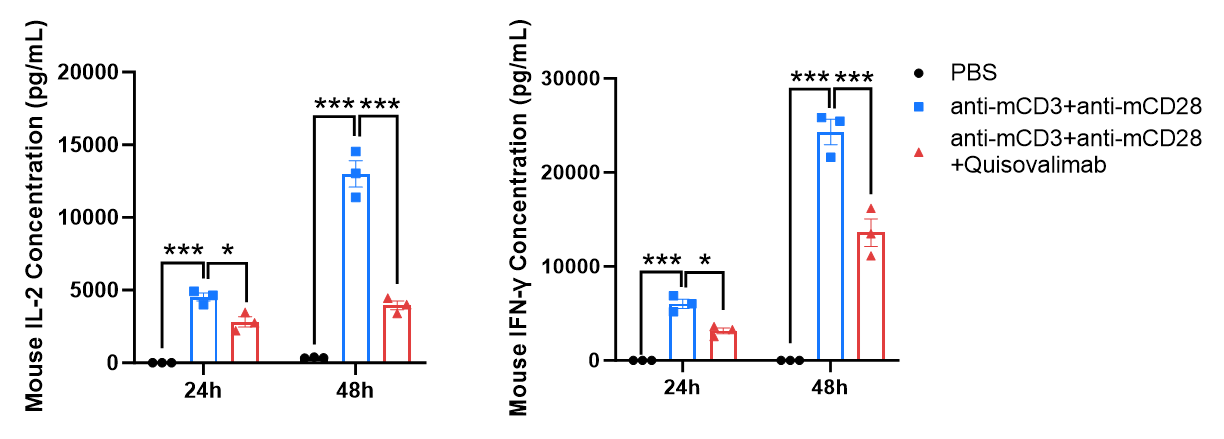
Mouse IL-2 and IFN-γ expression analysis in homozygous B-hTL1A/hLIGHT mice by ELISA. T cells (2×10⁵) were isolated from the splenocytes of B-hTL1A/hLIGHT mice, then T cells were cultured on anti-mCD3ε antibody (2 μg/mL, BioXcell, BE0001-2) and anti-mCD28 antibody (5 μg/mL, BioXcell,BE0015-1) pre-coated plates, and stimulated with 10 μg/mL anti-LIGHT antibody Quisovalimab (commercially purchased) at 37℃. The cell supernatant was collected at time points of 24 h and 48 h for ELISA analysis of mouse IL-2 (Biolegend, 431004) and IFN-γ (Biolegend, 430807). The stimulation with anti-mCD3ε antibody and anti-mCD28 antibody could promote the production of mouse IL-2 and IFN-γ. Quisovalimab could inhibit the expression of mouse IL-2 and IFN-γ in homozygous B-hTL1A/hLIGHT mice stimulated with anti-mCD3ε antibody and anti-mCD28 antibody, indicating that blocking the signal transduction of LIGHT could inhibit the activation of T cells.
* When publishing results obtained using this animal model, please acknowledge the source as follows: The animal model [B-hTL1A/hLIGHT mice] (Cat# 114006) was purchased from Biocytogen.