B-hCD3EDG/hCD19 ad mice

C57BL/6-Cd3etm1(CD3E)Bcgen Cd3dtm1(CD3D)BcgenCd3gtm1(CD3G)Bcgen Cd19tm7(CD19)Bcgen/Bcgen • 114862

B-hCD3EDG/hCAIX mice
B-hCD3EDG/hCD19 ad mice(C)

B-hCD3EDG/hCD19 ad mice

Catalog Number: 114862
Strain Name: C57BL/6-Cd3etm1(CD3E)Bcgen Cd3dtm1(CD3D)BcgenCd3gtm1(CD3G)Bcgen Cd19tm7(CD19)Bcgen/Bcgen
Strain Background: C57BL/6
NCBI gene ID: 916,915,917,930 (Human)
Aliases: T3E; TCRE; IMD18; CD3epsilon; T3D; IMD19; CD3DELTA; CD3-DELTA; T3G; IMD17; CD3GAMMA; CD3-GAMMA; B4; CVID3
---
Licensing option available
B-hCD3EDG/hCD19 ad mice

on this page

  • Description
  • Phenotypic analysis
  • Efficacy

Posters

View All

    Publication

      Description

      CD3×CD19 Bispecific Antibody-Based Therapy

      • Gene Information: CD3: Encoded by CD3E, D, G; part of the Ig superfamily. It forms the essential signaling backbone of the T-cell receptor (TCR) complex. CD19: is a transmembrane glycoprotein, located on chromosome 16p11.2. It belongs to the immunoglobulin superfamily and plays a critical role in B-cell development, activation, and maintenance throughout the immune system.
      • Protein Expression: CD3: Constitutive and universal marker for all mature T cells (CD4+, CD8+). Always present on the cell surface. CD19: is expressed almost exclusively on B-lineage cells, beginning at the early B-cell stage and persisting through mature B cells. Its expression is typically absent or markedly reduced in plasma cells.
      • Signaling Pathway: CD3: Operates via ITAM phosphorylation and ZAP-70. It triggers the initial "on" switch, Ca2+ flux, and immediate cytotoxicity. CD19: a key co-receptor of the B-cell receptor (BCR) complex. By interacting with molecules such as CD21 and CD81, it amplifies BCR-mediated signaling and activates downstream pathways including PI3K/AKT and MAPK/ERK.
      • Therapeutic Inhibition: CD3×CD19 bispecific antibodies recruit and activate T cells by simultaneously binding CD3 on T cells and CD19 on B cells, leading to targeted killing of CD19-positive malignant cells. This approach has demonstrated strong clinical efficacy in B-cell malignancies, with Blinatumomab being the first approved CD3×CD19 bispecific antibody. Ongoing efforts aim to improve efficacy, durability, and safety.
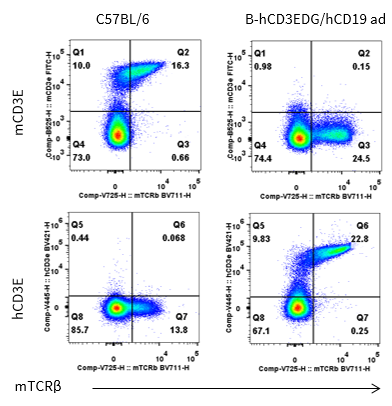
      CD3E Protein Expression in Spleen
      • Mouse CD3E was detected on T cells populations in wild-type C57BL/6 mice, but not in B-hCD3EDG/hCD19 ad mice.
      • Human CD3E was detected on T cells populations in B-hCD3EDG/hCD19 ad mice, but not in wild-type C57BL/6 mice.

      Mouse and human CD3E expression analysis in splenocytes. Splenocytes were collected from wild-type C57BL/6 mice and homozygous B-hCD3EDG/hCD19 ad mice (female, 8-week-old, n = 1). CD3E expression on T cells was analyzed by flow cytometry using species-specific anti-CD3E antibodies (anti-human CD3E antibody, BD Horizon, 562426; anti-mouse CD3E antibody, Biolegend, 100312 ).
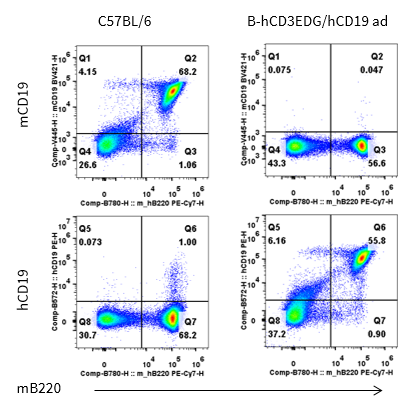
      CD19 Protein Expression in Spleen
      • Mouse CD19 was detected on B cells populations in wild-type C57BL/6 mice, but not in B-hCD3EDG/hCD19 ad mice.
      • Human CD19 was detected on B cells populations in B-hCD3EDG/hCD19 ad mice, but not in wild-type C57BL/6 mice.

      Mouse and human CD19 expression analysis in splenocytes. Splenocytes were collected from wild-type C57BL/6 and homozygous B-hCD3EDG/hCD19 ad mice (female, 8-week-old, n = 1). CD19 expression on B cells was analyzed by flow cytometry using species-specific anti-CD19 antibodies (anti-human CD19 antibody, BD Horizon, 302208; anti-mouse CD19 antibody, Biolegend, 115538 ).
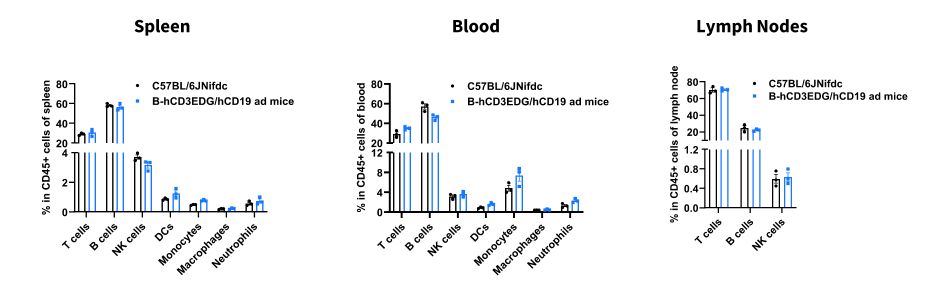
      Analysis of Leukocyte Subpopulations
      • The percentages of T cells, B cells, NK cells, DCs, neutrophils, monocytes, and macrophages in homozygous B-hCD3EDG/hCD19 ad mice were similar to those in C57BL/6 mice.
      • Humanization of CD3EDG and CD19 does not affect normal immune cell development or distribution.

      Analysis of leukocyte subpopulations by flow cytometry in immune organs and blood. Splenocytes, peripheral blood, and lymph nodes were isolated fromC57BL/6 and B-hCD3EDG/hCD19 ad mice (female, n=3, 8-week-old). Single live cells were gated on the mCD45⁺ population and analyzed by flow cytometry asindicated. Values are expressed as mean ± SEM.
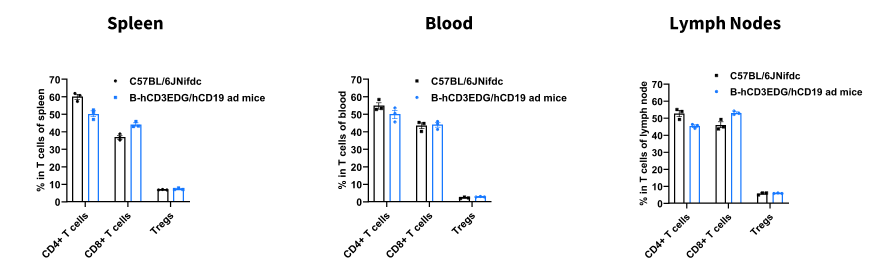
      Analysis of T Cell Subpopulations
      • The proportions of CD4⁺ T cells, CD8⁺ T cells, and Tregs in homozygous B-hCD3EDG/hCD19 ad mice were comparable to those in C57BL/6 mice.
      • Humanization of CD3EDG and CD19 does not affect normal T cell development, differentiation, or distribution.

      Analysis of T-cell subpopulations by flow cytometry in immune organs and blood. Splenocytes, peripheral blood, and lymph nodes were isolated fromC57BL/6 and B-hCD3EDG/hCD19 ad mice (female, n=3, 8-week-old). Single live cells were gated on the mTCRβ⁺ T-cell population and analyzed by flowcytometry as indicated. Values are expressed as mean ± SEM.

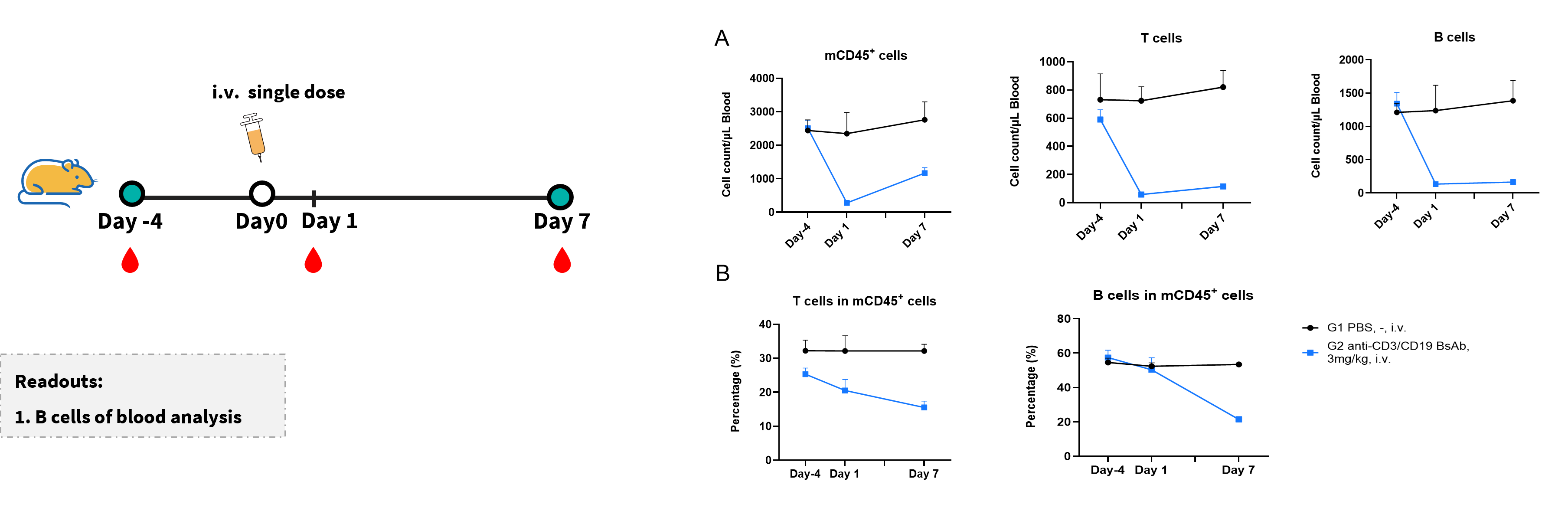
      In vivo B cell Depletion

      In vivo B cell depletion of anti-human CD3/CD19 bispecific antibody (BsAb) in homozygous B-hCD3EDG/hCD19 ad mice. Anti–human CD3/CD19 bispecific antibody and PBS were administered into B-hCD3EDG/hCD19 ad mice (G1:n=2; G2: n=3) through a single dose injection. Blood  were collected at Day-4, Day1, and Day7 after treatment. The numbers and the frequency of mCD45+ cells, B cells (mB220+) and T cells (mTCRβ+) were determined by flow cytometry. (A) The number of CD45+ cells, B cells and T cells in blood. (B) The proportion of T and B cells in the CD45+Ly6G- cells. Values are expressed as mean ± SEM.
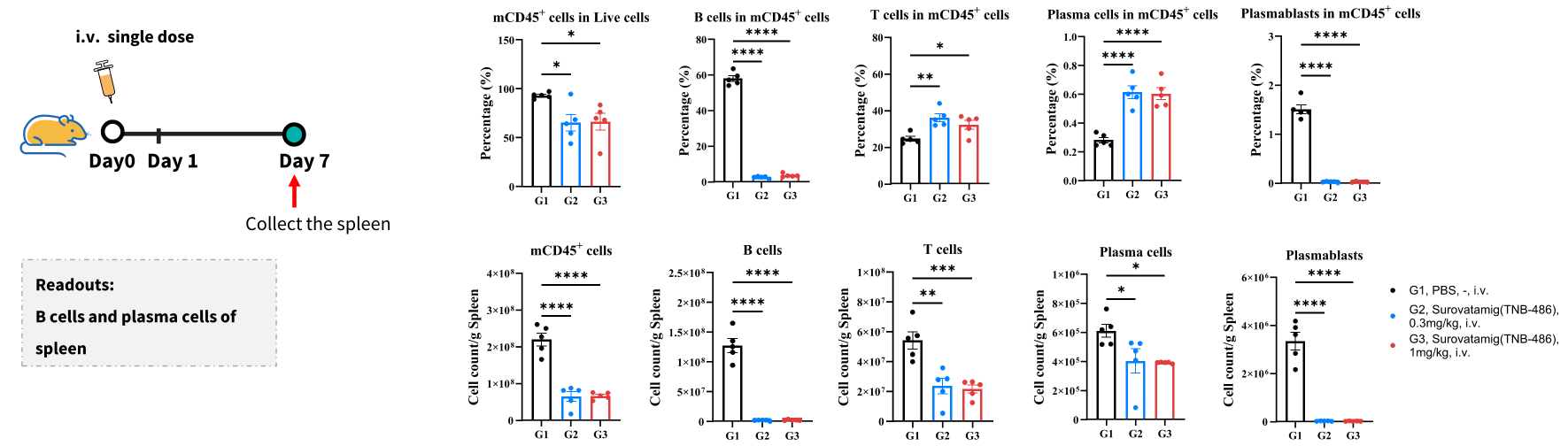
      In vivo B Cells and Plasma Cells Depletion

      In vivo B-cell and plasma cells depletion by anti-human CD3/CD19 bispecific antibodies (Surovatamig analog, Synonyms: AZD0486 or TNB-486) in B-hCD3EDG/hCD19 ad mice. Bispecific antibodies or PBS were administered as a single dose to B-hCD3EDG/hCD19 ad mice (n=5). Spleens were harvested on day 7 post-treatment. The frequency and absolute numbers of mCD45⁺ cells, B cells, T cells, plasma cells, and plasmablasts were quantified by flow cytometry. Data are presented asmean ± SEM and analyzed by one-way ANOVA followed by Dunnett’s multiple comparisons test versus the PBS control group (*p<0.05, **p<0.01, ***p<0.001,****p<0.0001).
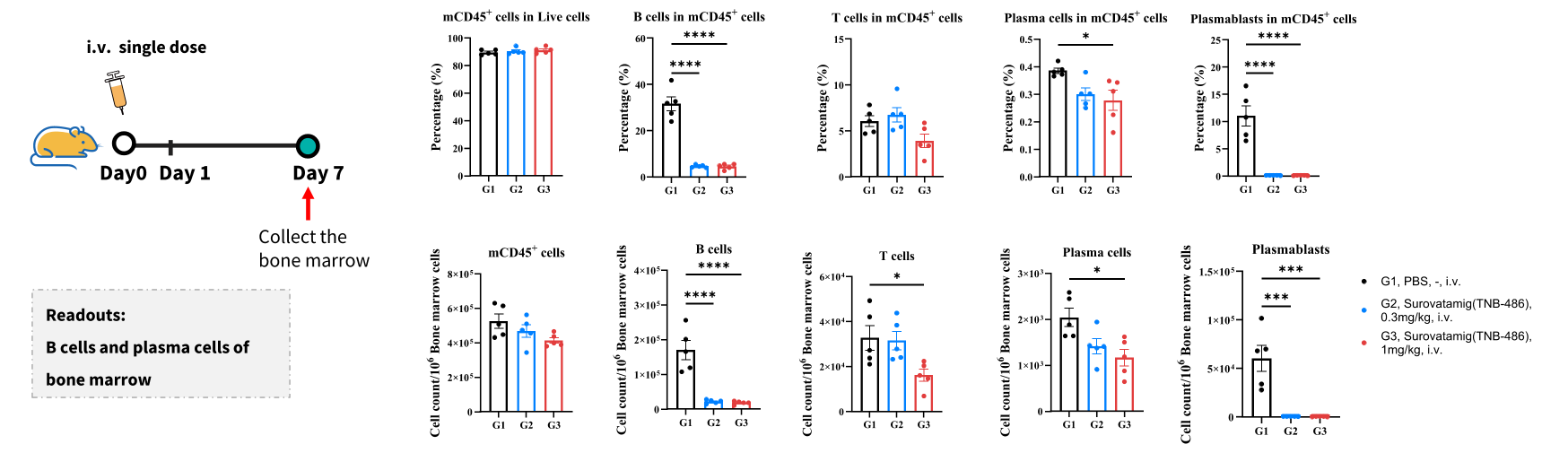
      In vivo B-cell and plasma cells depletion by anti-human CD3/CD19 bispecific antibodies (Surovatamig analog, Synonyms: AZD0486 or TNB-486) in B-hCD3EDG/hCD19 ad mice. Bispecific antibodies or PBS were administered as a single dose to B-hCD3EDG/hCD19 ad mice (n=5). Bone marrow cells were harvested on day7 post-treatment. The frequency and absolute numbers of mCD45⁺ cells, B cells, T cells, plasma cells, and plasmablasts were quantified by flow cytometry. Data arepresented as mean ± SEM and analyzed by one-way ANOVA followed by Dunnett’s multiple comparisons test versus the PBS control group (*p<0.05, **p<0.01,***p<0.001,****p<0.0001).

      * When publishing results obtained using this animal model, please acknowledge the source as follows: The animal model [B-hCD3EDG/hCD19 ad mice] (Cat# 114862) was purchased from Biocytogen.