

C57BL/6-Cd40tm1(CD40)BcgenCd40lgtm1(CD40LG)BcgenFcgrttm1(FCGRT)Bcgen /Bcgen • 115012

CD40/CD40L: A key costimulatory axis in adaptive immunity and its therapeutic intervention
Gene Information: CD40 is a protein-coding gene located on chromosome 20q13.12, encoding a cell surface receptor that belongs to the tumor necrosis factor receptor (TNFR) superfamily. Its corresponding ligand, CD40L (CD154), is encoded by a gene situated on chromosome Xq26.3 and is a member of the TNF superfamily.
Protein Expression: CD40 is constitutively expressed primarily by antigen-presenting cells (APCs) including B cells, dendritic cells, and macrophages, as well as endothelial cells. CD40L is predominantly and transiently expressed on the surface of activated T helper cells and platelets during an immune response.
Signaling Pathway: CD40L exerts its effects by binding as a functional homotrimer to CD40 receptors on target cells, inducing receptor clustering. This interaction recruits intracellular tumor necrosis factor receptor-associated factors (TRAFs), activating downstream canonical/non-canonical NF-κB and MAPK pathways to drive B cell activation, antibody class switching, and macrophage differentiation.
Therapeutic Intervention: By selectively modulating this costimulatory axis, antagonistic therapeutics (such as dapirolizumab or frexalimab) block CD40/CD40L binding to inhibit pathogenic autoantibody production and systemic inflammation in autoimmune diseases like lupus or multiple sclerosis. Alternatively, agonistic anti-CD40 antibodies (such as selicrelumab) are utilized in immuno-oncology to "license" dendritic cells and unleash cell-mediated anti-tumor immunity.

CD40
The exons 2-7 of mouse Cd40 gene that encodes the extracellular region were replaced by human CD40 exons 2-7 in B-hCD40/hCD40L/hFcRn mice.
CD40L
The exons 2-5 of mouse Cd40l gene that encode the extracellular region were replaced by human CD40L exons 2-5 in B-hCD40/hCD40L mice.
FcRn
B-hCD40/hCD40L/hFcRn Mice were obtained by mating B-hCD40/hCD40L Mice (121335) and B-hFcRn Mice (110001).

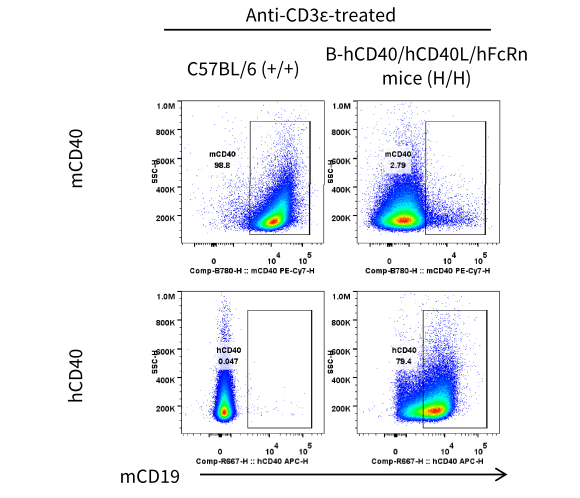
Strain specific analysis of CD40 expression in homozygous B-hCD40/hCD40L/hFcRn mice by flow cytometry. Splenocytes were collected from C57BL/6 mice(+/+;+/+) and homozygous B-hCD40/hCD40L/hFcRn mice (H/H;H/H) stimulated with anti-mouse CD3ε antibody (7.5 μg, i.p.) in vivo for 24 hr, and analyzed by flow cytometry with species-specific anti-CD40 antibody. Mouse CD40 was detectable in wild-type mice. Human CD40 was exclusively detectable in homozygous B-hCD40/hCD40L/hFcRn mice but not in wild-type mice.
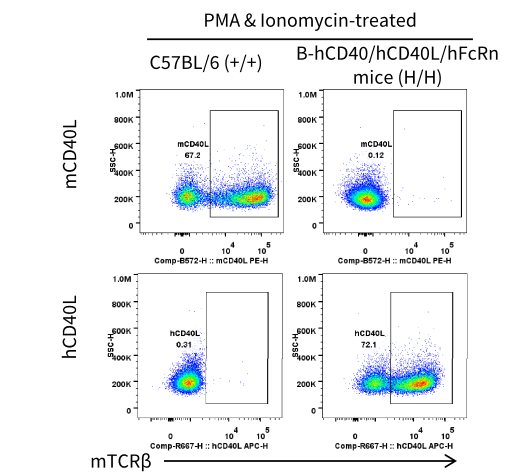
Strain specific CD40L expression analysis in wild-type C57BL/6 mice and homozygous B-hCD40/hCD40L/hFcRn mice by flow cytometry. Splenocytes were collected from wild-type C57BL/6 mice(+/+) and homozygous B-hCD40/hCD40L/hFcRn mice (H/H;H/H;H/H) and stimulated with PMA & Ionomycin. Protein expression was analyzed with anti-mouse CD40L antibody (Biolegend, 106509) and anti-human CD40L antibody (Biolegend, 310805) by flow cytometry. Mouse CD40L was detectable in wild-type C57BL/6 mice. Human CD40L was exclusively detectable in homozygous B-hCD40/hCD40L/hFcRn mice but not in wild-type C57BL/6 mice.
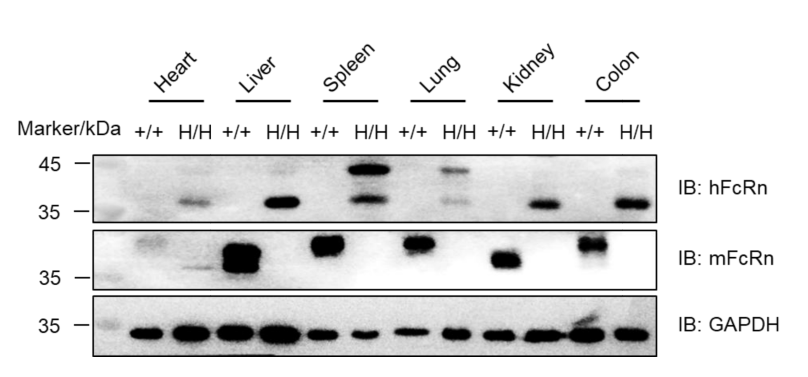
Strain specific analysis of FcRn expression in homozygous B-hCD40/hCD40L/hFcRn mice by western blot. Heart, liver, spleen, lung, kidney, and colon were collected from C57BL/6 mice (+/+;+/+) and homozygous B-hCD40/hCD40L/hFcRn mice (H/H;H/H;H/H) and analyzed by western blot with species-specific anti-FcRn antibody. Mouse FcRn was detectable in wild-type mice. Human FcRn was detectable only in homozygous B-hCD40/hCD40L/hFcRn mice but not in wild-type mice.