Description
- Growth hormone receptor (GHR): A key receptor in growth regulation and its therapeutic intervention.
- Gene Information: GHR encodes a type I cytokine receptor superfamily member with a transmembrane architecture. The gene is localized at chromosome 5p13-p12 and its protein product is expressed at the cell surface and plasma membrane.
- Protein Expression: GHR protein is highly expressed in theproximal digestive tract and gastrointestinal tract, with abundant RNA transcripts detected in adipose tissue, the hepatobiliary system, and the female reproductive system.
- Signaling Pathway: GHR transmits signals via growth hormone-induced dimerization, activating STAT5, MAPK, and PI3K-AKT cascades that regulate metabolism, proliferation, and growth.
- Therapeutic Inhibition: GHR is targeted by the antagonist pegvisomant (blocks dimerization/signaling, countering acromegaly) and agonists somapacitan/somatotropin (activate GHR for growth indeficiency states).
Key Advantages
- Intact Intracellular Signaling:Preserves the intact downstream intracellular signaling by retaining the mouse transmembrane domain and cytoplasmic portion.
- In Vivo Efficacy Evaluation:Suitable for preclinical pharmacodynamics studies of targeting-GHR therapeutics.
- Congenital Disease Phenotype:Stable congenital dwarf phenotype due to the inability of endogenous GH to activate the humanized receptor.
Key Applications
- Target & Pathway Validation:Appropriate for research on GHR-mediated STAT5, MAPK, and PI3K-AKT signaling axes that regulate metabolism, proliferation, and growth.
- Efficacy & Safety Evaluation:Supports efficacy and safety assessment of hGHR agonists therapies in disease models.
- Novel Therapeutic Screening:Support the discovery, screening, and optimization of new treatment strategies, leveraging a relevant humanized models for translational research.
Targeting Strategy
GHR
- The part of exon 2 and exon 3-8 of mouse Ghr gene that encode signal peptide and extracellular domain is replaced by human counterparts in B-hGHR mice.
- The genomic region of mouse Ghr gene that encodes transmembrane domain and cytoplasmic portion is retained. The promoter, 5’UTR and 3’UTR regions ofthe mouse gene are retained. The chimeric GHR expression is driven by the endogenous mouse Ghr promoter, while mouse Ghr gene transcription andtranslation will be disrupted.
mRNA Expression by RT-PCR
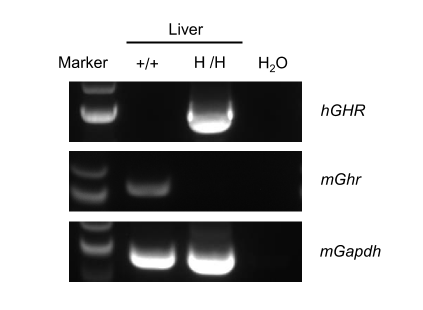
- Human GHR mRNA was exclusively detectable in homozygous B-hGHR mice, but not in wild-type mice.
Strain specific analysis of GHR mRNA expression in wild-type C57BL/6JNifdc mice and homozygous B-hGHR mice by RT-PCR. Liver RNAwere isolated from wild-type C57BL/6JNifdc mice (+/+) and homozygous B-hGHR mice (H/H), then cDNA libraries were synthesized by reversetranscription, followed by PCR with mouse or human GHR primers. Mouse Ghr mRNA was detectable only in wild-type C57BL/6JNifdc mice. HumanGHR mRNA was detectable only in homozygous B-hGHR mice but not in wild-type mice.
GHR Protein Expression Analysis
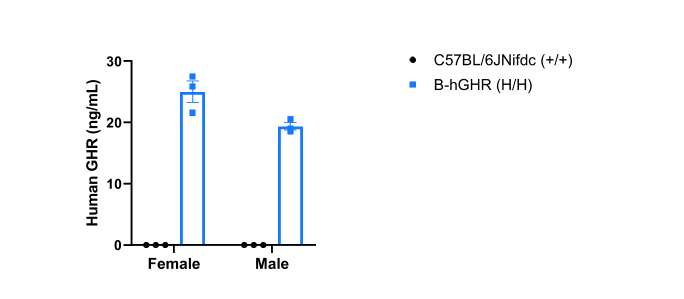
- Human GHR was detected only in homozygous B-hGHR mice, but not in wild-type mice.
Strain specific human GHR expression analysis in wild-type C57BL/6JNifdc mice and homozygous B-hGHR mice by ELISA. Serum were collectedfrom wild-type C57BL/6JNifdc mice (+/+, 8-week-old, n=3) and homozygous B-hGHR mice (H/H, 8-week-old, n=3), then analyzed by ELISA with species-specific human GHR SimpleStep ELISA® Kit (Growth Hormone Receptor) (Abcam, ab260060). Human GHR was exclusively detectable in homozygous B-hGHR mice but not in wide-type mice. Values are expressed as mean ± SEM.
Functional Validation
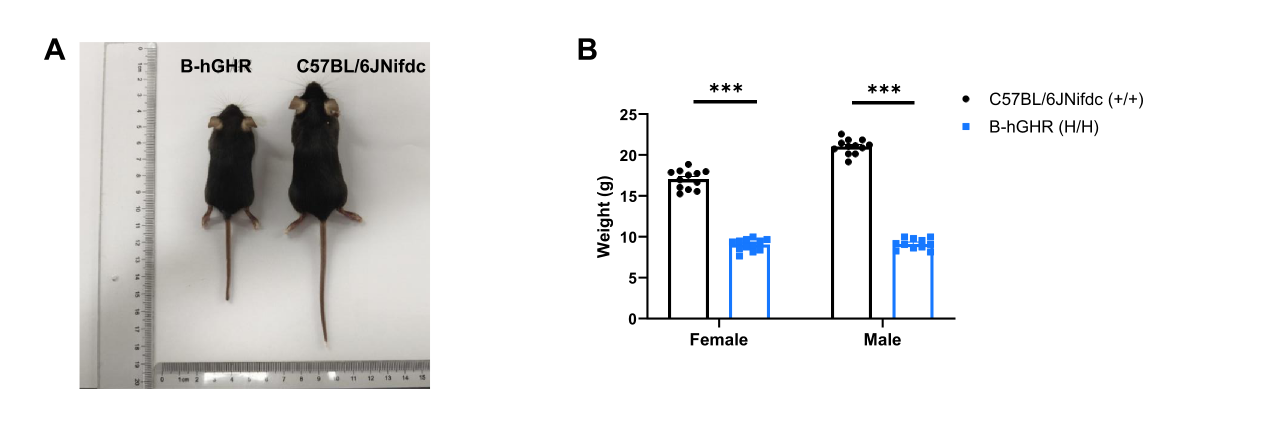
- B-hGHR Mice exhibit a phenotype of retarded growth and development.
Animal phenotypes in wild-type C57BL/6JNifdc mice and homozygous B-hGHR mice. (A) Photographs of wild-type C57BL/6JNifdc mice (Female, 8-week-old) and homozygous B-hGHR mice (Female, 8-week-old). (B) Body weight of wild-type C57BL/6JNifdc mice (5-week-old, n=12) and homozygous B-hGHR mice (5-week-old, n=12). Values are expressed as mean ± SEM.
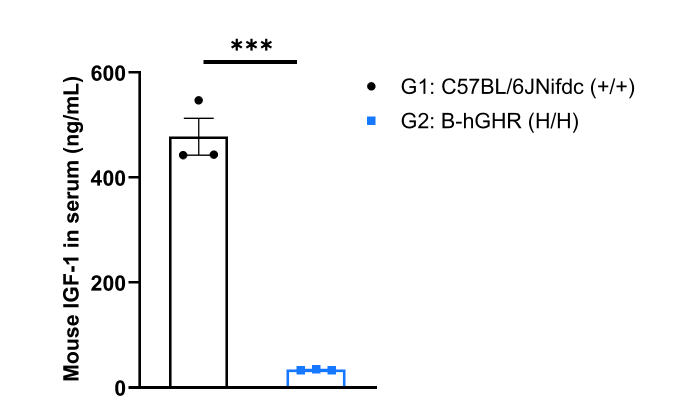
- Mouse IGF-1 was detected in wild-type C57BL/6JNifdc mice and homozygous B-hGHR mice.
- Serum mIGF-1 level in homozygous B-hGHR mice was significantly lower than that in wild-type mice.
Mouse IGF-1 expression analysis in wild-type C57BL/6JNifdc mice and homozygous B-hGHR mice by ELISA. Serum were collected from wild-typeC57BL/6JNifdc mice (Female, 6-week-old, n=3) and homozygous B-hGHR mice (Female, 6-week-old, n=3), then analyzed by ELISA with non-specificMouse/Rat IGF-I/IGF-1 Quantikine ELISA Kit (R&D, MG100). Serum IGF-1 level in homozygous B-hGHR mice was significantly lower than that in wild-typemice, consistent with a dwarf phenotype. Mouse IGF-1 was detected in wild-type C57BL/6JNifdc mice and homozygous B-hGHR mice. Values areexpressed as mean ± SEM.
* When publishing results obtained using this animal model, please acknowledge the source as follows: The animal model [B-hGHR mice] (Cat# 114408) was purchased from Biocytogen.