Description
Background:
- Hereditary angioedema (HAE) has three main types: type I, type II, and type III. Among them, types I and II are caused by mutations in the SERPING1 gene, resulting in deficiency (type I) or dysfunction (type II) of complement C1 inhibitor (C1-INH). Types I and II account for approximately 99% of all cases.
- The figure depicts the core regulatory role of C1 esterase inhibitor (C1-INH) in the kallikrein-kinin system (KKS): C1-INH controls KKS activation and bradykinin (BK) production by inhibiting FXII activation, plasma kallikrein (PK) activity, and the reciprocal activation between FXII and PK (including the plasmin-mediated amplification loop).
Targeting strategy:
- The exons 1-8 of the mouse Serping1 gene that encode the whole molecule were replaced by the exons 1-8 of the human counterparts. The promoter, 5’UTR and 3’UTR region of the mouse gene are also replaced by human counterparts. The human SERPING1 expression is driven by the human SERPING1 promoter, while the mouse Serping1 gene transcription and translation will be disrupted.
Verification:
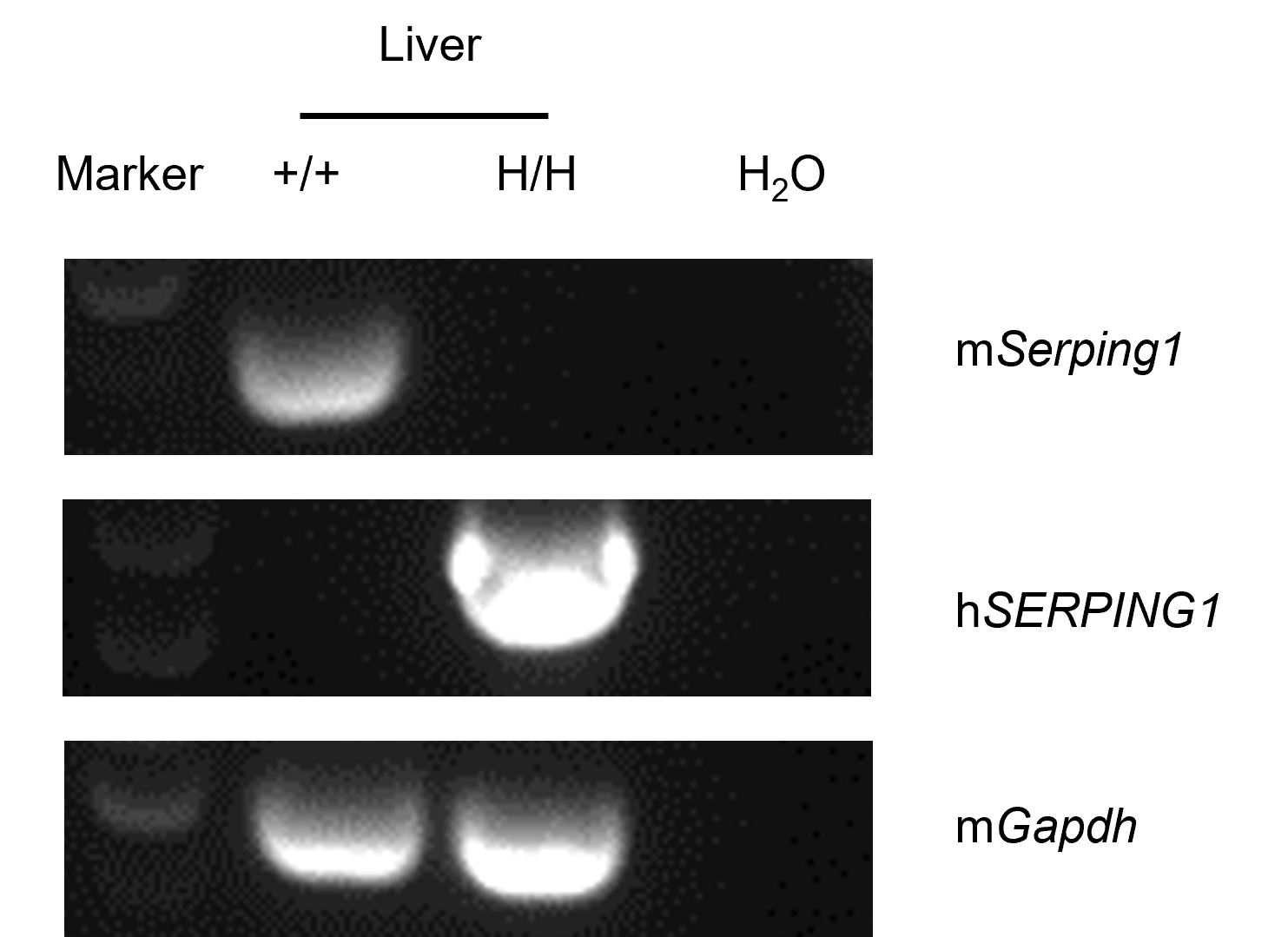
- Mouse Serping1 mRNA was detectable in wild-type mice but not B-hSERPING1 mice. Human SERPING1 mRNA was detectable only in homozygous B-hSERPING1 mice but not in wild-type mice.
- Human C1 inhibitor protein was detectable in homozygous B-hSERPING1 mice but not wild-type mice.
Application:
- This product can be used to study the drug screening and mechanism research of hereditary angioedema (HAE) and other related diseases, and study the complement system, coagulation abnormalities and the development of anti-inflammatory drugs.
Targeting strategy
Gene targeting strategy for B-hSERPING1 mice. The exons 1-8 of the mouse Serping1 gene that encode the whole molecule were replaced by the exons 1-8 of the human counterparts. The promoter, 5’UTR and 3’UTR region of the mouse gene are also replaced by human counterparts. The human SERPING1 expression is driven by the human SERPING1 promoter, while the mouse Serping1 gene transcription and translation will be disrupted.
mRNA expression analysis
Strain specific analysis of SERPING1 mRNA expression in wild-type C57BL/6JNifdc mice and B-hSERPING1 mice by RT-PCR. Liver RNA were isolated from wild-type C57BL/6JNifdc mice (+/+) and homozygous B-hSERPING1 mice (H/H), then cDNA libraries were synthesized by reverse transcription, followed by PCR with mouse Serping1 primers and human SERPING1 primers. Mouse Serping1 mRNA was only detectable in wild-type C57BL/6JNifdc mice. Human SERPING1 mRNA was only detectable in B-hSERPING1 mice but not in wild-type C57BL/6JNifdc mice.
Protein expression analysis in serum
Strain specific human C1 inhibitor expression analysis in homozygous B-hSERPING1 mice by ELISA. Serum were collected from wild-type mice C57BL/6JNifdc mice (+/+) (female, 6-week-old) and homozygous B-hSERPING1 mice (H/H) (female, 6-week-old), then analyzed by ELISA with species-specific human C1 inhibitor elisa ELISA (Human C1 inhibitor SimpleStep ELISA Kit: Abcam, ab224883). Human C1 inhibitor was exclusively detectable in B-hSERPING1 mice but not in C57BL/6JNifdc mice. Values are expressed as mean ± SEM.
* When publishing results obtained using this animal model, please acknowledge the source as follows: The animal model [B-hSERPING1 mice] (Cat# 113793) was purchased from Biocytogen.