
B-hCD16A*F158 mice plus(CB-17 SCID)

CB17/lcr-PrkdcscidFcgr4tm3(FCGR3A*F158)Bcgen/Bcgen • 113022

B-hCD16A mice(CB-17 SCID)
B-hCD16A/hNKP46 mice(CB-17 SCID)

B-hCD16A*F158 mice plus(CB-17 SCID)

Catalog Number
113022
Strain Name
CB17/lcr-PrkdcscidFcgr4tm3(FCGR3A*F158)Bcgen/Bcgen
Strain Background
CB-17 SCID
NCBI gene ID
246256 (Human)
Aliases
4833442P21Rik, CD16-2, FcgRIV, FcgammaRIV, Fcgr3a, Fcrl3

on this page

  • Description
  • Targeting strategy
  • Phenotypic analysis

Posters

View All

    Publication

      Description

      CD16A: A key Fc receptor in innate immune activation and therapeutic targeting 

      • Gene Information: CD16A is encoded by the FCGR3A gene on chromosome 1q23.1 and is a low-affinity activating Fcγ receptor for IgG. The V158F polymorphism modulates IgG binding affinity and clinical response to antibody therapies. The F158 variant is reported to confer a lower IgG affinity and weaker ADCC function compared with V158. 
      • Protein Expression: CD16A (FcγRIIIA) is mainly expressed on NK cells, as well as on monocytes, macrophages, DCs and γδ T cell subsets. It associates with FcRγ/CD3ζ adaptor chains that contain ITAM motifs. 
      • Signaling Pathway: Upon binding IgG-opsonized targets, CD16A clustering triggers ITAM phosphorylation via Src-family kinases, activating downstream signaling. This leads to NK-cell activation, cytokine release (e.g., IFN-γ, TNF-α), and ADCC via perforin/granzyme-mediated cytotoxicity. CD16A signaling can be downregulated by ADAM17-mediated shedding. 
      • Therapeutic Activation: Therapeutic strategies targeting CD16A aim to enhance Fc-mediated immune effector functions, particularly antibody-dependent cellular cytotoxicity (ADCC). Its activity can be enhanced by Fc-engineered antibodies and it serves as a key target for NK cell engagers.
      Targeting strategy

      CD16A*F158

      •  The exons 1-5 of mouse Fcgr4 gene that encode extracellular domain are replaced by human counterparts FCGR3A(F158) in B-hCD16A*F158 mice plus(CB-17 SCID). The genomic region of mouse Fcgr4 gene that encodes transmembrane domain and cytoplasmic portion is retained. 
      • The promoter and 5’UTR region of the mouse gene are replaced by human counterparts. The chimeric CD16A expression is driven by endogenous human CD16A promoter, while mouse Fcgr4 gene transcription and translation will be disrupted.
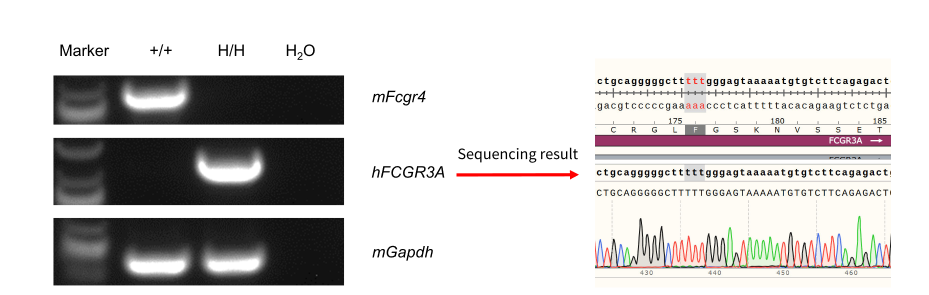
      FCGR3A mRNA Expression Analysis by RT-PCR

      Strain specific analysis of FCGR3A mRNA expression in wild-type CB-17 SCID and B-hCD16A*F158 mice plus (CB-17 SCID) by RT-PCR and sequencing. Spleen RNA were isolated from wild-type CB-17 SCID mice (+/+) and homozygous B-hCD16A*F158 mice plus (CB-17 SCID) (H/H), then cDNA libraries were synthesized by reverse transcription, followed by PCR with mouse Fcgr4 or human FCGR3A primers. Mouse Fcgr4 mRNA was only detectable in wild-type mice, human FCGR3A mRNA was exclusively detectable in homozygous B-hCD16A*F158 mice plus (CB-17 SCID) but not in wild-type mice. The F158 amino acid was confirmed via Sanger sequencing.
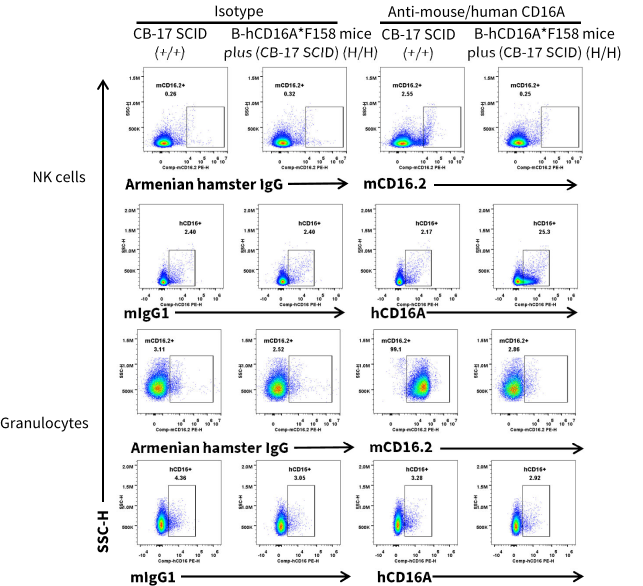
      CD16A Protein Expression Analysis

      Mouse and human CD16A expression analysis in multiple lymphocyte subtypes. Splenocytes were collected from wild-type CB-17 SCID mice(+/+) and homozygous B-hCD16A*F158 mice plus(CB-17 SCID) (H/H). CD16A expression on various types of immune cells was analyzed by flow cytometry using species-specific anti-mouse CD16.2 antibody (Biolegend, 149503) and anti-human CD16A antibody (BioLegend, 302008).
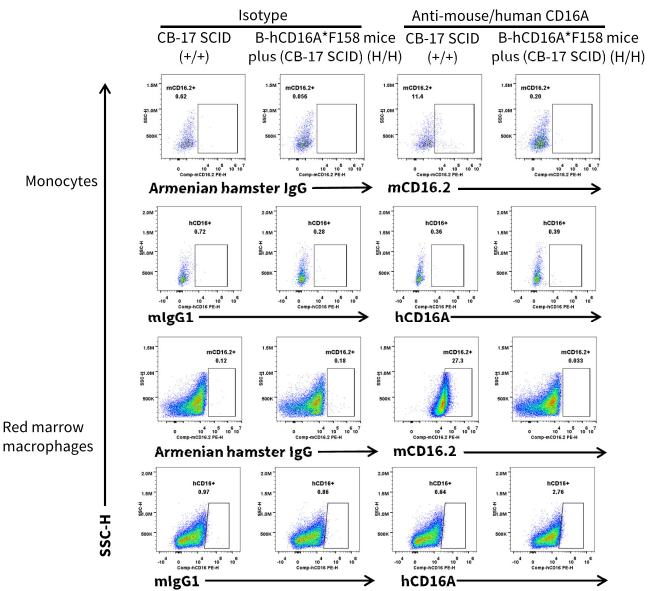
      Mouse and human CD16A expression analysis in multiple lymphocyte subtypes. Splenocytes were collected from wild-type CB-17 SCID mice(+/+) and homozygous B-hCD16A*F158 mice plus(CB-17 SCID) (H/H). CD16A expression on various types of immune cells was analyzed by flow cytometry using species-specific anti-mouse CD16.2 antibody (Biolegend, 149503) and anti-human CD16A antibody (BioLegend, 302008).
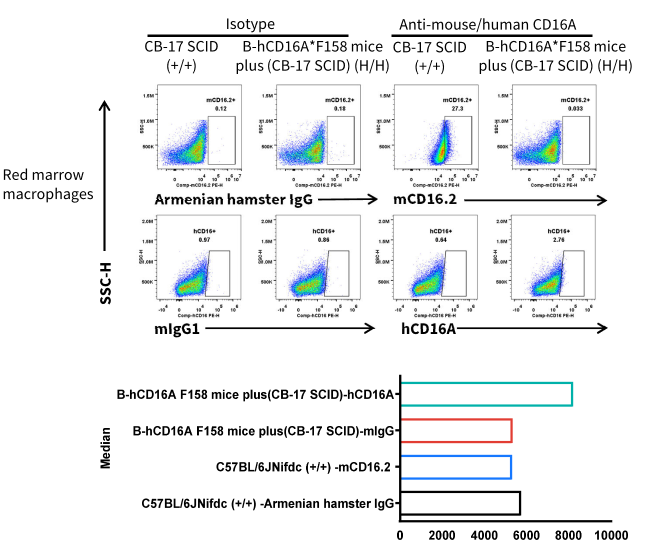
      Mouse and human CD16A expression analysis in red marrow macrophages. Splenocytes were collected from wild-type CB-17 SCID mice(+/+) and homozygous B-hCD16A*F158 mice plus(CB-17 SCID) (H/H). CD16A expression on various types of red marrow macrophages was analyzed by flow cytometry using species-specific anti-mouse CD16.2 antibody (Biolegend, 149503) and anti-human CD16A antibody (BioLegend, 302008). An increase of anti-human CD16A MFI was only seen in the homozygous B-hCD16A*F158 mice plus(CB-17 SCID) , confirming its low expression in the homozygous B-hCD16A*F158 mice plus(CB-17 SCID) .

      * When publishing results obtained using this animal model, please acknowledge the source as follows: The animal model [B-hCD16A*F158 mice plus(CB-17 SCID)] (Cat# 113022) was purchased from Biocytogen.