Description
MUC1: A tumor-associated antigen driving cancer progression and immune evasion
- Gene Information: MUC1 (Mucin 1) is a membrane-associated mucin encoded on human chromosome 1. It is highly expressed on epithelial surfaces and frequently overexpressed in many solid tumors.
- Protein Expression: MUC1 is normally expressed on the apical surface of epithelial cells in tissues such as the breast, lung, pancreas, and gastrointestinal tract. In cancer, MUC1 is often overexpressed and loses its polarized distribution.
- Signaling Pathway: The MUC1 cytoplasmic tail interacts with signaling molecules including β-catenin, EGFR, and NF-κB, promoting cell proliferation, survival, and metastasis. Aberrant MUC1 signaling contributes to tumor progression and immune suppression.
- Therapeutic Inhibition: Targeting MUC1 can inhibit tumor growth and enhance anti-tumor immunity. MUC1-directed therapies, including antibodies, ADCs, vaccines, CAR-T cells, and T-cell engagers, are being actively developed for cancer treatment.
Targeting strategy
MUC1
- Exons 1-7 of mouse Muc1 gene that encode signal peptide, extracellular domain, transmembrane domain, cytoplasmic region are replaced by human counterparts in B-hMUC1 mice.
- The promoter and 5’ and 3’ UTR region of the mouse gene are retained. The human MUC1 expression is driven by endogenous mouse Muc1 promoter, while mouse Muc1 gene transcription and translation will be disrupted.
mRNA Expression by RT-PCR
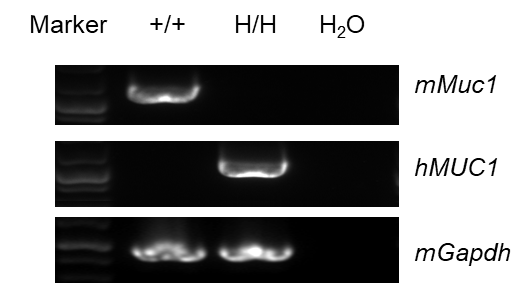
- Mouse Muc1 mRNA was detectable only in splenocytes of wild-type C57BL/6 mice.
- Human MUC1 mRNA was detectable only in homozygous B-hMUC1 mice, but not in wild-type mice.
mRNA MUC1 were detectable in B-hMUC1 mice by RT-PCR and sequencing. Liver tissues were isolated from wild-type C57BL/6 mice (+/+) and homozygous B-hMUC1 mice (H/H). Primers were designed to detect the human and mouse MUC1. Human MUC1 mRNA was detectable in B-hMUC1 mice, but not in wild-type mice. Sequencing of the PCR products confirmed that the amplified sequences were consistent with database reference sequences.
MUC1 Protein Expression
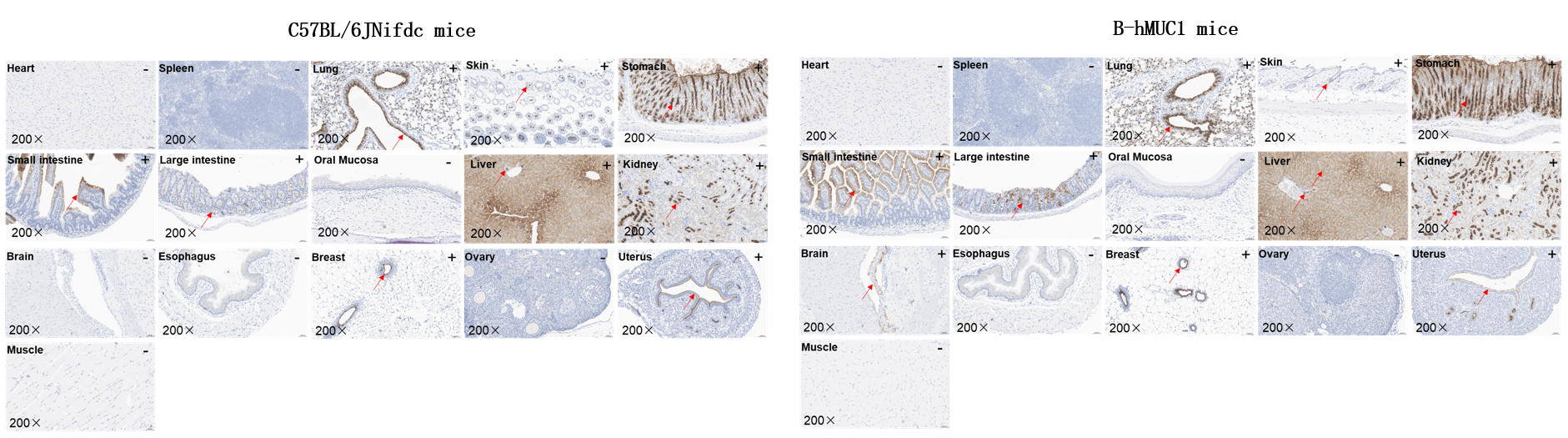
- Human MUC1 was detected in the lung, skin, stomach, small intestine, large intestine, liver, kidney, breast and uterus of C57BL/6JNifdc mice and homozygous B-hMUC1 mice, the antibody was cross-reactive between human and mouse.
Immunohistochemical (IHC) analysis of MUC1 protein expression in wild-type mice and B-hMUC1 mice. Major tissues were collected from wild-type mice and homozygous B-hMUC1 mice and analyzed by IHC with anti-MUC1 antibody (Abcam, ab109185).
* When publishing results obtained using this animal model, please acknowledge the source as follows: The animal model [B-hMUC1 mice] (Cat# 110867) was purchased from Biocytogen.