on this page
Multiple sclerosis (MS) is a chronic autoimmune and inflammatory disease of the central nervous system (CNS) that leads to encephalitis, demyelination, and progressive neurological dysfunction. Clinical symptoms include muscle stiffness and paralysis, visual disturbances, sensory loss, and ataxia, often occurring in recurrent relapses. Among the various animal models of multiple sclerosis, the experimental autoimmune encephalomyelitis (EAE) model is the most widely used because it closely reproduces the pathological inflammation and demyelination observed in human MS.
In rodents, especially EAE mouse models and EAE rat models, disease induction can be achieved using spinal cord homogenates, purified myelin proteins such as myelin basic protein (MBP), proteolipoprotein (PLP), or myelin oligodendrocyte glycoprotein (MOG). These antigens may activate myelin-specific T cells, which cross the blood–brain barrier, initiating inflammatory cascades that cause axonal injury, demyelination, and motor function loss. Disease progression in EAE models is typically evaluated through standardized clinical scoring and histopathological analysis of local demyelination and CNS inflammation.
Biocytogen has established a MOG-induced EAE mouse model, a well-validated preclinical multiple sclerosis model ideal for drug efficacy evaluation, mechanistic research, and immunomodulatory therapy development. These EAE models provide a reliable in vivo platform for studying autoimmune neuroinflammation and advancing MS-related therapeutic discovery.
Modeling method: Animal receive MOG35-55/CFA emulsion (s.c.) on flank (blue point) or neck and buttocks (red point) on day 0, PTX (i.p.) are injected to mice 2h and 24h after MOG35-55/CFA emulsion injection. Body weight and EAE score are recorded every 2 days. lumbar enlargement of the spinal cord are collected for HE and LFB at the end.
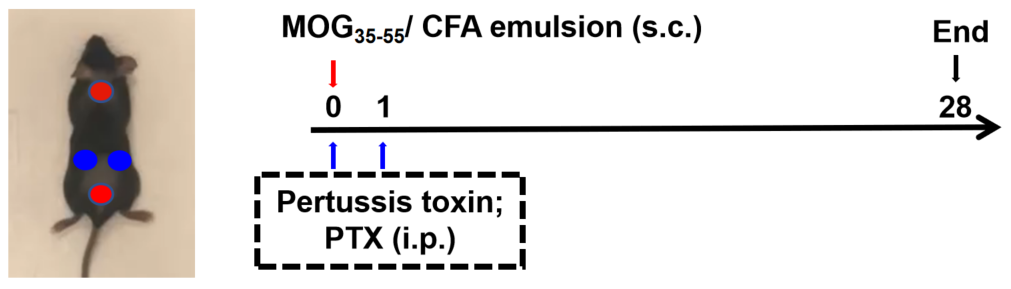
Animal: C57BL/6, B-hCD40hFcRn mice, 8-10 week, female
Detaction indicator: Body weight and clinical score (every two days) H&E, Luxol Fast Blue (LFB) staining
| Readout | ||
| Included tests | Phenotype | Body weight |
| Clinical score | ||
| Histopathology | H&E; LFB | |
| Optional tests | Tissue homogenate | Cytokines analysis |
| Peripheral blood flow cytometry | Flow cytometry assay | |
| Score | Symptoms | Description |
| 0 | Normal | Hold mouse by the base of the tail. Unaffected, mouse can "helicopter" tail. |
| 0.5 | Tail limpness | Hold mouse by the base of the tail. Some loss of tail tone. |
| 1 | Hold mouse by the base of the tail. Complete tail limpness, with no evidence of limb weakness. | |
| 1.5 | Limpness | No hind limb paralysis, but the hind limbs fail when ambulating on the lid metal grid. |
| 2 | Gait irregularities. Hold mouse by the base of the tail, the hind limbs are curled up. Or mouse's head is tilted, it can't keep balance with no hind limb paralysis. |
|
| 2.5 | Hind limbs paralysis | Partial paralysis of hind limbs, waddles upon ambulation, but does not drag limbs. Or mouse's head is tilted, and it keep fall down with no hind limb paralysis. |
| 3 | Partial paralysis of hind limbs as evidenced by dragging one limb upon ambulation. | |
| 3.5 | Forelimbs paralysis | Complete paralysis of both hind limbs, dragging body by forearms, still capable of moving around the cage. |
| 4 | Responsive but not moving/stationary, listless, rapid breathing (consult institutional veterinarian, consider euthanasia). | |
| 4.5 | Dead | Immobile and unresponsive, moribund (immediate euthanasia recommended). |
| 5 | - |
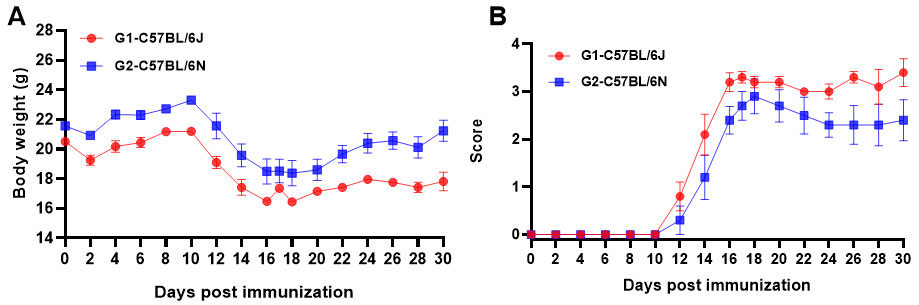
| Group | Onset (day) | Peak (day) | Incidence |
| G1: C57BL/6J |
12 | 16 | 5/5 |
| 12 | 16 | ||
| 14 | 17 | ||
| 12 | 16 | ||
| 12 | 16 | ||
| G2: C57BL/6N |
14 | 18 | 5/5 |
| 12 | 14 | ||
| 14 | 18 | ||
| 14 | 16 | ||
| 14 | 18 |
Fig1. MOG35-55 induced EAE. C57BL/6J and C57BL/6N (A, B) mice received MOG35-55 emulsion injection (s.c.) on neck and buttocks (C) the day 0. PTX (i.p.) were given 2 and 24 hour after MOG injection. Body weight and clinical score were recorded every two days. Values are expressed as mean ± SEM, n=5.
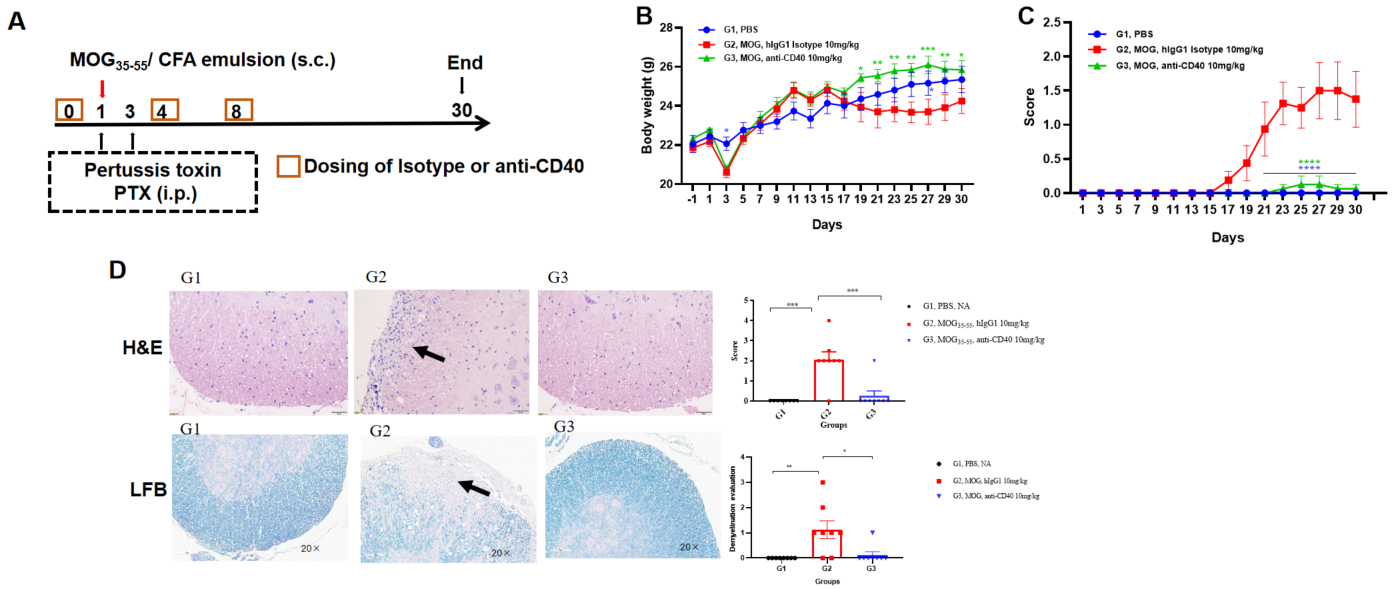
Effects of anti-CD40 on MOG35-55 induced EAE. Mice received MOG35-55 emulsion injection (s.c.) on flank (blue point) on day 0. PTX (i.p.) were given 2 and 48 hour after MOG injection. Isotype control or anti-CD40 were administered on day 0, 4 and 8. (A). Body weight (B) and clinical score (C) were recorded every two days. Immune cell Infiltration and demyelination were assessed by H&E and LFB staining of the spinal cord (D). Values are expressed as mean ± SEM, n=5. compared with G2, *p<0.05, **p<0.01, ***p<0.001 , **** p<0.0001.
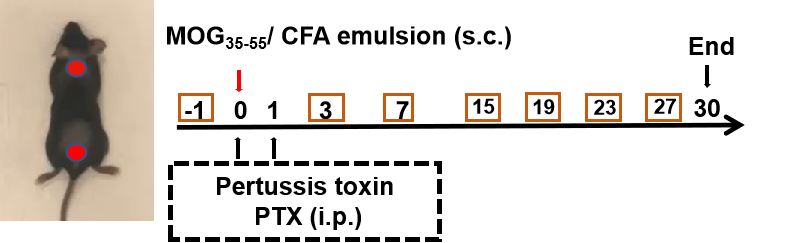
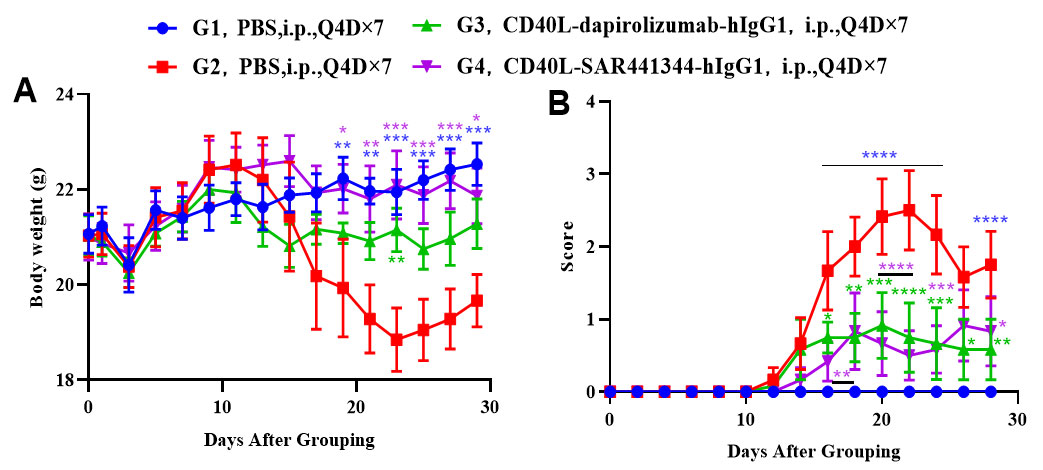
Effects of anti-CD40L on MOG35-55 induced EAE. Mice received MOG35-55 emulsion injection (s.c.) on neck and buttock (red point) on day 0. PTX (i.p.) were given 2 and 48 hour after MOG injection (G2-G4). Isotype control group(G3) or anti-CD40 antibodies group(G4) were administered BIW. Body weight (A) and clinical score (B) were recorded every two days. Values are expressed as mean ± SEM, compared with G2, *p<0.05, **p<0.01, *** p<0.001, **** p<0.0001.
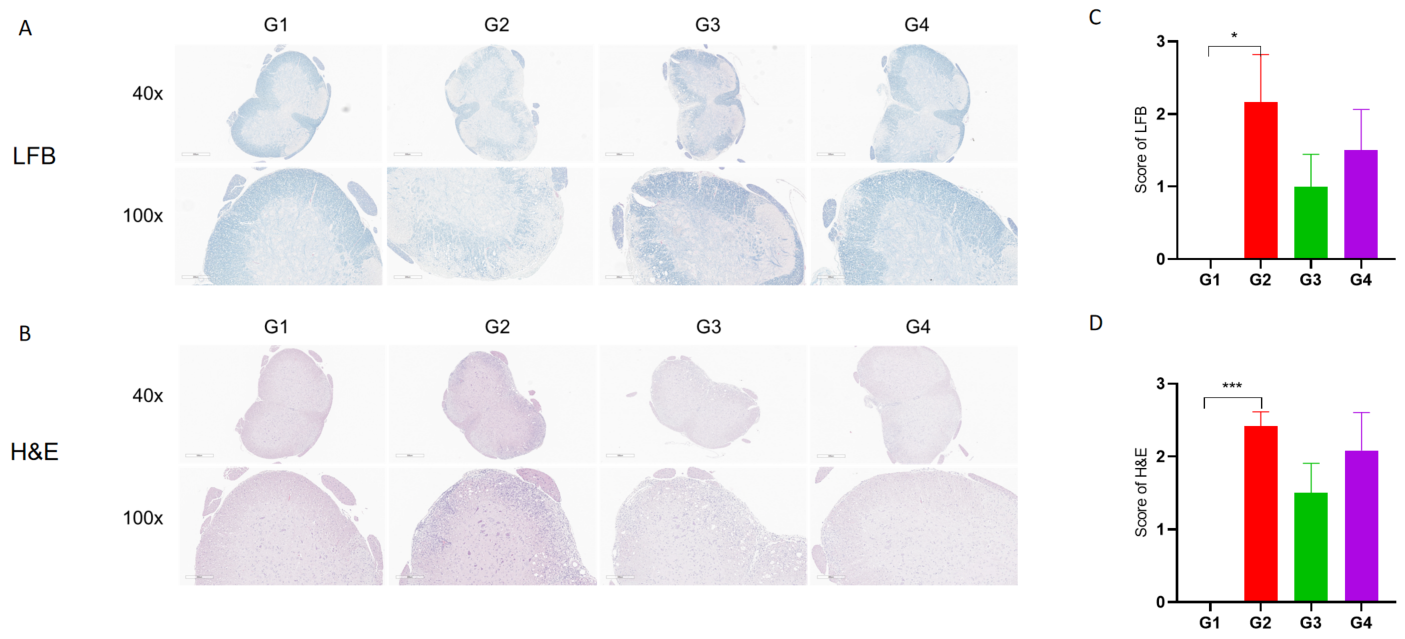
Anti-CD40L antibodies (analog, in-house) improves EAE clinical signs and controls inflammation and demyelination.
Spinal cords were removed from B-hCD40/hCD40L mice on day 30 and stained with Luxol fast blue (LFB) (A) or Hematoxylin and eosin (H&E) (B). Representative sections are shown. The score of inflammatory cells and demyelination of spinal cord (C&D). Values are expressed as mean ± SEM, compared with G2, *p<0.05, **p<0.01, *** p<0.001.
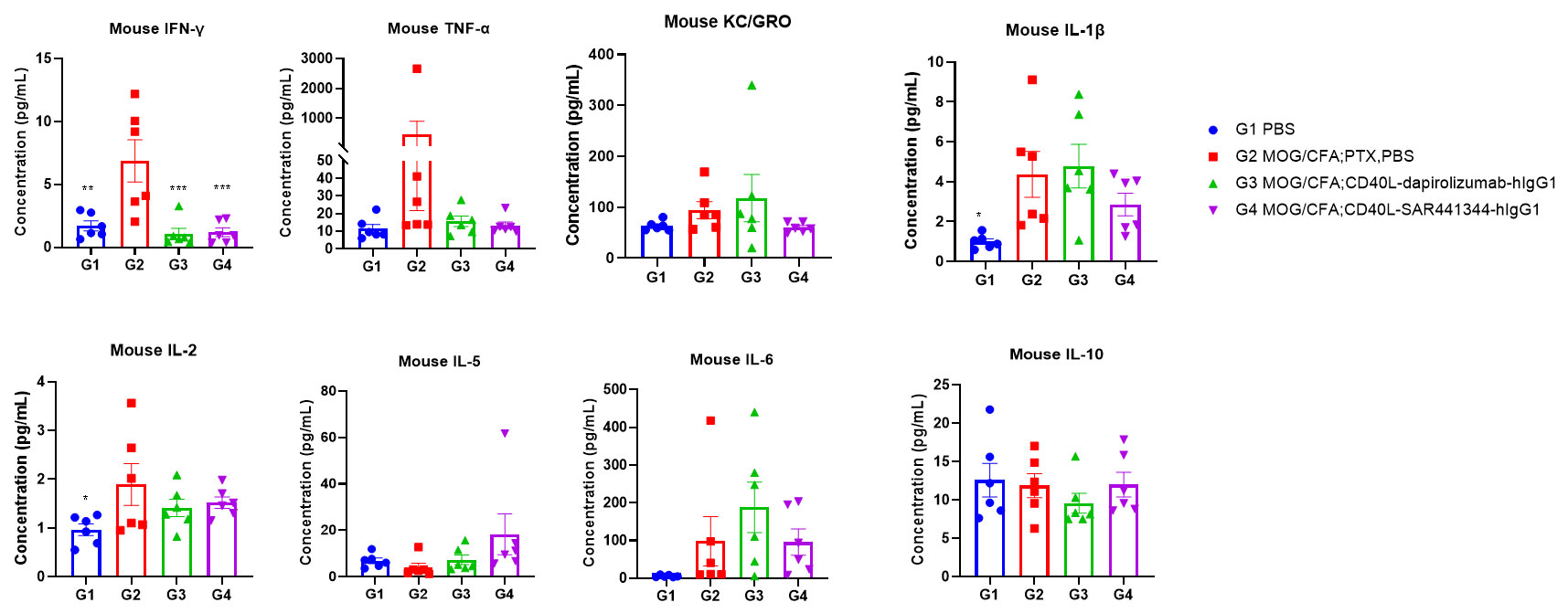
Effects of anti-CD40L on MOG35-55 induced EAE. Mice received MOG35-55 emulsion injection (s.c.) on neck and buttock (red point) on day 0. PTX (i.p.) were given 2 and 48 hour after MOG injection. Isotype control or anti-CD40 antibodies were administered BIW. Serum were collected at study endpoint and the cytokine levels were assessed. Values are expressed as mean ± SEM, n=6, compared with G2, *p<0.05, **p<0.01, *** p<0.001, **** p<0.0001.