Background
In vivo CAR-T therapy has emerged as a promising next-generation cell therapy approach by generating functional CAR-T cells within the body using the off-the-shelf CAR-encoding vectors. This novel strategy helps overcome the limitations of conventional ex vivo CAR-T cell therapy. Despite this promise, there is still an increasing need for preclinical models to support the evaluation of efficacy, biodistribution, and safety.
Methods
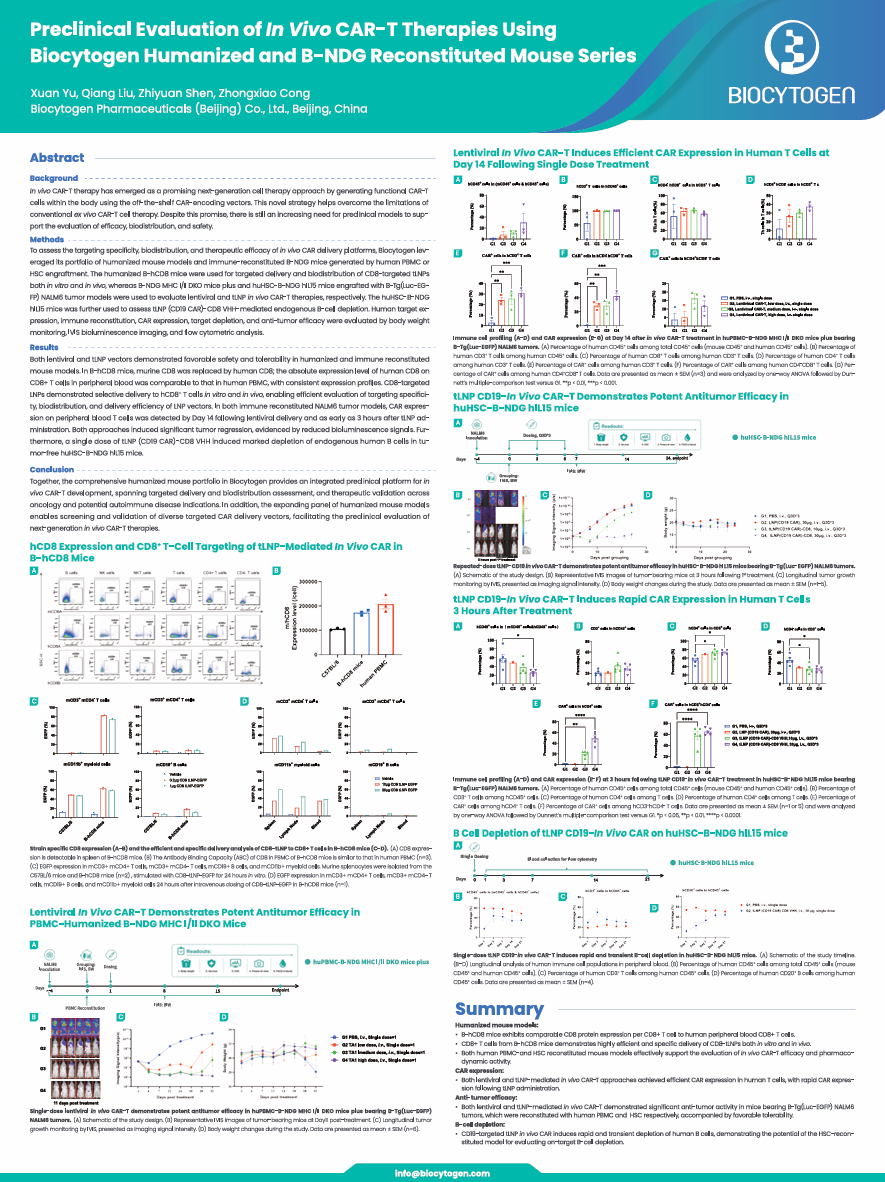
To assess the targeting specificity, biodistribution, and therapeutic efficacy of in vivo CAR delivery platforms, Biocytogen lev-eraged its portfolio of humanized mouse models and immune-reconstituted B-NDG mice generated by human PBMC or HSC engraftment. The humanized B-hCD8 mice were used for targeted delivery and biodistribution of CD8-targeted tLNPs both in vitro and in vivo, whereas B-NDG MHC 1/11 DKO mice plus and huHSC-B-NDG hlL15 mice engrafted with B-Tg(Luc-EG- FP) NALM6 tumor models were used to evaluate lentiviral and tLNP in vivo CAR-T therapies, respectively. The huHSC-B-NDG hlL15 mice was further used to assess tLNP (CD19 CAR)-CD8 VHH-mediated endogenous B-cell depletion. Human target expression, immune reconstitution, CAR expression, target depletion, and anti-tumor efficacy were evaluated by body weight monitoring, IVIS bioluminescence imaging, and flow cytometric analysis.
Results
Both lentiviral and tLNP vectors demonstrated favorable safety and tolerability in humanized and immune reconstituted mouse models. In B-hCD8 mice, murine CD8 was replaced by human CD8; the absolute expression level of human CD8 on CD8+ T cells in peripheral blood was comparable to that in human PBMC, with consistent expression profiles. CD8-targeted LNPs demonstrated selective delivery to hCD8+ T cells in vitro and in vivo, enabling efficient evaluation of targeting specificity, biodistribution, and delivery efficiency of LNP vectors. In both immune reconstituted NALM6 tumor models, CAR expression on peripheral blood T cells was detected by Day 14 following lentiviral delivery and as early as 3 hours after tLNP administration. Both approaches induced significant tumor regression, evidenced by reduced bioluminescence signals. Fur- thermore, a single dose of tLNP (CD19 CAR)-CD8 VHH induced marked depletion of endogenous human B cells in tumor-free huHSC-B-NDG hlL15 mice.
Conclusion
Together, the comprehensive humanized mouse portfolio in Biocytogen provides an integrated preclinical platform for in vivo CAR-T development, spanning targeted delivery and biodistribution assessment, and therapeutic validation across oncology and potential autoimmune disease indications. In addition, the expanding panel of humanized mouse models enables screening and validation of diverse targeted CAR delivery vectors, facilitating the preclinical evaluation of next-generation in vivo CAR-T therapies.