Abstract:
The major pathological hallmark of Alzheimer’s disease (AD), the most common type of dementia, is deposition of amyloid β peptide (Aβ) in the brain. A lot of mutations in the amyloid precursor protein (APP) gene and presenilin 1 (PSEN1) gene have been identified as disease-associated mutations. Since single App knock-in mouse models require 12 months or more to produce Aβ plaques or the Aβ is difficult to be cleared and metabolized, they are not suitable for preclinical treatment studies. Biocytogen combined App mutations and Psen1 mutations to generate a new model that showed Aβ plaque pathology and neuroinflammation.
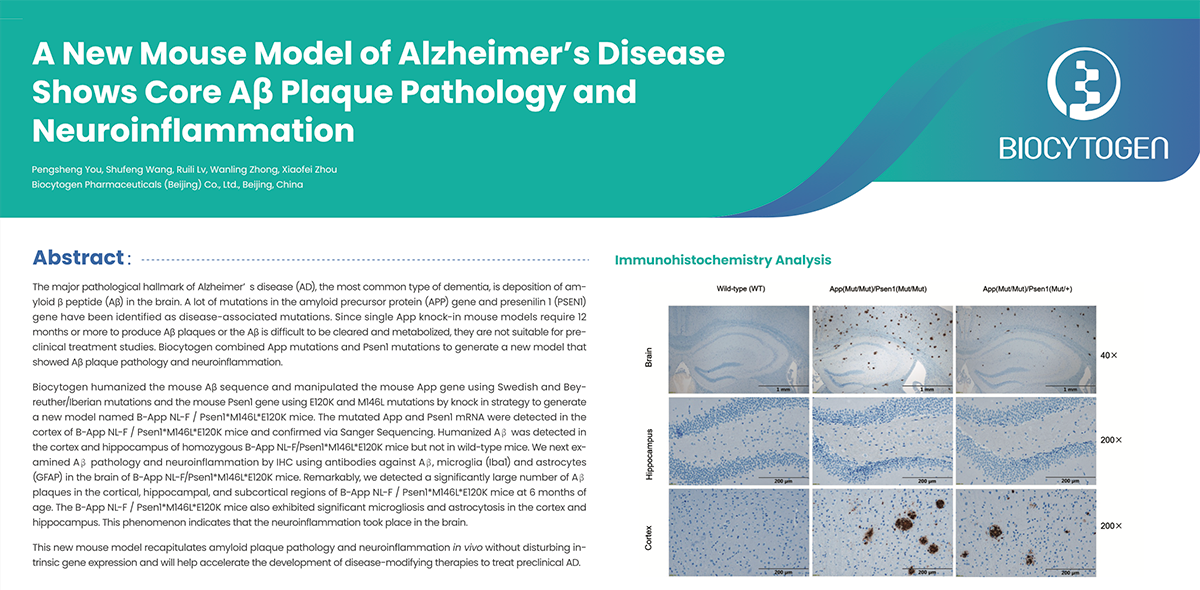
Biocytogen humanized the mouse Aβ sequence and manipulated the mouse App gene using Swedish and Beyreuther/Iberian mutations and the mouse Psen1 gene using E120K and M146L mutations by knock in strategy to generate a new model named B-App NL-F / Psen1*M146L*E120K mice. The mutated App and Psen1 mRNA were detected in the cortex of B-App NL-F / Psen1*M146L*E120K mice and confirmed via Sanger Sequencing. Humanized Aβ was detected in the cortex and hippocampus of homozygous B-App NL-F/Psen1*M146L*E120K mice but not in wild-type mice. We nextexamined Aβ pathology and neuroinflammation by IHC using antibodiesagainst Aβ, microglia (Iba1) and astrocytes (GFAP) in the brain of B-App NL-F/Psen1*M146L*E120K mice. Remarkably, we detected a significantly large number of Aβ plaques in the cortical, hippocampal, and subcortical regions of B-App NL-F / Psen1*M146L*E120K mice at 6 months of age. The B-App NL-F / Psen1*M146L*E120K mice also exhibited significant microgliosis and astrocytosis in the cortex and hippocampus. This phenomenon indicates that the neuroinflammation took place in the brain.
This new mouse model recapitulates amyloid plaque pathology and neuroinflammation in vivo without disturbing intrinsic gene expression and will help accelerate the development of disease-modifying therapies to treat preclinical AD.