
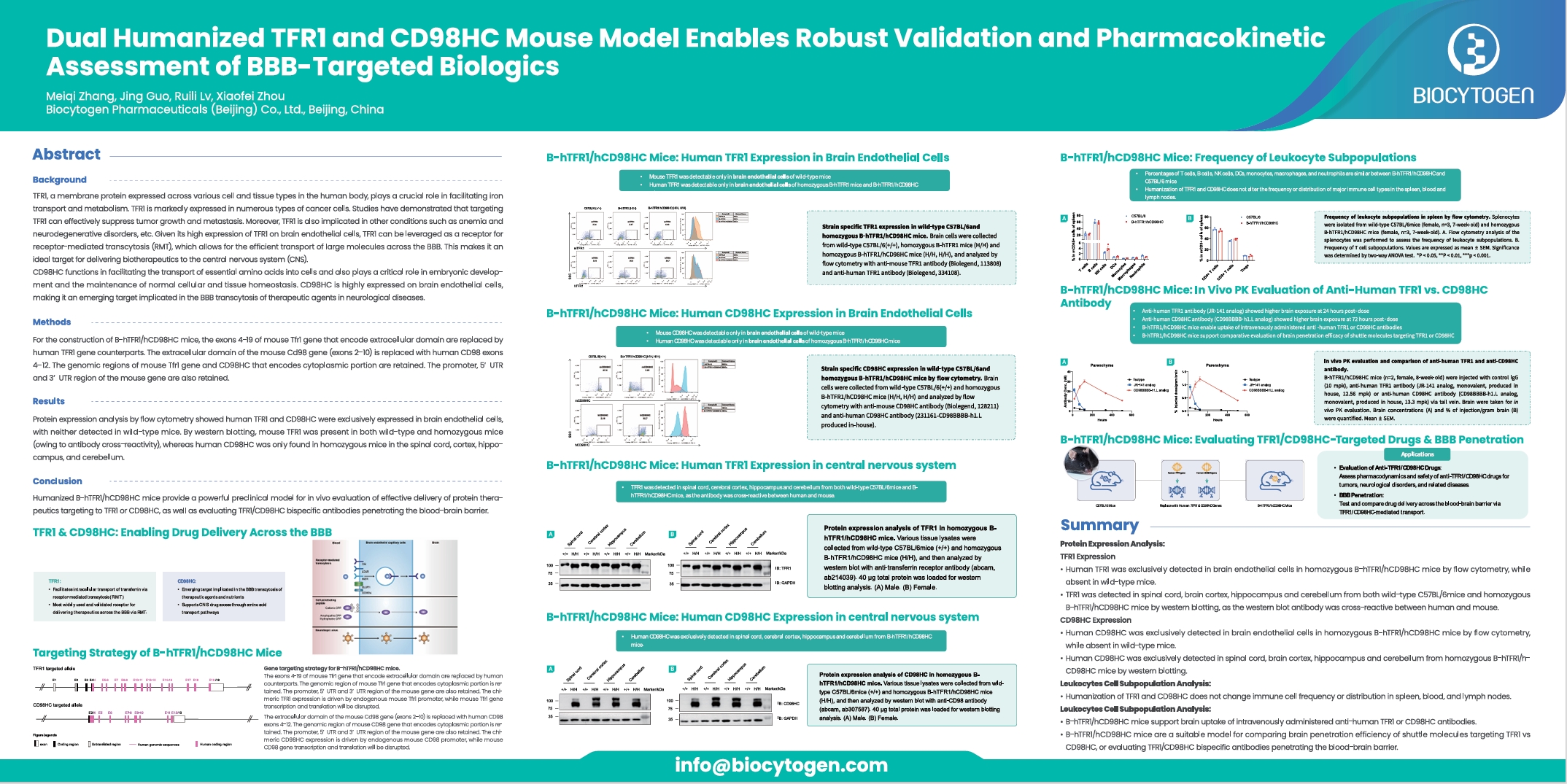
Background TFR1, a membrane protein expressed across various cell and tissue types in the human body, plays a crucial role in facilitating iron transport and metabolism. TFR1 is markedly expressed in numerous types of cancer cells. Studies have demonstrated that targeting TFR1 can effectively suppress tumor growth and metastasis. Moreover, TFR1 is also implicated in other conditions such as anemia and neurodegenerative disorders, etc. Given its high expression of TFR1 on brain endothelial cells, TFR1 can be leveraged as a receptor for receptor-mediated transcytosis (RMT), which allows for the efficient transport of large molecules across the BBB. This makes it an ideal target for delivering biotherapeutics to the central nervous system (CNS). CD98HC functions in facilitating the transport of essential amino acids into cells and also plays a critical role in embryonic development and the maintenance of normal cellular and tissue homeostasis. CD98HC is highly expressed on brain endothelial cells, making it an emerging target implicated in the BBB transcytosis of therapeutic agents in neurological diseases.
Methods For the construction of B-hTFR1/hCD98HC mice, the exons 4-19 of mouse Tfr1 gene that encode extracellular domain are replaced by human TFR1 gene counterparts. The extracellular domain of the mouse Cd98 gene (exons 2-10) is replaced with human CD98 exons 4-12. The genomic regions of mouse Tfr1 gene and CD98HC that encodes cytoplasmic portion are retained. The promoter, 5’ UTR and 3’ UTR region of the mouse gene are also retained.
Results Protein expression analysis by flow cytometry showed human TFR1 and CD98HC were exclusively expressed in brain endothelial cells, with neither detected in wild-type mice. By western blotting, mouse TFR1 was present in both wild-type and homozygous mice (owing to antibody cross-reactivity), whereas human CD98HC was only found in homozygous mice in the spinal cord, cortex, hippocampus, and cerebellum.
Conclusion Humanized B-hTFR1/hCD98HC mice provide a powerful preclinical model for in vivo evaluation of effective delivery of protein therapeutics targeting to TFR1 or CD98HC, as well as evaluating TFR1/CD98HC bispecific antibodies penetrating the blood-brain barrier.
