
Abstract:
Background:
B-cell–depleting therapies, such as anti-CD20 antibodies like rituximab, play a critical role in the treatment of both cancer and autoimmune diseases. The development of novel agents requires robust preclinical models that accurately replicate human B-cell biology and depletion dynamics. Humanized mice reconstituted with CD34⁺ human hematopoietic stem cells (huCD34⁺ HSCs) in immunodeficient strains such as B-NDG hIL15 mice enable improved engraftment of human immune cells—including B cells—offering a valuable platform for evaluating B-cell–targeted therapies.
Methods:
huCD34+ HSC-reconstituted B-NDG hIL15 mice were used. Baseline human CD19+ and CD20+ cell percentages within human CD45+ cells in peripheral blood were measured by flow cytometry 24 hours pre-dose. Mice were divided into four groups (n=4/group): G1 (vehicle, short-term), G2 (rituximab-analog, 20µg/mouse, IV, single dose, short-term), G3 (vehicle, long-term), G4 (rituximab-analog, 20µg/mouse, IV, single dose, long-term). G1/G2: Peripheral blood was sampled at 6h, 24h, and 48h post-dose; mice were euthanized at 72h for flow cytometry analysis of human CD19+/CD20+ cells in blood, liver, spleen, lung, kidney, and bone marrow. G3/G4: Peripheral blood was analyzed on day 8 post-dose; tissues (liver, spleen, lung, kidney, bone marrow) were analyzed on day 15 post-dose.
Results:
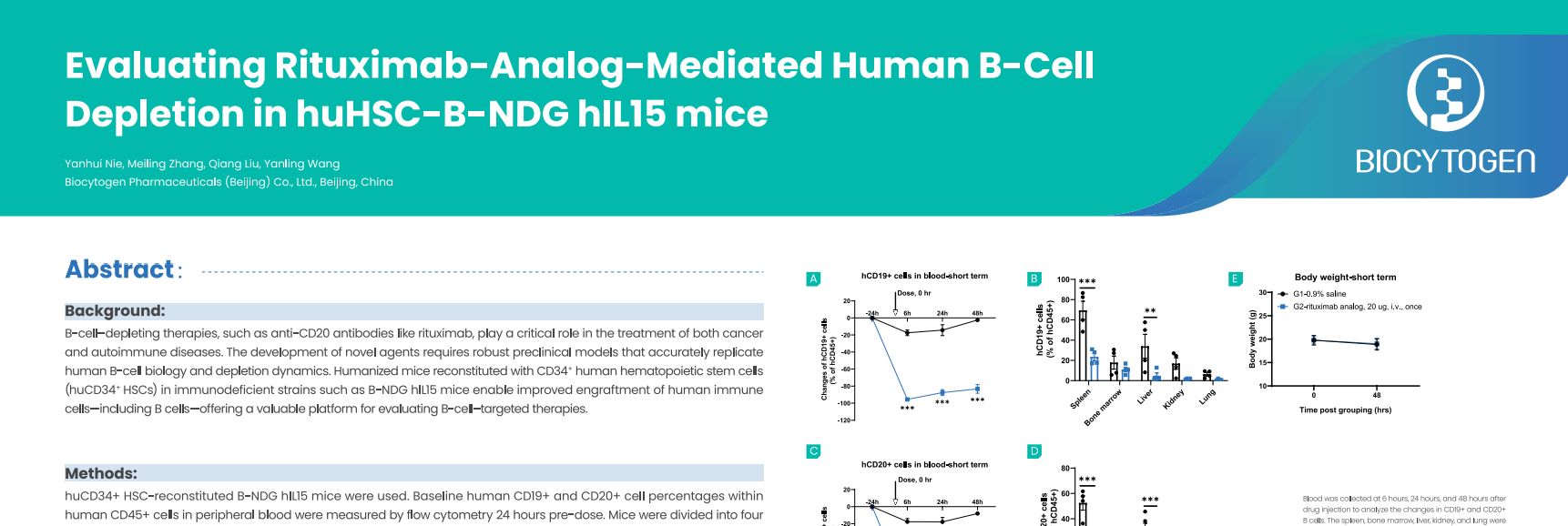
Administration of the rituximab-analog induced rapid and profound B-cell depletion. In peripheral blood (G2 vs. G1), human CD19+/CD20+ cells decreased by >95% at 6h post-dose. Depletion averaged 83.3% at 48h. At 72h, significant reductions (p<0.05) in human CD19+/CD20+ cell percentages were observed in all examined tissues (liver, spleen, lung, kidney, bone marrow) compared to vehicle controls (G1). In the long-term cohort (G4 vs. G3), peripheral blood B-cell depletion persisted, averaging 68% at Day 8 and showing a continued downward trend on Day 14. Critically, on Day 15, analysis of all tissues (liver, spleen, lung, kidney, BM) in G4 mice still demonstrated a significant downward trend in human CD19+/CD20+ cell percentages compared to G3 controls. No significant body weight loss was observed in treated groups.
Conclusions:
This study demonstrates that the rituximab-analog effectively depletes human CD19+ and CD20+ cells in huHSC-B-NDG hIL15 mice, showing rapid onset, significant tissue penetration, and sustained effects. The huHSC-B-NDG hIL15 mice prove highly suitable for preclinical evaluation of B-cell depleting therapeutics, accurately reflecting both the potency and kinetics of drug action in peripheral blood and key tissues. This model provides a valuable tool for assessing novel B-cell targeting agents.
