Abstract:
Background:
Programmed cell death protein 1 (PD-1) is a key immune checkpoint receptor that inhibits T cell activity upon engagement with its ligands PD-L1 or PD-L2, thereby limiting immune overactivation and maintaining immune homeostasis. Tumor cells exploit this mechanism to evade immune surveillance. Concurrently, vascular endothelial growth factor A (VEGFA), the primary mediator of angiogenesis, promotes tumor vascularization, supporting tumor growth and metastasis. Tumor-induced immunosuppression and abnormal vasculature often impair cytotoxic T lymphocyte (CTL) infiltration and function, limiting the efficacy of single-agent immune checkpoint inhibitors. Bispecific antibodies (bsAbs) targeting both PD-1 and VEGFA offer a promising therapeutic strategy by simultaneously relieving immune suppression and normalizing tumor vasculature to enhance antitumor immunity.
Methods:
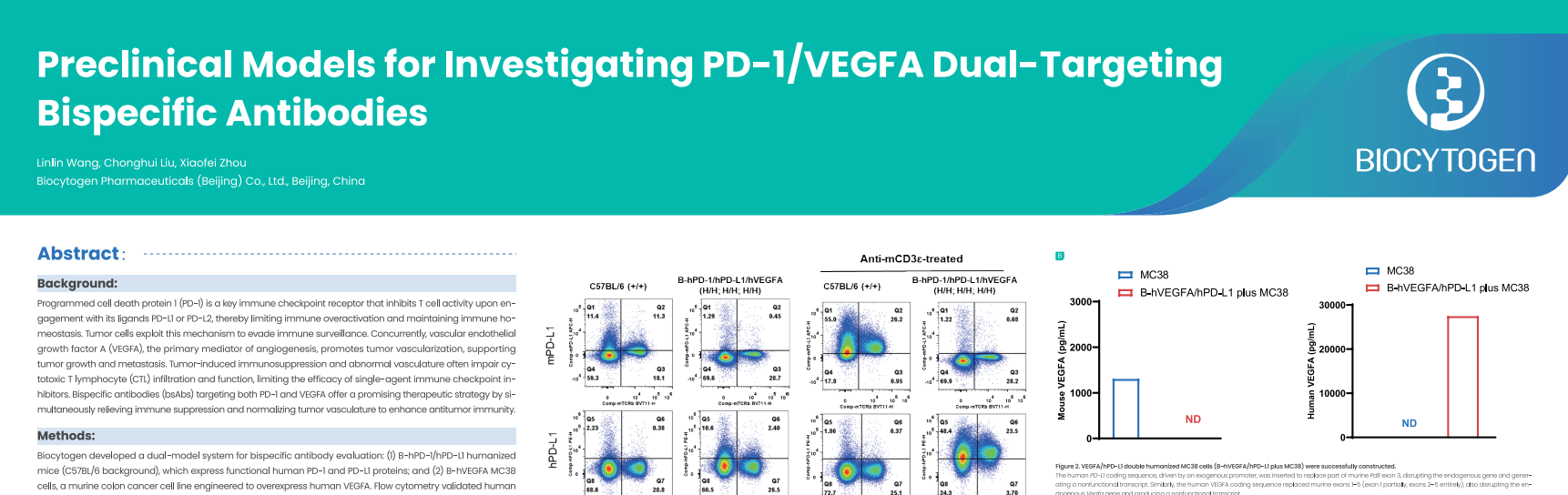
Biocytogen developed a dual-model system for bispecific antibody evaluation: (1) B-hPD-1/hPD-L1 humanized mice (C57BL/6 background), which express functional human PD-1 and PD-L1 proteins; and (2) B-hVEGFA MC38 cells, a murine colon cancer cell line engineered to overexpress human VEGFA. Flow cytometry validated human PD-1/PD-L1 expression in splenic T cells of the humanized mice, and ELISA confirmed VEGFA overexpression in the modified tumor cells. These models were used to establish a syngeneic pharmacodynamic platform to evaluate the anti-PD-1/VEGFA bispecific antibody AK112. In parallel, a humanized CDX model using Biocytogen’s NDG immunodeficient mice engrafted with human PBMCs was employed to assess AK112 activity against human lung cancer cell line HCC827.
Results:
In the B-hPD-1/hPD-L1 and B-hVEGFA MC38 syngeneic model, administration of 1 mg/kg AK112 significantly inhibited tumor growth. Although the initial combination regimens did not exhibit marked synergy, adjusting the tumor volume threshold for grouping from 100 mm³ to 400 mm³ enhanced AK112 efficacy, demonstrating superior tumor suppression compared to monotherapies. In the humanized CDX model, AK112 treatment resulted in robust antitumor activity against HCC827 tumors, with efficacy exceeding that of the corresponding monoclonal antibody. These results confirm both the functional utility of the dual-humanized models and the therapeutic potential of the PD-1/VEGFA bispecific approach.
Conclusion:
Biocytogen has established a comprehensive set of humanized models to enable preclinical evaluation of bispecific antibodies targeting both immune and angiogenic pathways. The bispecific antibody AK112 demonstrated strong antitumor efficacy in both the B-hPD-1/hPD-L1 + B-hVEGFA MC38 syngeneic model and the humanized CDX model using B-NDG immunodeficient mice, validating the dual-targeting strategy and supporting the use of these models as robust platforms to accelerate bispecific antibody development.