you may also like
Artificial intelligence is rapidly reshaping biologics discovery. Yet as AI becomes ubiquitous, competitive advantage will increasingly depend not on model sophistication alone, but on the biological intelligence that powers it. The next era of antibody discovery will be defined by how effectively AI can integrate, interpret, and learn from experimentally grounded biological data.
At Biocytogen, we have always believed:
The real opportunity lies in solid biology. AI serves not as a replacement, but as its ultimate amplification system.
At the heart of antibody discovery lies a fundamental truth: biology is not a static dataset. It is a dynamic evolutionary optimization process.
To enable truly predictive modeling, AI must learn from experimentally grounded, biologically generated data rather than abstract approximations.
Biocytogen’s AI foundation was built on the living immune system. In our RenMice®, antigen exposure triggers iterative cycles of somatic hypermutation, affinity maturation, clonal selection. This functions as a biological optimization engine that continuously enriches antibodies with superior biophysical fitness in real time—something current in silico algorithm can not fully replicate.
Our target KO strategy further enables precise immune shaping by removing endogenous target tolerance, allowing in vivo natural selection to efficiently access difficult-to-drug targets and reveal conserved epitopes that are often inaccessible to conventional approaches.
By the time our AI analyzes a sequence, it originates from an in vivo B-cell repertoire that has already undergone natural immune selection, dramatically de-risking downstream development liabilities.
Today, this foundation includes:
Together, this foundation provides what the industry has long sought:
A direct empirical bridge between molecular sequence and real-world therapeutic performance.
Generating a rich in vivo immune repertoire addresses only the first half of the discovery challenge; the second is resolution.
Traditional single-cell and Beacon-based screening approaches have advanced antibody discovery, but these technologies interrogate only a fraction of an immune response—typically prioritizing easily quantifiable phenotypes such as fluorescence intensity or high secretion—leaving the vast majority of biologically viable sequence diversity uncharacterized.
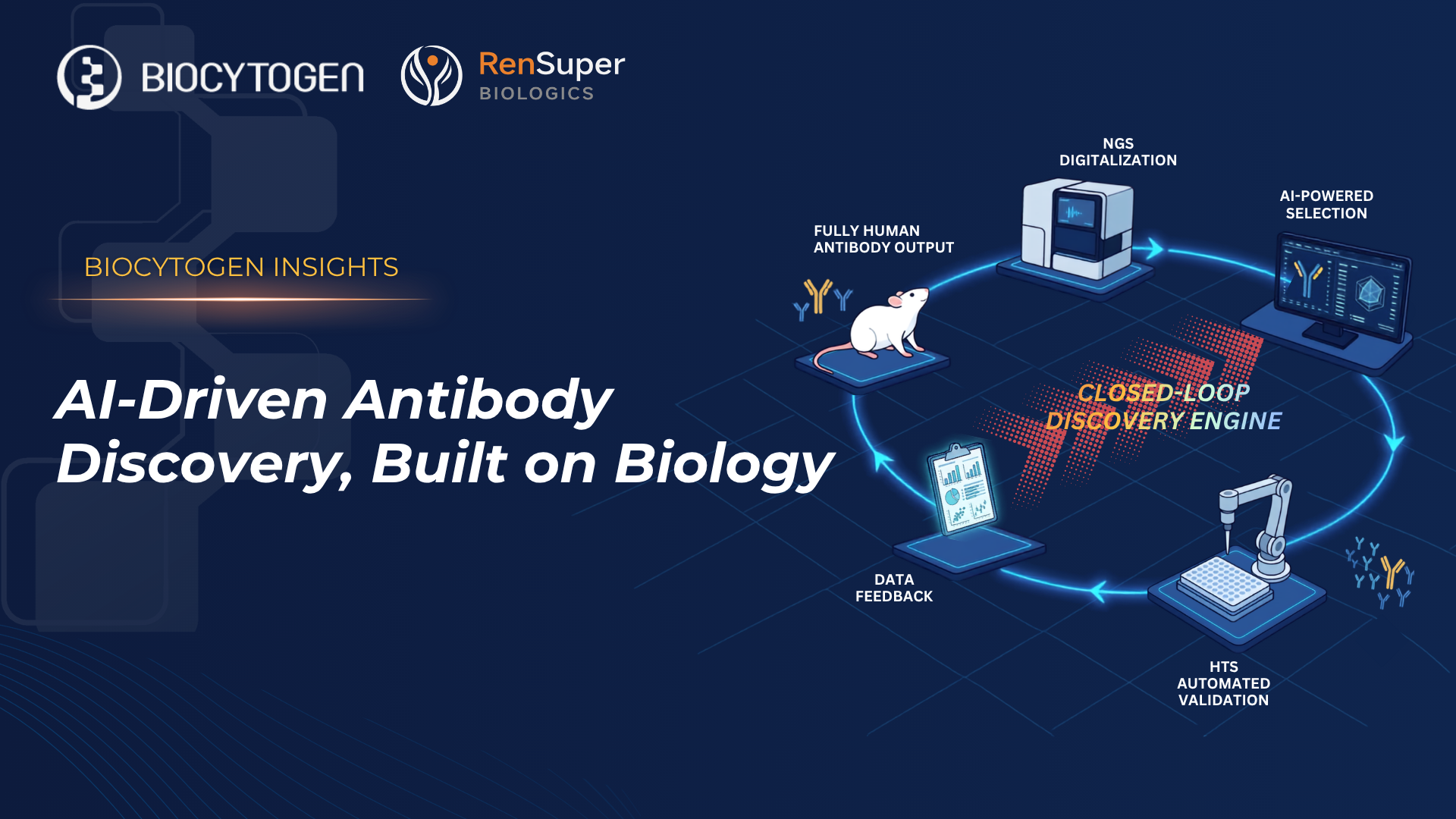
The resulting datasets are inherently fragmented. Elevating AI into a reliable engineering discipline requires a shift from phenotype-limited screening to data-complete capture. By coupling high-throughput NGS with AI system, we enable AI to make discovery decisions across the complete immune repertoire.
After in vivo immunization, NGS allows near-complete sequencing of immune repertoires at scale. Rather than operating on a phenotype-limited subset, our proprietary AI system then analyzes the complete repertoire to prioritize antibody candidates.
In this paradigm:
Biology generates sequence diversity;
NGS captures the complete landscape;
AI extracts the predictive rules.
Every campaign trains the AI; every AI upgrade de-risks the next campaign.
In 2026, through engagements at global scientific forums including the BioX Innovation Forum in Shanghai and the Biocytogen Symposium in Boston, we shared perspectives on the convergence of large-scale biological datasets, AI, and automated experimental systems.
The next era of biologics discovery will not be driven by artificial intelligence alone, nor by traditional experimental, trial-and-error biology in isolation. It will be shaped by platforms that seamlessly integrate biological intelligence, AI, and laboratory automation into a continuous learning system.
As machine learning models mature and biological datasets expand, researchers will be able to pursue increasingly complex therapeutic challenges—from historically undruggable targets to sophisticated multispecific modalities—with greater speed, confidence, and precision.
The RenSuper™ Workstation was built for this moment. By directly connecting AI with large-scale proprietary in vivo datasets and automated experimental validation, it transforms into a new type of discovery system: one that learns from biology, evolves with data, and improves with every campaign.
Biological intelligence is the foundation.
Artificial intelligence is the learning engine.
Automation is the ultimate accelerator.
That is the future we envision—and the future we are building. Biocytogen's mission remains unchanged: to empower global biologics discovery by making antibody discovery faster, smarter, and more predictable.
In an industry constrained by trial and error, what we offer is certainty.