on this page

Built on the RenMab® platform , BCG010 is a fully human IgG1κ monoclonal antibody targeting NKG2A. RenMab® mice carry in situ replacement of complete human antibody heavy and light chain variable regions, enabling fully human monoclonal antibody discovery with high diversity, high affinity, and low immunogenicity risk. This fully human NKG2A antibody further incorporates Fc LALA mutations (L234A/L235A) to reduce Fc-mediated effector function and support selective NKG2A checkpoint blockade without intended depletion of NKG2A-expressing immune cells.
BCG010 is an NKG2A immune checkpoint blocker for cancer treatment, with a strong development rationale in combination immunotherapy settings. Preclinical efficacy with NK-cell administration and PD-L1 blockade supports its potential as a versatile partner for next-generation immuno-oncology regimens.

The preclinical data package supporting BCG010 demonstrates high-affinity and selective binding to NKG2A/CD94, functional blockade of NKG2A-mediated inhibitory signaling, and antitumor activity in immune-relevant combination models. Together with favorable pharmacokinetic (PK) profile, these data support the development of BCG010 as a differentiated NKG2A monoclonal antibody designed to promote NK cell cytotoxicity and enhance antitumor immunity.
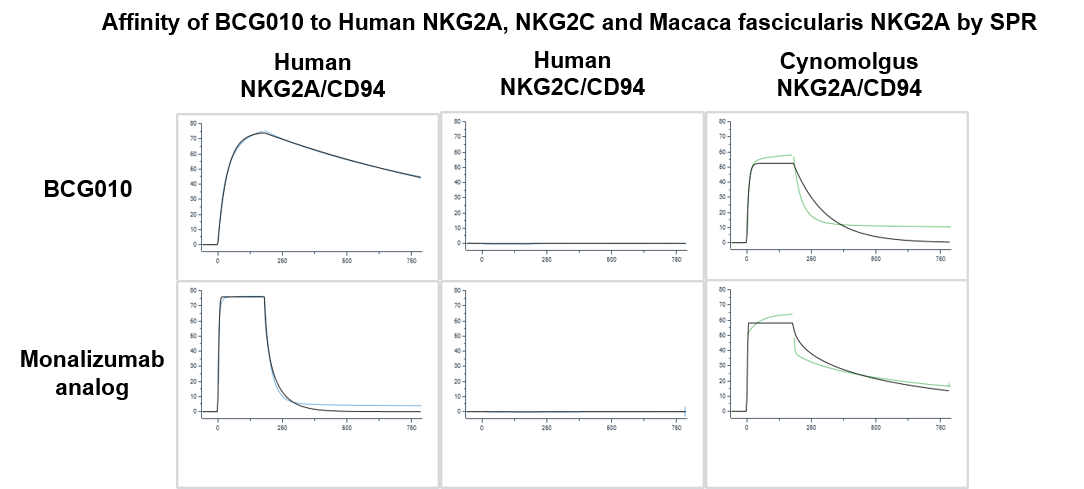
Figure 1. Surface plasmon resonance (SPR) affinity analysis of BCG010 against NKG2A/CD94 family complexes. Compared with the Monalizumab analog, BCG010 showed high affinity for both human and cynomolgus monkey NKG2A/CD94, while showing no measurable affinity for human NKG2C/CD94. These data support the cross-reactive and selective binding profile of BCG010 NKG2A antibody.
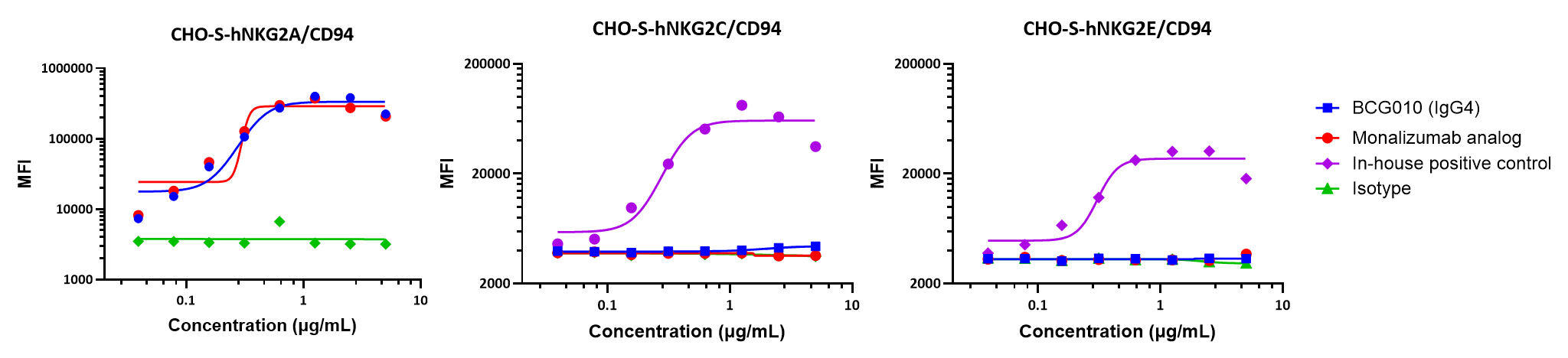
Cell-based binding analysis of BCG010 in CHO-S cells expressing different NKG2/CD94 complexes. Compared with the Monalizumab analog, BCG010 NKG2A antibody showed comparable binding activity in CHO-S-hNKG2A/CD94 cells, while showing no binding to CHO-S-hNKG2C/CD94 or CHO-S-hNKG2E/CD94 cells. These data further confirm the selective recognition of NKG2A/CD94 by BCG010.
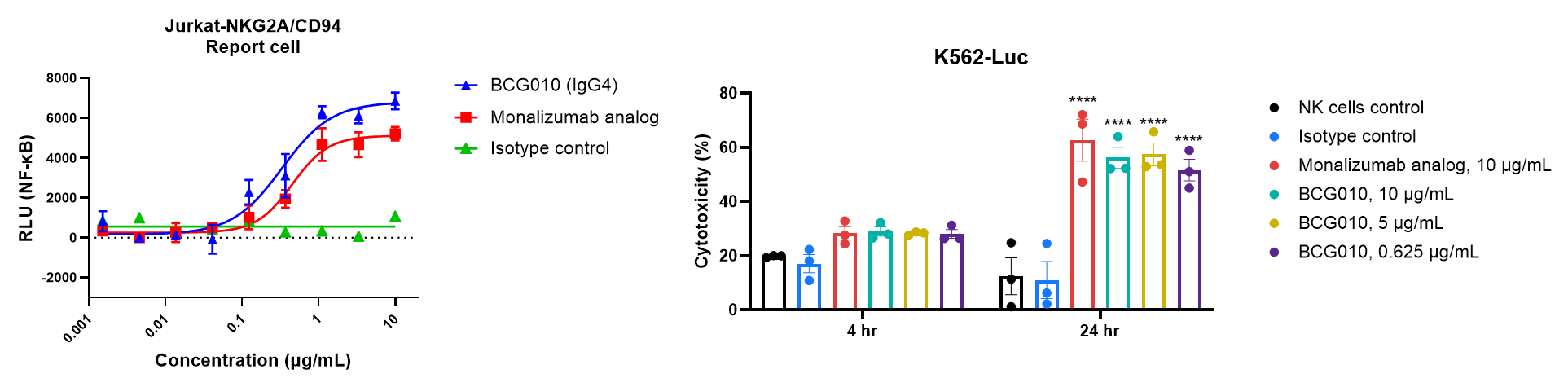
Figure 2. Functional blocking and NK cell cytotoxicity analysis of BCG010. BCG010 relieved NKG2A-mediated inhibitory signaling through its blocking activity, demonstrating stronger functional NKG2A checkpoint blockade than the monalizumab analog. In parallel, BCG010 NKG2A blocker enhanced NK cell-mediated killing of K562-Luc target cells using amplified human NK cells at an E:T ratio of 2:1, with in vitro cytotoxicity comparable to the Monalizumab analog. Together, these data support BCG010 as a functional NKG2A blocker with NK cell cytotoxic activity.
(Data was shown as Mean±SEM and analyzed using Two-way ANOVA followed Dunnett compared with Control group; p <0.0001.)
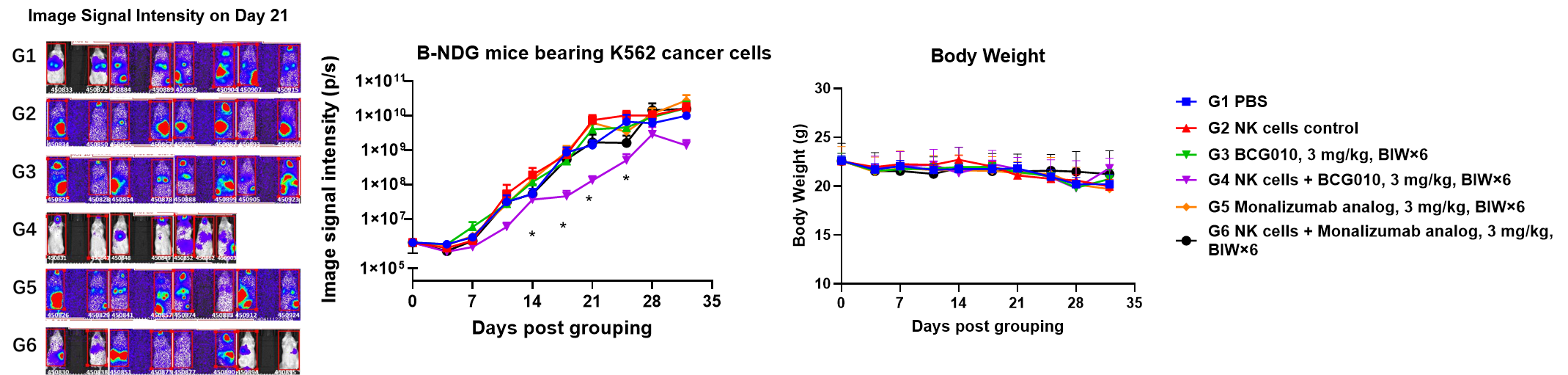
Figure 3. In vivo efficacy analysis of BCG010 in combination with NK cell administration in a K562 tumor model. In B-NDG mice bearing K562 cancer cells, BCG010 NKG2A inhibitor was evaluated alone or in combination with NK cell administration and compared with the Monalizumab analog under the same 3 mg/kg BIW × 6 dosing schedule. BCG010 combined with NK cell administration effectively controlled tumor burden without body weight loss, supporting its potential to enhance NK cell-mediated antitumor activity.
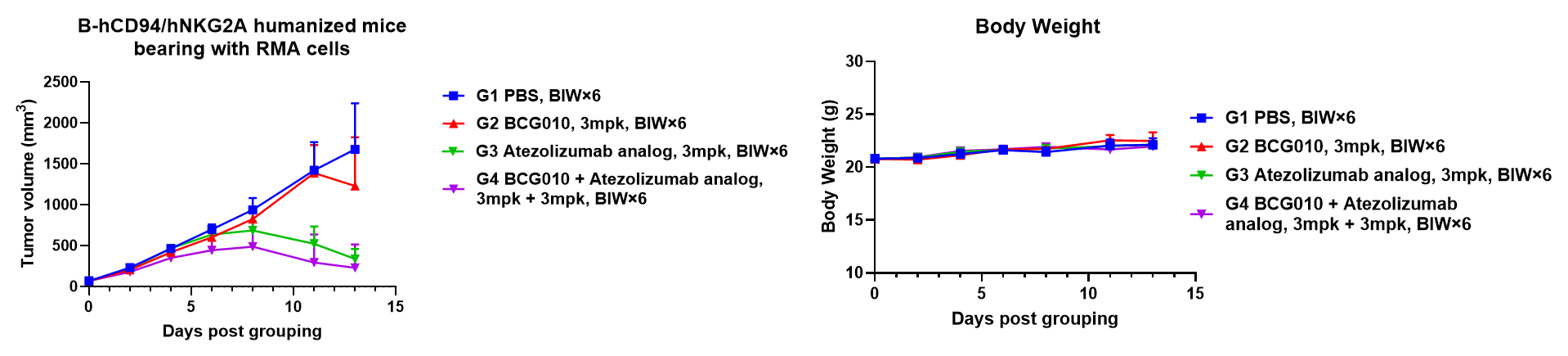
In vivo efficacy analysis of BCG010 in combination with PD-L1 blockade in an RMA tumor model. In B-hCD94/hNKG2A humanized mice bearing RMA cells, BCG010 NKG2A inhibitor was evaluated alone and in combination with an Atezolizumab analog under a 3 mg/kg BIW × 6 dosing schedule. BCG010 in combination with the Atezolizumab analog significantly inhibited tumor growth without body weight loss, supporting the potential of NKG2A blockade in checkpoint combination strategies.

Biocytogen welcomes partnership discussions to further evaluate this NKG2A blocker asset.

BCG010 is a fully human IgG1κ monoclonal antibody engineered to selectively block the HLA-E–CD94–NKG2A inhibitory checkpoint. Compared with first-generation NKG2A inhibitors, BCG010 combines high-affinity target engagement, strict selectivity over NKG2C and NKG2E, favorable pharmacokinetic properties, and robust developability characteristics, supporting its potential as a next-generation NKG2A blocker.
BCG010 exhibits full cross-reactivity with cynomolgus NKG2A while maintaining strict selectivity for the human NKG2A pathway. Together with its Fc-silent LALA design and favorable developability profile, these features support efficient preclinical evaluation and future clinical development.
While clinical-stage NKG2A inhibitors have shown limited monotherapy activity, BCG010 addresses the need for more pathway-specific NKG2A blockade by avoiding human NKG2C/CD94 and NKG2E/CD94 engagement. This selectivity helps preserve NKG2A checkpoint specificity and supports combination immunotherapy development.
BCG010 showed antitumor activity in multiple preclinical models, including combination activity with NK cell administration and an atezolizumab analog. These findings support the exploration of this NKG2A blocker in NK cell-based therapies, PD-1/PD-L1 blockade, and broader combination immunotherapy strategies.