on this page

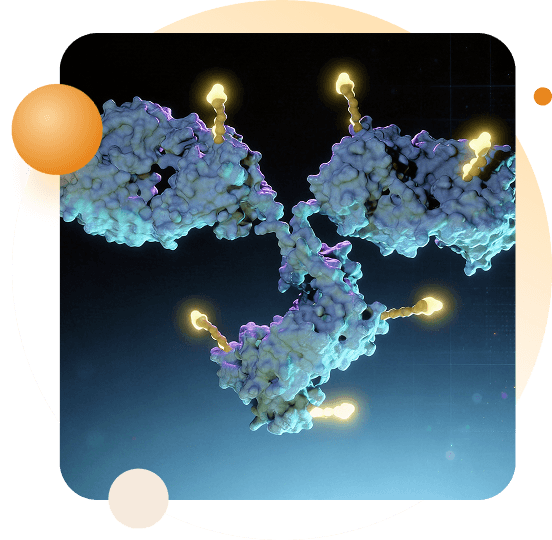
Built on the RenLite® platform, BCG017 utilizes common light chain technology to eliminate heavy/light chain mispairing, ensure seamless assembly, simplify manufacturing, and provide a developable antibody backbone for the PTK7 × EGFR bispecific ADC drug development.
BCG017 can be developed with two linker–payload options to support different ADC development strategies: either vcMMAE or Biocytogen's proprietary BLD1102 linker–payload system, which contains BCPT02, a topoisomerase I (TOP1) inhibitor payload.
BCG017 is being evaluated as a PTK7 × EGFR bispecific ADC drug development asset for solid tumors. Potential development areas include non-small cell lung cancer (NSCLC), colorectal cancer (CRC), small cell lung cancer (SCLC), triple-negative breast cancer (TNBC), ovarian cancer, esophageal cancer, and head and neck cancer.

The preclinical data package for BCG017, generated from Biocytogen internal preclinical studies, includes PTK7 and EGFR co-expression across multiple cancer types, selective binding and efficient internalization in tumor cells with different target expression levels, synergistic and superior antitumor efficacy across CDX and PDX models, tumor-targeted payload delivery, and excellent plasma stability across multiple species. Together, these data support the development of BCG017 as a novel PTK7 × EGFR bispecific ADC for solid tumors.

Figure 1. Co-expression analysis of PTK7 and EGFR in solid tumors based on RNA sequencing data. Expression levels of PTK7 and EGFR were evaluated across multiple cancer types, including lung cancer, head and neck cancer, esophageal cancer, ovarian cancer, breast cancer, triple-negative breast cancer (TNBC), colorectal cancer, and gastric cancer. These data support the rationale for developing PTK7 × EGFR dual-targeting strategies in selected solid tumors.

Figure 2. Antigen binding analysis of the PTK7 × EGFR bispecific antibody across tumor cell lines with different PTK7 and EGFR expression levels. Compared with benchmark controls including cofetuzumab, MRG003, and cetuximab, the PTK7 × EGFR bsAb showed strong binding activity in PTK7/EGFR co-expressing tumor cell lines, including HCC70 breast cancer and OVCAR-3 ovarian cancer cells, while showing activity comparable to corresponding benchmarks in tumor cell lines expressing PTK7 or EGFR alone, including NUGC4 gastric cancer and NCI-H522 lung cancer cells. These data support a dual-arm-dependent binding mechanism across tumor cells with different PTK7 and EGFR expression levels.
(Note: cofetuzumab, PTK7 ADC; MRG003, EGFR ADC; cetuximab, EGFR mAb.)
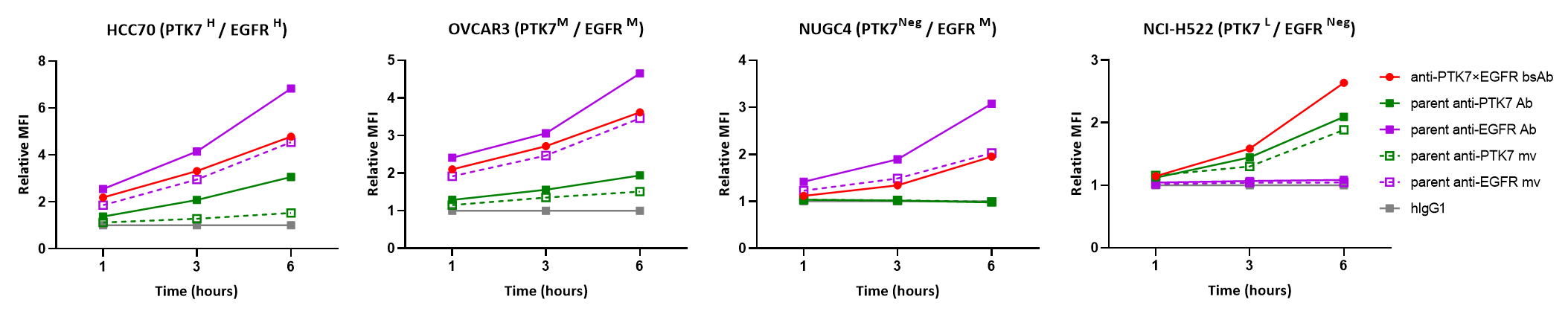
Figure 3. Internalization analysis of the PTK7 × EGFR bispecific antibody across tumor cell lines. Internalization activity was evaluated for PTK7 × EGFR bispecific antibody versus parental monovalent antibodies in HCC70 breast cancer, OVCAR-3 ovarian cancer, NUGC4 gastric cancer, and NCI-H522 lung cancer cells. The bsAb showed efficient internalization across variable PTK7/EGFR expression levels, while parental monovalent antibodies showed markedly reduced uptake, indicating that dual-targeting mechanism may improve tumor selectivity and reduce on-target off-tumor toxicity.
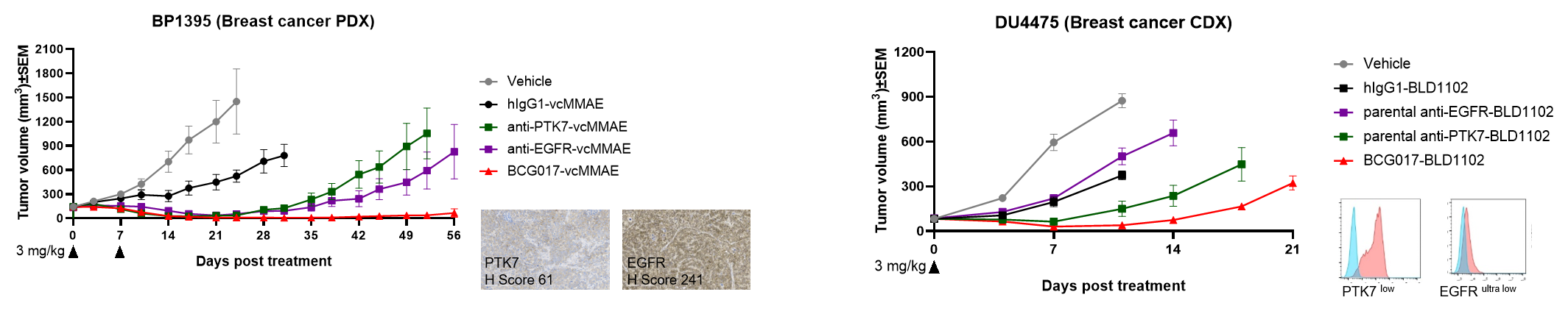
Figure 4. Antitumor efficacy of BCG017 PTK7 × EGFR bispecific ADC across CDX and PDX models. In the BP1395 breast cancer PDX model and DU4475 breast cancer CDX model, PTK7 × EGFR bispecific ADCs conjugated with either MMAE or BLD1102 showed synergistic antitumor efficacy compared with corresponding parental monoclonal ADCs, supporting the functional contribution of the bispecific antibody design.

Across BP1395 breast cancer PDX, BP8047 colorectal cancer PDX, BP1013 gastric cancer PDX, and DU4475 breast cancer CDX models, BCG017 conjugated with the BLD1102 linker–payload system demonstrated superior efficacy versus benchmark ADCs targeting PTK7 or EGFR alone, supporting broad in vivo activity across PTK7/EGFR-expressing tumors.
In addition, comparative studies using the same bispecific antibody backbone showed that BLD1102 conjugation achieved better efficacy than MMAE, highlighting the payload differentiation of BCG017.
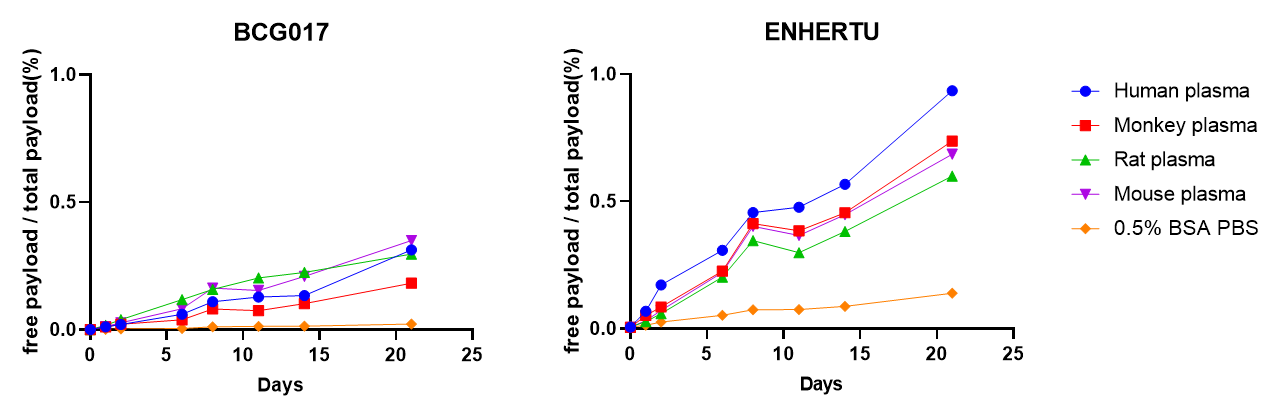
Figure 5A. In vitro plasma stability analysis of BCG017 compared with T-DXd across human, monkey, rat, and mouse plasma. After 21 days of plasma incubation, free BCPT02 accounted for less than 0.5% of the total payload of BCG017, which was lower than the free payload percentage observed for Enhertu. These data indicate excellent plasma stability of BCG017 across multiple species and support the circulation stability of the BLD1102 linker–payload system.
(Note: Enhertu refers to trastuzumab deruxtecan (T-Dxd), a HER2-directed ADC used as a benchmark control in the plasma stability comparison.)
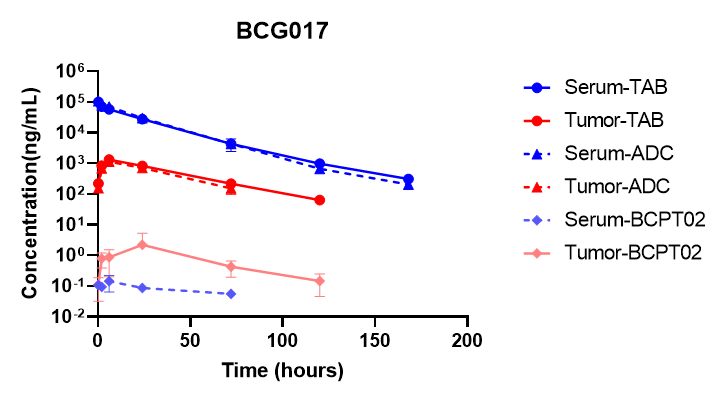
Figure 5B. Serum and tumor pharmacokinetic (PK) analysis of BCG017 in the NCI-H1975 CDX model with moderate PTK7 and EGFR expression established in B-NDG mice. Following a single 4 mg/kg dose of BCG017, total antibody (TAB), intact ADC, and released payload (BCPT02) were measured in serum and tumor over time. BCG017 showed pronounced tumor accumulation of the ADC, with high concentrations of free BCPT02 detected in tumor tissues and low systemic payload exposure in plasma, supporting efficient tumor-targeted delivery of the BCPT02 payload.

Conventional single-target EGFR ADCs are routinely constrained by acquired resistance, antigen heterogeneity, and severe on-target, off-tumor toxicities. BCG017 selectively co-engages PTK7 to establish a cooperative dual-anchor framework within the tumor microenvironment (TME). This bispecific architecture mitigates absolute reliance on EGFR expression alone, counteracting clonal evasion while maximizing tumor-selective payload delivery and cytotoxic efficacy in heterogeneous solid tumors.
BCG017 incorporates a sterically attenuated, moderate-affinity EGFR arm to restrict target engagement in normal tissues, significantly mitigating the risk of on-target, off-tumor toxicities. Preclinical profiles demonstrate accelerated endocytosis and potent cytotoxicity strictly within PTK7/EGFR co-expressing tumor cells, validating that dual-antigen topology broadens the therapeutic window without compromising antitumor fitness.
RenLite® provides a fully human common light chain antibody backbone for PTK7 × EGFR bispecific ADC engineering. This design helps reduce heavy/light chain mispairing, supports correct bispecific antibody assembly, simplifies manufacturing, and improves downstream ADC developability.
BCG017 can be conjugated with vcMMAE or Biocytogen’s proprietary BLD1102 linker–payload system. BLD1102 contains BCPT02, a TOP1 inhibitor payload, with linker properties engineered for hydrophilicity, controlled payload release, and circulation stability. In the tested PDX models using the same PTK7 × EGFR bispecific antibody backbone, BCG017-BLD1102 showed stronger antitumor efficacy than the vcMMAE-conjugated version, supporting BLD1102 as a differentiated payload option for BCG017 development.
BCG017 has demonstrated preclinical antitumor activity in CDX and PDX models of multiple solid tumors, including colorectal cancer (CRC), gastric cancer, and breast cancer. Based on PTK7/EGFR co-expression and the dual-target ADC design rationale, BCG017 may have broader development potential in non-small cell lung cancer (NSCLC), small cell lung cancer (SCLC), triple-negative breast cancer (TNBC), ovarian cancer, esophageal cancer, and head and neck cancer.