
B-hPTK7 mice

C57BL/6-Ptk7tm1(PTK7)Bcgen/Bcgen • 112192

B-hPTHrP mice
B-hPVRIG mice

B-hPTK7 mice

Catalog Number: 112192
Strain Name: C57BL/6-Ptk7tm1(PTK7)Bcgen/Bcgen
Strain Background: C57BL/6
NCBI gene ID: 5754 (Human)
Aliases: CCK-4, CCK4
---
Licensing option available
B-hPTK7 mice

on this page

  • Description
  • Targeting strategy
  • Phenotypic analysis
  • Efficacy

Posters

View All

    Publication

      Description

      PTK7: A pseudokinase receptor that regulates Wnt signaling, cell migration, and tumor progression.

      • Gene Information: PTK7 (Protein Tyrosine Kinase 7), also known as CCK-4, is a single-pass transmembrane pseudokinase encoded on human chromosome 6. It belongs to the receptor tyrosine kinase family but lacks conventional kinase activity.
      • Protein Expression: PTK7 is expressed in various normal tissues and plays important roles in embryonic development and tissue organization. It is frequently overexpressed in multiple solid tumors, including colorectal, breast, ovarian, and lung cancers, and is associated with tumor progression.
      • Signaling Pathway: PTK7 primarily regulates non-canonical Wnt/planar cell polarity (PCP) signaling and interacts with Wnt pathway components to control cell polarity, migration, and invasion. PTK7 can also modulate canonical Wnt/β-catenin signaling in a context-dependent manner.
      • Model Application: Targeting PTK7 with monoclonal antibodies, ADCs, and bispecific antibodies can selectively eliminate PTK7-positive tumor cells and enhance anti-tumor activity.
      Targeting strategy

      PTK7

      • The exons 2 14 of the mouse Ptk7 gene, which encode the extracellular domain, were replaced by human counterparts in B hPTK7 mice. The genomic region of the mouse Ptk7 gene encoding the signal peptide, transmembrane domain, and cytoplasmic portion was retained.
      mRNA expression analysis

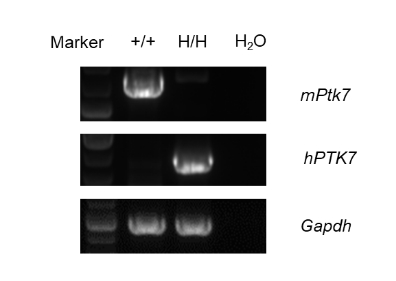
      mRNA PTK7 were detectable in B-hPTK7 mice by RT-PCR and sequencing. Lung RNA were isolated from wild-type C57BL/6 mice (+/+) and homozygous B-hPTK7 mice (H/H), then cDNA libraries were synthesized by reverse transcription, followed by PCR with mouse or human PTK7 primers. Sequencing of the PCR products confirmed that the amplified sequences were consistent with database reference sequences.
      PTK7 Protein Expression

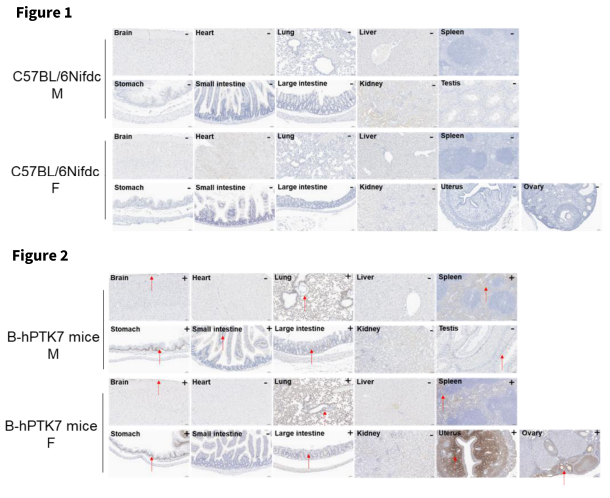
      Immunohistochemical (IHC) analysis of PTK7 protein expression in wild-type mice and B-hPTK7 mice. Major tissues were collected from wild-type mice and homozygous B-hPTK7 mice and analyzed by IHC with anti-PTK7 antibody (Abcam, 325170).(M: male, F: female)
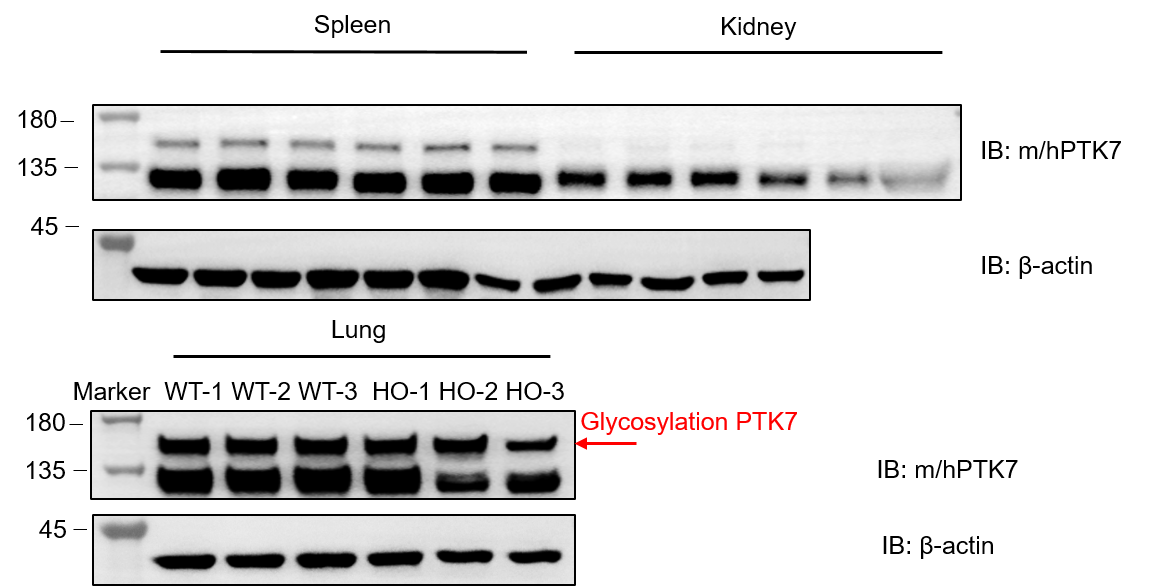
      Western blot analysis of PTK7 protein expression in homozygous B-hPTK7 mice. Various tissue lysates were collected from wild-type C57BL/6JNifdc mice (Female, n=3, 7-week-old) and homozygous B-hPTK7 mice (Female, n=3, 8-week-old), and then analyzed by western blot with anti-PTK7 antibody (Invitrogen, MA5-15669). 40 μg total proteins were loaded for western blotting analysis.

      In vivo Efficacy of anti-human PTK7 antibody-drug conjugate (ADC)

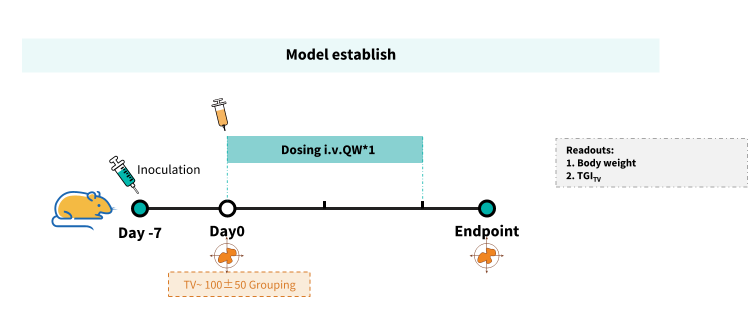
      Establishment of an MC38 model in B-hPTK7 mice and in vivo efficacy study of an anti-PTK7 antibody-drug conjugate (ADC). Murine colon cancer B-hPTK7 MC38 cells (Cat# 322241) were subcutaneously implanted into homozygous B-hPTK7 mice (female, 9-week-old, n=6). Mice were grouped when the tumor volume reached approximately 100 mm³, at which time they were intravenously injected with the anti-human PTK7 ADC cofetuzumab analog (in-house) as indicated in the panel.
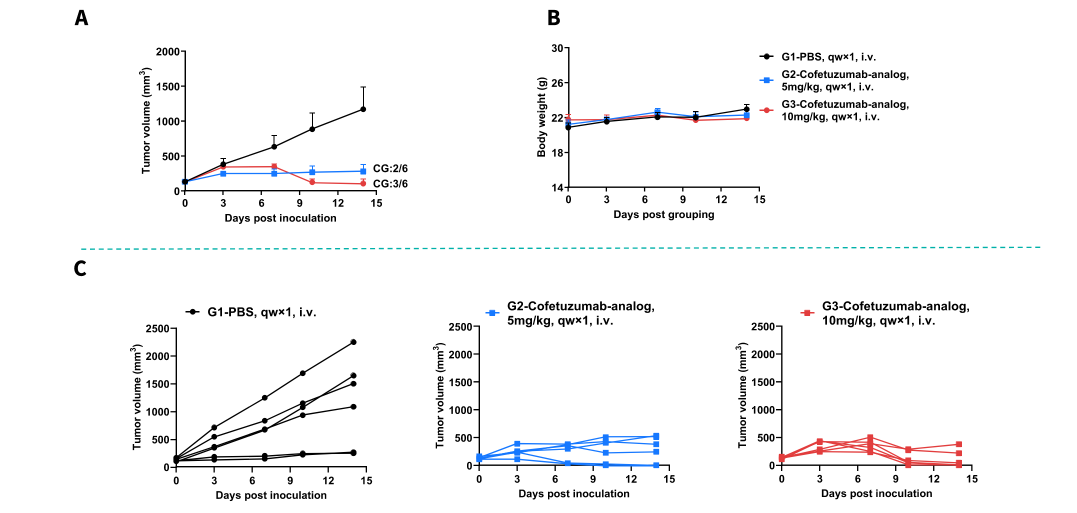
      Efficacy of anti-human PTK7 ADC in B-hPTK7 mice. (A) Tumor growth curves. (B) Body weight changes during treatment. (C) In vivo efficacy of anti-human PTK7 ADC-individual tumor growth curves. Values are expressed as mean ± SEM.

      * When publishing results obtained using this animal model, please acknowledge the source as follows: The animal model [B-hPTK7 mice] (Cat# 112192) was purchased from Biocytogen.