
C57BL/6-Gt(ROSA)26tm1(SIGLEC8)Bcgen/Bcgen • 111149

Key Advantages
Validation
Application

In B-hSIGLEC8 mice, a BAC containing the whole sequence of the human SIGLEC8 gene was inserted into the Rosa26 locus. This targeting strategy enables human SIGLEC8 expression in relevant immune-cell populations in a C57BL/6 background, supporting anti-human SIGLEC8 antibody binding and efficacy studies in eosinophil-, mast cell-, and asthma-related models.

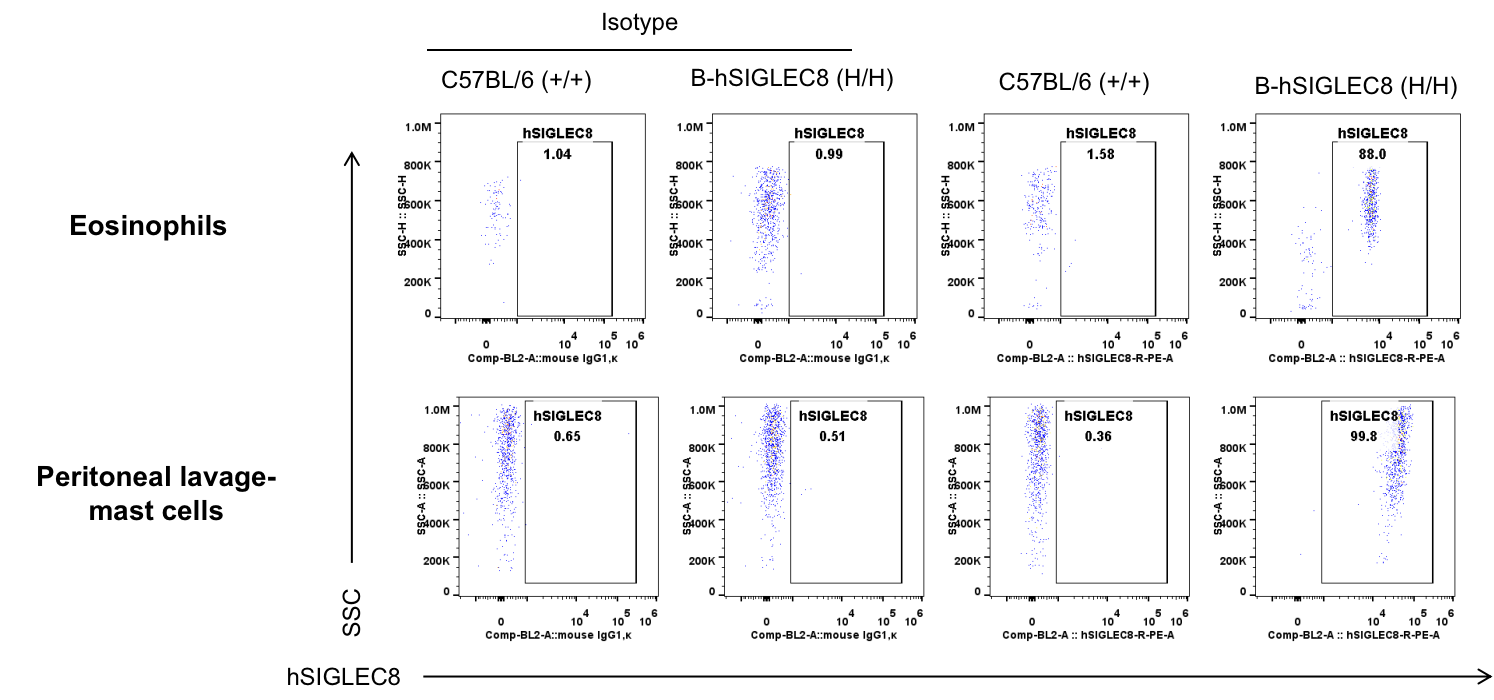
Human SIGLEC8 expression analysis in homozygous B-hSIGLEC8 mice by flow cytometry. Blood and peritoneal lavage fluid were collected from wild-type C57BL/6 mice (+/+) and homozygous B-hSIGLEC8 mice (H/H), and analyzed by FACS with anti-SIGLEC8 antibody. Human SIGLEC8 was detectable in eosinophils (88%, mSiglec-F+, mCD11c-) and mast cells (99.8%, mFcεRIα+, mCD117(c-kit)+, CD11b-) in homozygous B-hSIGLEC8 mice.

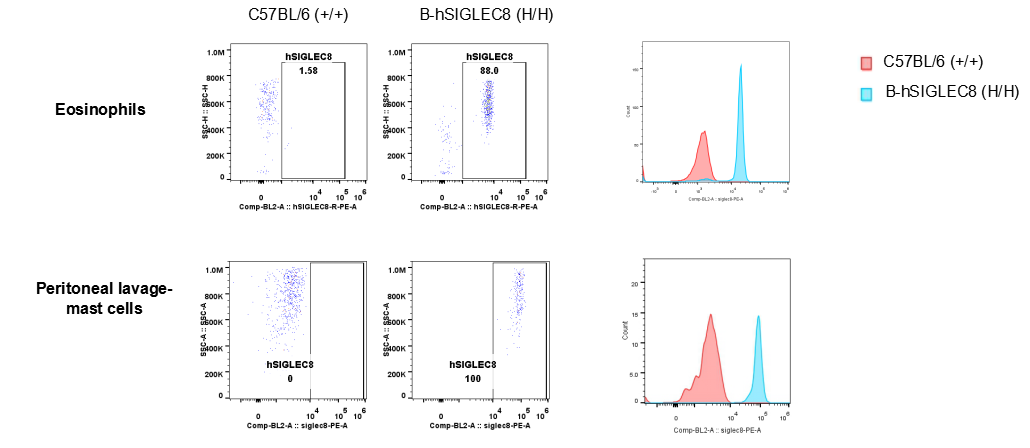
Analysis of eosinophils and mast cells of B-hSIGLEC8 mice by flow cytometry. Eosinophils and peritoneal lavage mast cells were isolated from wild-type C57BL/6 mice (+/+) and B-hSIGLEC8 mice (H/H). Flow cytometry analysis was performed to assess human SIGLEC8 expression using the benchmark antibody Lirentelimab (in house). Eosinophils were gated from the mSiglec-F+, mCD11c- population, and mast cells were gated from the CD45+mFcεRIα+, mCD117(c-kit)+CD11b- population. Lirentelimab binding was observed in homozygous B-hSIGLEC8 mice but not in wild-type mice.

The number of BALF immune cells in mouse asthma model. BALF immune cells were isolated from B-hSIGLEC8 mice (n=6). The number of eosinophils was analyzed by flow cytometry under PBS or lirentelimab (in house) treatment. After lirentelimab treatment, the expression level of inflammatory cells was lower than the positive control in homozygous B-hSIGLEC8 mice.
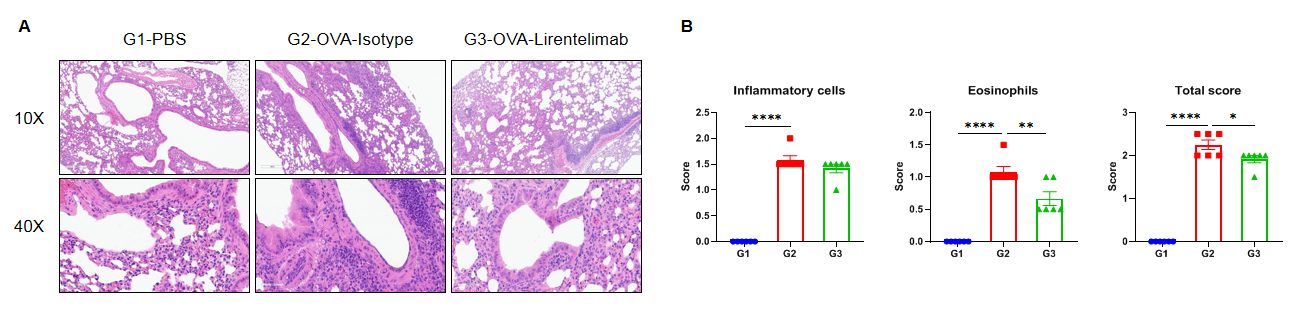
H&E staining in asthma-like model in B-hSIGLEC8 mice. Lung tissues were collected at the study endpoint. H&E staining showed that lung tissues from B-hSIGLEC8 mice exposed to PBS aerosols did not show inflammation. OVA exposure resulted in a significant increase in peribronchial and perivascular inflammation in B-hSIGLEC8 mice. A significant reduction in eosinophil infiltration was observed in mice treated with lirentelimab (in house). Note: Lirentelimab in the treatment model group was administered via intratracheal aerosolization.

Q1: What are B-hSIGLEC8 mice?
B-hSIGLEC8 mice are gene-humanized mice developed by Biocytogen for human target expression, pharmacology studies, and preclinical efficacy evaluation.
Q2: Why are B-hSIGLEC8 mice useful?
B-hSIGLEC8 mice support studies of human SIGLEC8 biology in eosinophils and mast cells, especially in allergic inflammation and asthma-like models.
Q3: How was human SIGLEC8 expression validated?
Human SIGLEC8 expression and lirentelimab binding were validated in eosinophils and peritoneal lavage mast cells by flow cytometry.