

C57BL/6-Tnfsf15tm3(TNFSF15)Bcgen Itga4tm1(ITGA4)Bcgen Itgb7tm1(ITGB7)Bcgen/Bcgen • 114990

TL1A: A key inflammation cytokine in chronic intestinal inflammation and fibrosis-related diseases

TL1A
ITGA4
ITGB7
B-hTL1A plus/hα4β7 mice were obtained by mating B-hTL1A mice plus (112949) and B-hα4β7 mice (111913).

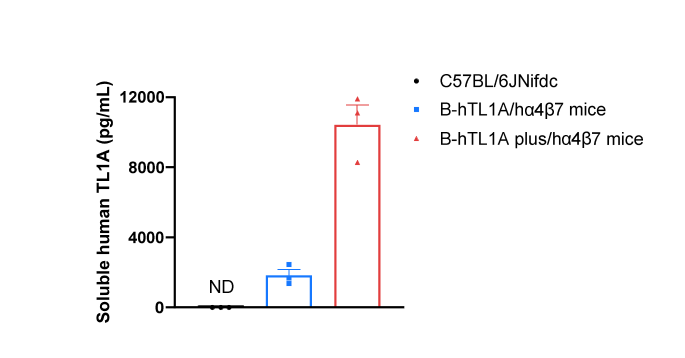
Soluble TL1A expression analysis in B-hTL1A plus/hα4β7 mice by ELISA. Bone marrow derived dendritic cells (BMDC) were produced by culturing the bone marrow from wild-type C57BL/6JNifdc mice (+/+), homozygous B-hTL1A/hα4β7 mice (H/H;H/H;H/H) and B-hTL1A plus/hα4β7 mice (H/H;H/H;H/H), which were stimulated with LPS in vitro. After stimulation, the supernatants were collected and the level of soluble TL1A was analyzed by ELISA. Soluble human TL1A was exclusively detectable in homozygous B-hTL1A/hα4β7 mice and B-hTL1A plus/hα4β7 mice, but not in wild-type C57BL/6JNifdc mice. Values are expressed as mean ± SEM. ND: not detectable.
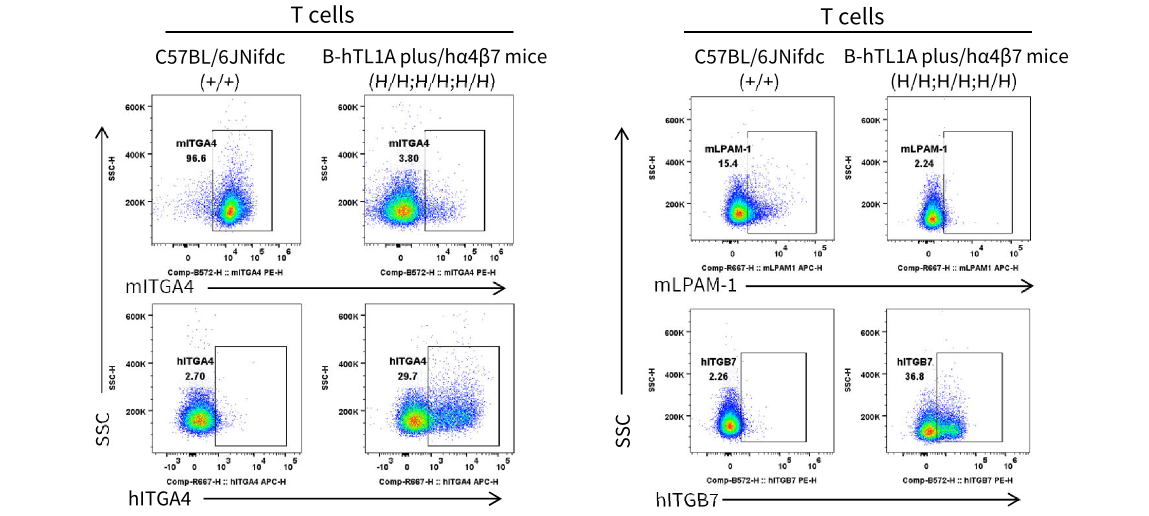
Strain specific ITGA4 and ITGB7 expression analysis in wild-type C57BL/6JNifdc mice and homozygous humanized B-hTL1A plus/hα4β7 mice by flow cytometry. Splenocytes were collected from wild-type C57BL/6JNifdc mice (+/+) and homozygous B-hTL1A plus/hα4β7 mice (H/H;H/H;H/H). Protein expression was analyzed with anti-mouse ITGA4 antibody (Biolegend, 103705), anti-mouse LPAM-1/α4β7 antibody (Biolegend, 120607), anti-human ITGA4 antibody (Biolegend, 304307) anti-human ITGB7 antibody (Invitrogen, MA5-23541) by flow cytometry. Mouse ITGA4 and ITGB7 were only detectable in wild-type C57BL/6JNifdc mice. Human ITGA4 and ITGB7 were exclusively detectable in homozygous B-hTL1A plus/hα4β7 mice, but not in wild-type C57BL/6JNifdc mice.
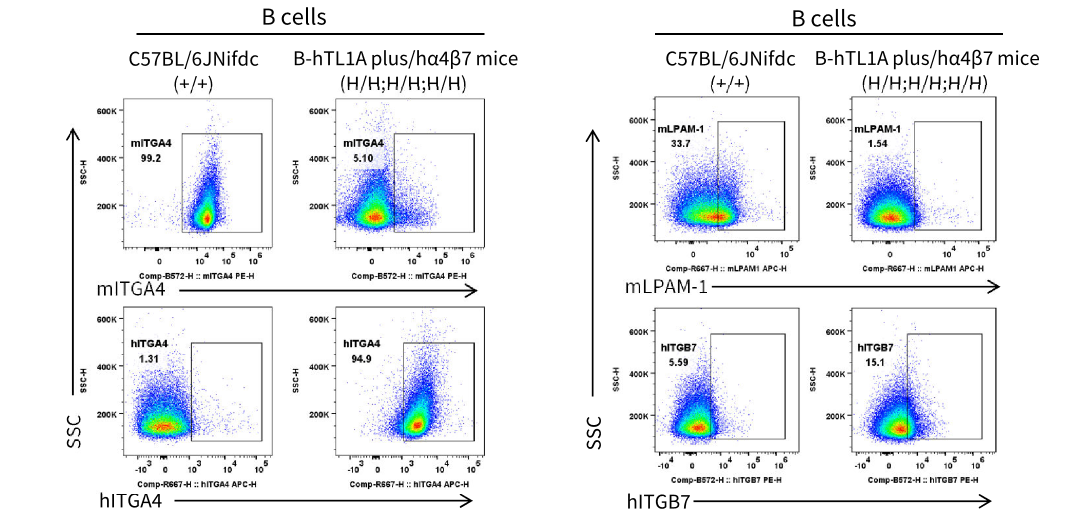
Strain specific ITGA4 and ITGB7 expression analysis in wild-type C57BL/6JNifdc mice and homozygous humanized B-hTL1A plus/hα4β7 mice by flow cytometry. Splenocytes were collected from wild-type C57BL/6JNifdc mice (+/+) and homozygous B-hTL1A plus/hα4β7 mice (H/H;H/H;H/H). Protein expression was analyzed with anti-mouse ITGA4 antibody (Biolegend, 103705), anti-mouse LPAM-1/α4β7 antibody (Biolegend, 120607), anti-human ITGA4 antibody (Biolegend, 304307) anti-human ITGB7 antibody (Invitrogen, MA5-23541) by flow cytometry. Mouse ITGA4 and ITGB7 were only detectable in wild-type C57BL/6JNifdc mice. Human ITGA4 and ITGB7 were exclusively detectable in homozygous B-hTL1A plus/hα4β7 mice, but not in wild-type C57BL/6JNifdc mice.
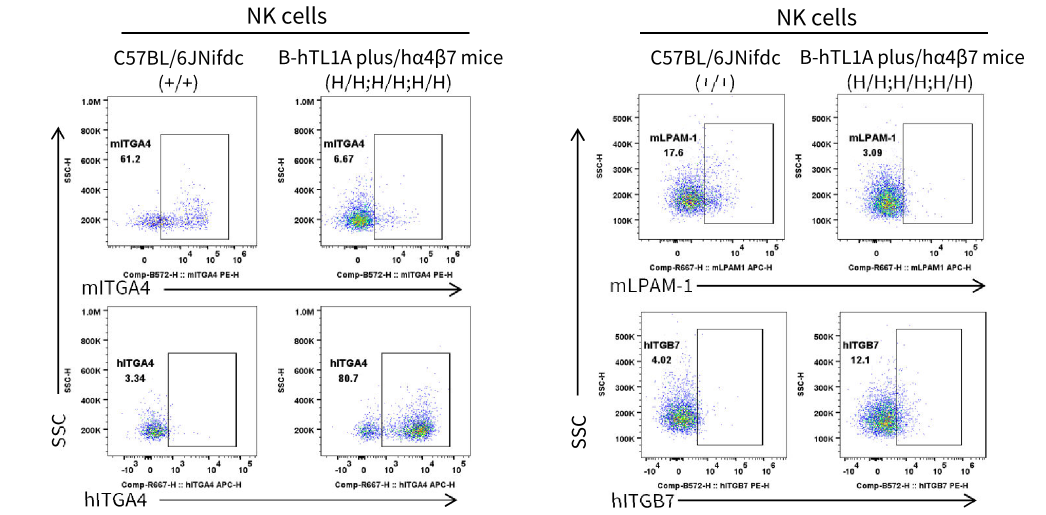
Strain specific ITGA4 and ITGB7 expression analysis in wild-type C57BL/6JNifdc mice and homozygous humanized B-hTL1A plus/hα4β7 mice by flow cytometry. Splenocytes were collected from wild-type C57BL/6JNifdc mice (+/+) and homozygous B-hTL1A plus/hα4β7 mice (H/H;H/H;H/H). Protein expression was analyzed with anti-mouse ITGA4 antibody (Biolegend, 103705), anti-mouse LPAM-1/α4β7 antibody (Biolegend, 120607), anti-human ITGA4 antibody (Biolegend, 304307) anti-human ITGB7 antibody (Invitrogen, MA5-23541) by flow cytometry. Mouse ITGA4 and ITGB7 were only detectable in wild-type C57BL/6JNifdc mice. Human ITGA4 and ITGB7 were exclusively detectable in homozygous B-hTL1A plus/hα4β7 mice, but not in wild-type C57BL/6JNifdc mice.
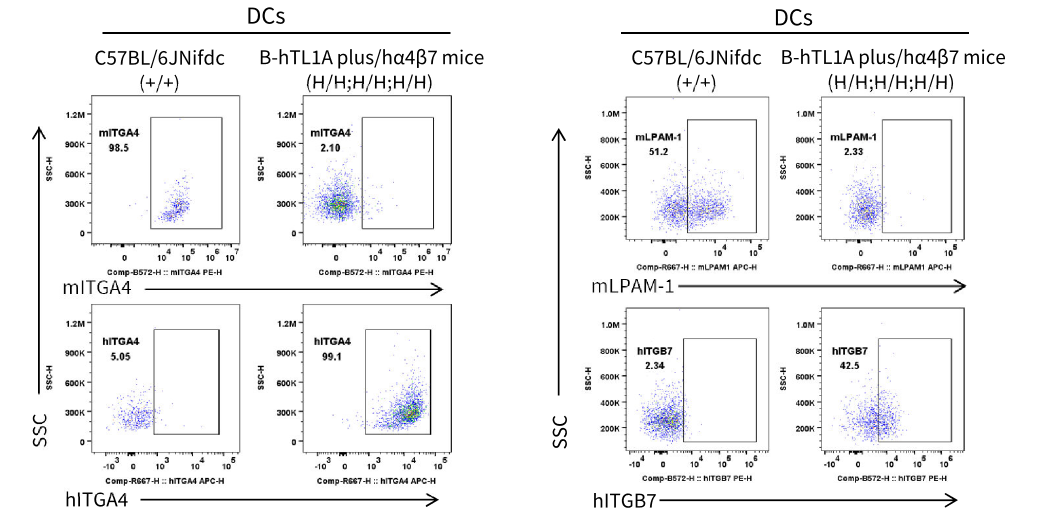
Strain specific ITGA4 and ITGB7 expression analysis in wild-type C57BL/6JNifdc mice and homozygous humanized B-hTL1A plus/hα4β7 mice by flow cytometry. Splenocytes were collected from wild-type C57BL/6JNifdc mice (+/+) and homozygous B-hTL1A plus/hα4β7 mice (H/H;H/H;H/H). Protein expression was analyzed with anti-mouse ITGA4 antibody (Biolegend, 103705), anti-mouse LPAM-1/α4β7 antibody (Biolegend, 120607), anti-human ITGA4 antibody (Biolegend, 304307) anti-human ITGB7 antibody (Invitrogen, MA5-23541) by flow cytometry. Mouse ITGA4 and ITGB7 were only detectable in wild-type C57BL/6JNifdc mice. Human ITGA4 and ITGB7 were exclusively detectable in homozygous B-hTL1A plus/hα4β7 mice, but not in wild-type C57BL/6JNifdc mice.
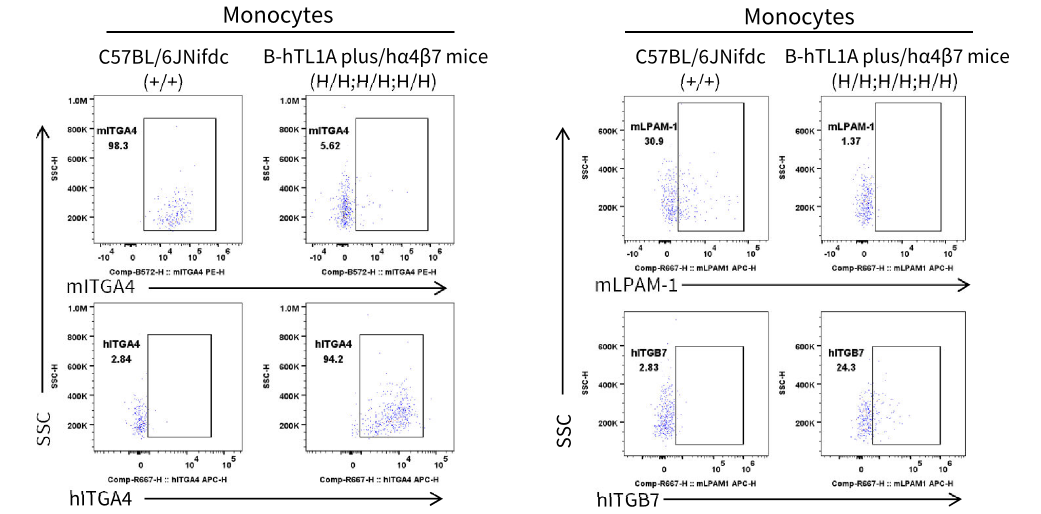
Strain specific ITGA4 and ITGB7 expression analysis in wild-type C57BL/6JNifdc mice and homozygous humanized B-hTL1A plus/hα4β7 mice by flow cytometry. Splenocytes were collected from wild-type C57BL/6JNifdc mice (+/+) and homozygous B-hTL1A plus/hα4β7 mice (H/H;H/H;H/H). Protein expression was analyzed with anti-mouse ITGA4 antibody (Biolegend, 103705), anti-mouse LPAM-1/α4β7 antibody (Biolegend, 120607), anti-human ITGA4 antibody (Biolegend, 304307) anti-human ITGB7 antibody (Invitrogen, MA5-23541) by flow cytometry. Mouse ITGA4 and ITGB7 were only detectable in wild-type C57BL/6JNifdc mice. Human ITGA4 and ITGB7 were exclusively detectable in homozygous B-hTL1A plus/hα4β7 mice, but not in wild-type C57BL/6JNifdc mice.
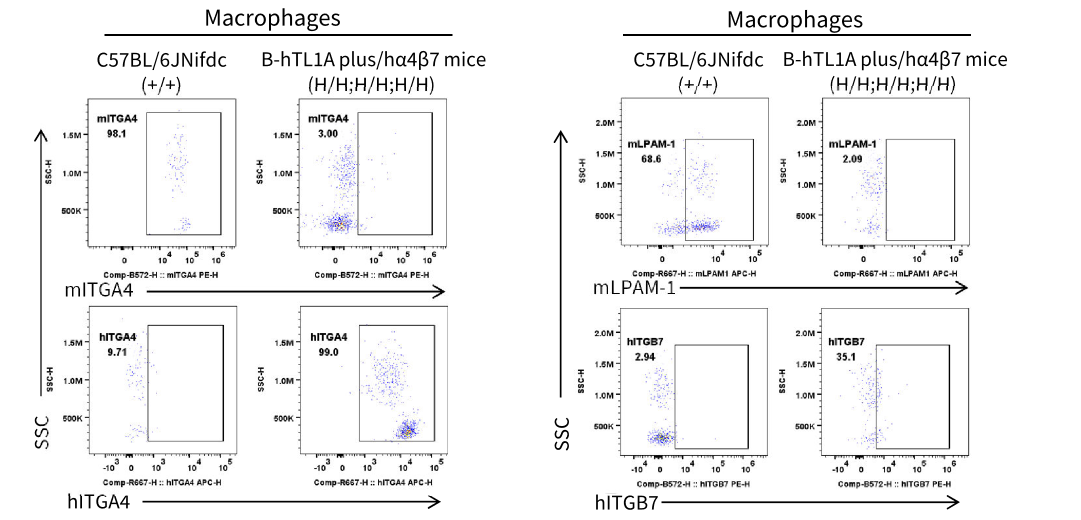
Strain specific ITGA4 and ITGB7 expression analysis in wild-type C57BL/6JNifdc mice and homozygous humanized B-hTL1A plus/hα4β7 mice by flow cytometry. Splenocytes were collected from wild-type C57BL/6JNifdc mice (+/+) and homozygous B-hTL1A plus/hα4β7 mice (H/H;H/H;H/H). Protein expression was analyzed with anti-mouse ITGA4 antibody (Biolegend, 103705), anti-mouse LPAM-1/α4β7 antibody (Biolegend, 120607), anti-human ITGA4 antibody (Biolegend, 304307) anti-human ITGB7 antibody (Invitrogen, MA5-23541) by flow cytometry. Mouse ITGA4 and ITGB7 were only detectable in wild-type C57BL/6JNifdc mice. Human ITGA4 and ITGB7 were exclusively detectable in homozygous B-hTL1A plus/hα4β7 mice, but not in wild-type C57BL/6JNifdc mice.