
C57BL/6N-Tnfsf15tm3(TNFSF15)Bcgen Tnfrsf25tm3(TNFRSF25)Bcgen/Bcgen • 114943

TL1A/DR3: A key inflammation signaling pathway in chronic intestinal inflammation and fibrosis-related diseases
Gene Information: TNF Superfamily Member 15 (TNFSF15, also known as TL1A) is a protein-coding gene located on chromosome 9q32. This cytokine is a ligand for receptor TNFRSF25 (also known as DR3) and TNFRSF6B (also known as DcR3).
Protein Expression: TL1A is expressed in various immune cells (such as monocytes, macrophages, dendritic cells, and T cells) as well as in non-immune cells (such as synovial fibroblasts and endothelial cells). TL1A is a type II transmembrane protein that exists in either membrane-bound (mTL1A) or soluble (sTL1A) forms.
Signaling Pathway: TL1A competes with Death Receptor 3 (DR3) for binding, providing stimulus signals for downstream signaling pathways, thereby regulating the proliferation, activation, apoptosis of effector cells, and the production of cytokines and chemokines.

TL1A
DR3
The exons 1-10 of mouse DR3 gene that encode the whole molecule (ATG to STOP codon), including promoter, 5’ UTR and 3’ UTR were replaced by human counterparts in B-hTL1A plus/hDR3 mice.
B-hTL1A plus/hDR3 mice were obtained by mating B-hTL1A mice plus (112949) and B-hDR3 mice (113926).

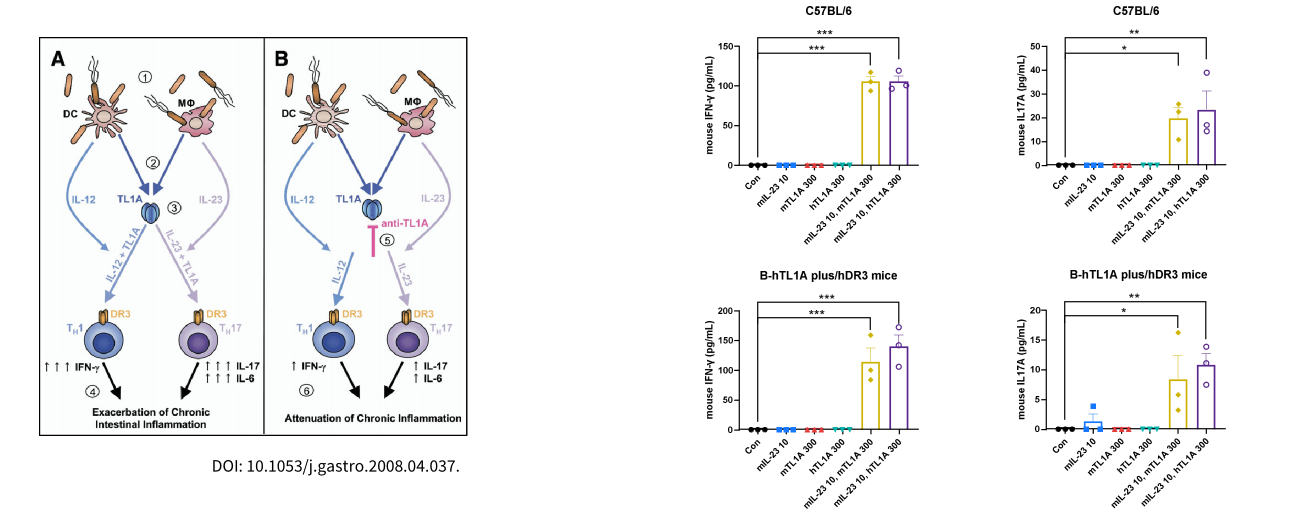
Ex vivo functional analysis in B-hTL1A plus/hDR3 mice. Splenocytes were collected from wild type C57BL/6 mice (+/+) and homozygous B hTL1A plus/hDR3 mice (H/H;H/H), then the production of mouse IFN γ and mouse IL 17A in supernatants were assessed by ELISA after 72 h of incubation with mIL23 (10 ng/mL) and m/hTL1A (300 ng/mL) in vitro.