
Abstract
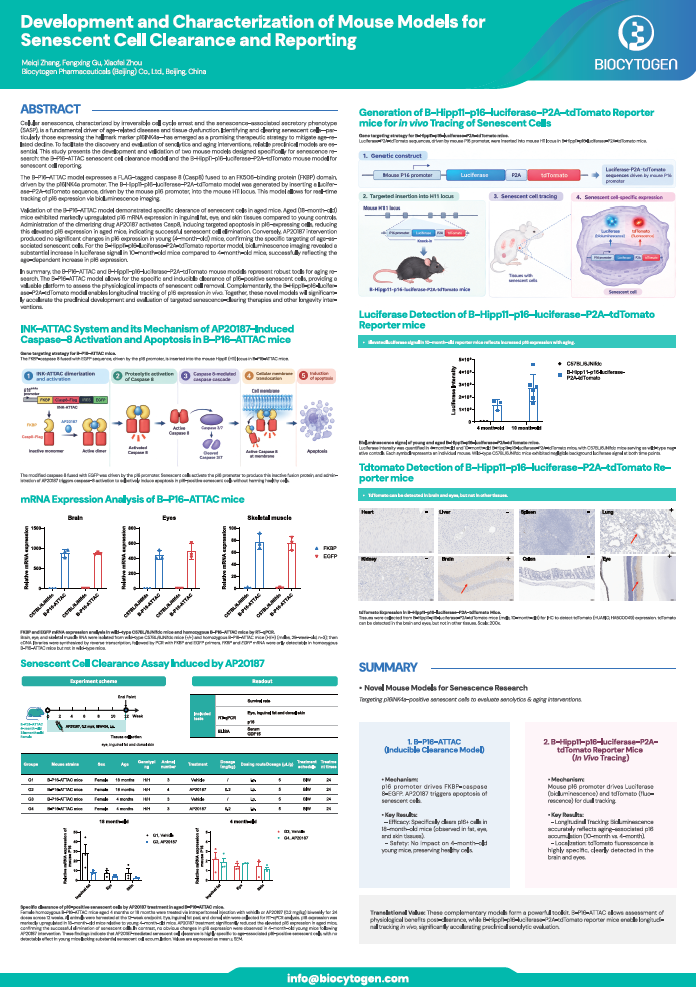
Cellular senescence, characterized by irreversible cell cycle arrest and the senescence-associated secretory phenotype (SASP), is a fundamental driver of age-related diseases and tissue dysfunction. Identifying and clearing senescent cells—particularly those expressing the hallmark marker p161NK4a—has emerged as a promising therapeutic strategy to mitigate age-related decline. To facilitate the discovery and evaluation of senolytics and aging interventions, reliable preclinical models are es- sential. This study presents the development and validation of two mouse models designed specifically for senescence research: the B-P16-ATTAC senescent cell clearance model and the B-Hipp11-p16-luciferase-P2A-tdTomato mouse model for senescent cell reporting.
The B-P16-ATTAC model expresses a FLAG-tagged caspase 8 (Casp8) fused to an FK506-binding protein (FKBP) domain, driven by the p161NK4a promoter. The B-Hipp11-p16-luciferase-P2A-tdTomato model was generated by inserting a luciferase-P2A-tdTomato sequence, driven by the mouse p16 promoter, into the mouse H11 locus. This model allows for real-time tracking of p16 expression via bioluminescence imaging.
Validation of the B-P16-ATTAC model demonstrated specific clearance of senescent cells in aged mice. Aged (18-month-old) mice exhibited markedly upregulated p16 mRNA expression in inguinal fat, eye, and skin tissues compared to young controls. Administration of the dimerizing drug AP20187 activates Casp8, inducing targeted apoptosis in p16-expressing cells, reducing this elevated p16 expression in aged mice, indicating successful senescent cell elimination. Conversely, AP20187 intervention produced no significant changes in p16 expression in young (4-month-old) mice, confirming the specific targeting of age-associated senescent cells. For the B-Hipp11-p16-luciferase-P2A-tdTomato reporter model, bioluminescence imaging revealed a substantial increase in luciferase signal in 10-month-old mice compared to 4-month-old mice, successfully reflecting the age-dependent increase in p16 expression.
In summary, the B-P16-ATTAC and B-Hipp11-p16-luciferase-P2A-tdTomato mouse models represent robust tools for aging research. The B-P16-ATTAC model allows for the specific and inducible clearance of p16-positive senescent cells, providing a valuable platform to assess the physiological impacts of senescent cell removal. Complementarily, the B-Hipp11-p16-luciferase-P2A-tdTomato model enables longitudinal tracking of p16 expression in vivo. Together, these novel models will significantly accelerate the preclinical development and evaluation of targeted senescence-clearing therapies and other longevity interventions.