
Background
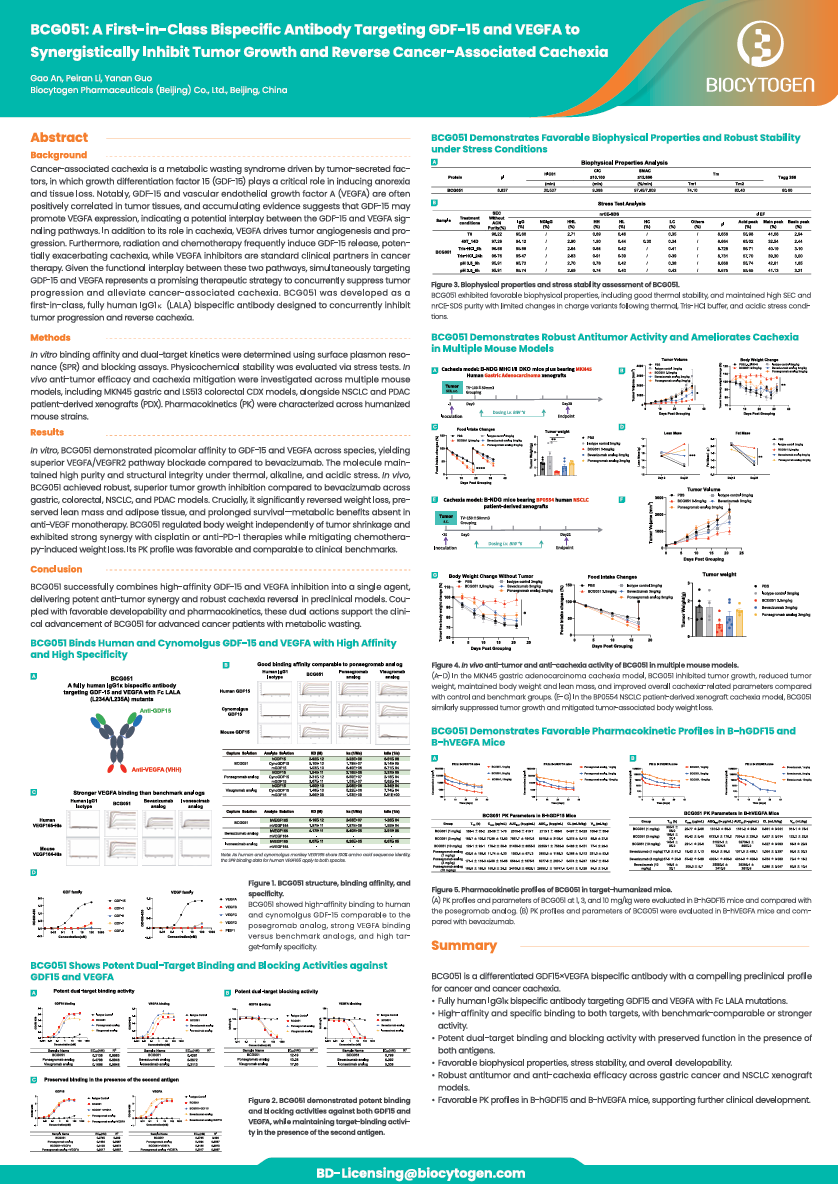
Cancer-associated cachexia is a metabolic wasting syndrome driven by tumor-secreted factors, in which growth differentiation factor 15 (GDF-15) plays a critical role in inducing anorexia and tissue loss. Notably, GDF-15 and vascular endothelial growth factor A (VEGFA) are often positively correlated in tumor tissues, and accumulating evidence suggests that GDF-15 may promote VEGFA expression, indicating a potential interplay between the GDF-15 and VEGFA signaling pathways. In addition to its role in cachexia, VEGFA drives tumor angiogenesis and progression. Furthermore, radiation and chemotherapy frequently induce GDF-15 release, potentially exacerbating cachexia, while VEGFA inhibitors are standard clinical partners in cancer therapy. Given the functional interplay between these two pathways, simultaneously targeting GDF-15 and VEGFA represents a promising therapeutic strategy to concurrently suppress tumor progression and alleviate cancer-associated cachexia. BCG051 was developed as a first-in-class, fully human IgGIÆ (LALA) bispecific antibody designed to concurrently inhibit tumor progression and reverse cachexia.
Methods
In vitro binding affinity and dual-target kinetics were determined using surface plasmon reso- nance (SPR) and blocking assays. Physicochemical stability was evaluated via stress tests. In vivo anti-tumor efficacy and cachexia mitigation were investigated across multiple mouse models, including MKN45 gastric and LS513 colorectal CDX models, alongside NSCLC and PDAC patient-derived xenografts (PDX). Pharmacokinetics (PK) were characterized across humanized mouse strains.
Results
In vitro, BCG051 demonstrated picomolar affinity to GDF-15 and VEGFA across species, yielding superior VEGFA/VEGFR2 pathway blockade compared to bevacizumab. The molecule maintained high purity and structural integrity under thermal, alkaline, and acidic stress. In vivo, BCG051 achieved robust, superior tumor growth inhibition compared to bevacizumab across gastric, colorectal, NSCLC, and PDAC models. Crucially, it significantly reversed weight loss, preserved lean mass and adipose tissue, and prolonged survival—metabolic benefits absent in anti-VEGF monotherapy. BCG051 regulated body weight independently of tumor shrinkage and exhibited strong synergy with cisplatin or anti-PD-I therapies while mitigating chemotherapy-induced weight loss. Its PK profile was favorable and comparable to clinical benchmarks.
Conclusion
BCG051 successfully combines high-affinity GDF-15 and VEGFA inhibition into a single agent, delivering potent anti-tumor synergy and robust cachexia reversal in preclinical models. Coupled with favorable developability and pharmacokinetics, these dual actions support the clinical advancement of BCG051 for advanced cancer patients with metabolic wasting.