
Background
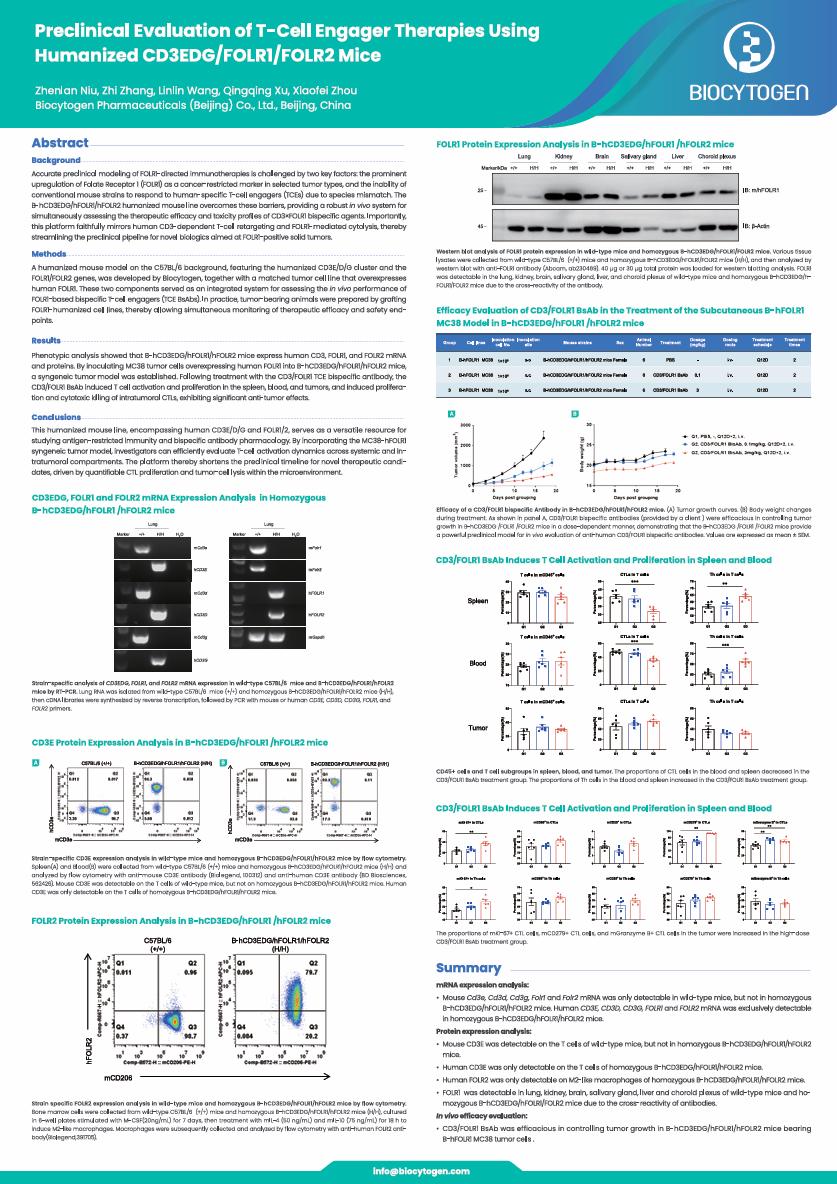
Accurate preclinical modeling of FOLR1-directed immunotherapies is challenged by two key factors: the prominent upregulation of Folate Receptor I (FOLRI) as a cancer-restricted marker in selected tumor types, and the inability of conventional mouse strains to respond to human-specific T-cell engagers (TCEs) due to species mismatch. The B-hCD3EDG/hFOLR1/hFOLR2 humanized mouse line overcomes these barriers, providing a robust in vivo system for simultaneously assessing the therapeutic efficacy and toxicity profiles of CD3xFOLRl bispecific agents. Importantly, this platform faithfully mirrors human CD3-dependent T-cell retargeting and FOLR1-mediated cytolysis, thereby streamlining the preclinical pipeline for novel biologics aimed at FOLR1-positive solid tumors.
Methods
A humanized mouse model on the C57BL/6 background, featuring the humanized CD3E/D/G cluster and the FOLR1/FOLR2 genes, was developed by Biocytogen, together with a matched tumor cell line that overexpresses human FOLRI. These two components served as an integrated system for assessing the in vivo performance of FOLR1-based bispecific T-cell engagers (TCE BsAbs). In practice, tumor-bearing animals were prepared by grafting FOLR1-humanized cell lines, thereby allowing simultaneous monitoring of therapeutic efficacy and safety endpoints.
Results
Phenotypic analysis showed that B-hCD3EDG/hFOLR1/hFOLR2 mice express human CD3, FOLRI, and FOLR2 mRNA and proteins. By inoculating MC38 tumor cells overexpressing human FOLRI into B-hCD3EDG/hFOLR1/hFOLR2 mice, a syngeneic tumor model was established. Following treatment with the CD3/FOLR1 TCE bispecific antibody, the CD3/FOLR1 BsAb induced T cell activation and proliferation in the spleen, blood, and tumors, and induced proliferation and cytotoxic killing of intratumoral CTLs, exhibiting significant anti-tumor effects.
Conclusions
This humanized mouse line, encompassing human CD3E/D/G and FOLRl/2, serves as a versatile resource for studying antigen-restricted immunity and bispecific antibody pharmacology. By incorporating the MC38-hFOLR1 syngeneic tumor model, investigators can efficiently evaluate T-cell activation dynamics across systemic and intratumoral compartments. The platform thereby shortens the preclinical timeline for novel therapeutic candidates, driven by quantifiable CTL proliferation and tumor-cell lysis within the microenvironment.