
Abstract
ACVRIC (Activin receptor-like kinase 7, ALK7) is a type I receptor of the TGF-ß superfamily. Activin E serves as its ligand, mediating activation of the Smad2/3 signaling pathway and regulating the expression of energy metabo- lism-associated genes.
ALK7 modulates fat storage by suppressing lipolysis. Rare variant analysis using UK Biobank datasets shows that ALK7 loss-of-function is associated with favorable fat distribution patterns and lipid profiles. To date, small nucleic acid drugs—particularly siRNAs—represent the primary focus of ALK7-targeted drug development.
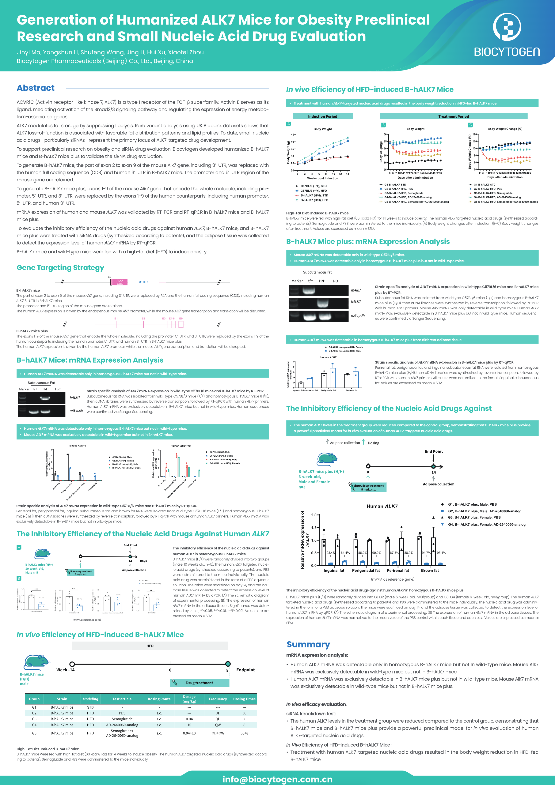
To support preclinical research on obesity and siRNA drug evaluation, Biocytogen developed humanized B-hALK7 mice and B-hALK7 mice plus to validate the siRNA drug evaluation.
To generate B-hALK7 mice, the part of exon 2 to exon 9 of the mouse Alk7 gene, including 3' UTR, was replaced with the human full coding sequence (CDS) and human 3' UTR in B-hALK7 mice. The promoter and 5' UTR region of the mouse gene are retained.
To generate B-hALK7 mice plus, exons 1-9 of the mouse Alk7 gene that encode the whole molecule, including pro- moter, 5' UTR, and 3' UTR, were replaced by the exons 1-9 of the human counterparts, including human promoter, 5' UTR, and human 3' UTR.
mRNA expression of human and mouse ALK7 was validated by RT-PCR and RT-qPCR in B-hALK7 mice and B-hALK7 mice plus.
To evaluate the inhibitory efficiency of the nucleic acid drugs against human ALK7, B-hALK7 mice, and B-hALK7 mice plus were treated with siRNA drugs (synthesized according to patents), and the adipose tissue was collected to detect the expression level of human ALK7 mRNA by RT-qPCR. B-hALK7 mice and wild-type mice were fed with a high-fat diet (HFD) to induce obesity.