


B-hACP3 MC38

• 322550

B-hACP3 PC-3

B-hACP3 MC38

Catalog Number: 322550
Strain Background: C57BL/6
NCBI gene ID: 55 (Human)
Aliases: ACPP; 5'-NT; ACP-3; TM-PAP
---
Licensing option available
B-hACP3 MC38

on this page

  • Description
  • Phenotypic analysis
  • Tumorigenicity

Posters

View All

    Publication

      Description
      • Origin: The MC38 cell line is derived from C57BL/6 murine colon adenocarcinoma cells. The cell line is a commonly used murine model for colorectal carcinoma.
      • Background Information: Acid phosphatase 3 (ACP3), also known as prostatic acid phosphatase (PAP), as an ecto-phosphatase that hydrolyzes extracellular nucleotides and phosphoproteins, influencing cell growth, migration, and invasive properties. ACP3 exhibits high tumor specificity, with high expression in prostate cancer tissues but minimal expression in non-cancerous tissues, making it a therapeutic target for prostate cancer.
      • Gene targeting strategy: The exon 3 to exon 4 of mouse Acp3 gene was replaced by the exogenous promoter and human ACP3 coding sequence in the B-hACP3 MC38.
      • Tumorigenicity: Confirmed in C57BL/6JNifdc mice.
      • Application: The B-hACP3 MC38 tumor models can be used for preclinical evaluation of monoclonal antibody drugs targeting human ACP3.
      ACP3 Protein Expression Analysis
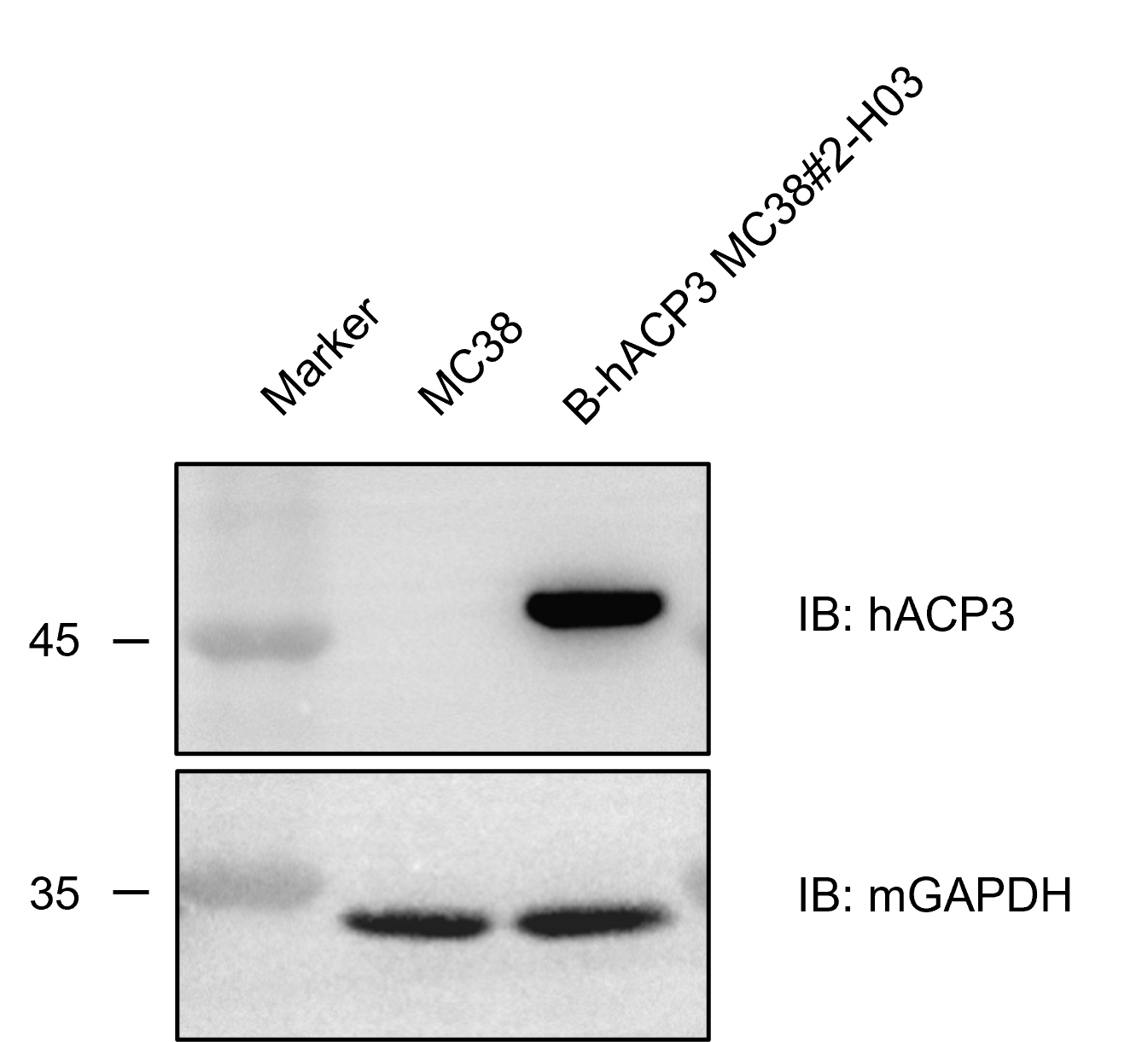
      • Human ACP3 was detected in B-hACP3 MC38 but not in wild-type MC38 cells.

      ACP3 expression analysis in B-hACP3 MC38 by western blot. Single cell suspensions from wild-type MC38 and B-hACP3 MC38 cultures were stained with anti-hACP3 antibody (CST, 12861S). Human ACP3 was detected in the B-hACP3 MC38 cells but not in wild-type MC38 cells. The 2-H03 clone of B-hACP3 MC38 cells was used for in vivo experiments.


      Tumor Growth Curve & Body Weight Changes

      Subcutaneous homograft tumor growth of B-hACP3 MC38 cells. B-hACP3 MC38 cells (5x10⁵) and wild-type MC38 cells (1x10⁶) were subcutaneously implanted into C57BL/6JNifdc mice (male, 8-week-old, n=6). Tumor volume and body weight were measured twice a week. (A) Average tumor volume ± SEM. (B) Body weight (Mean± SEM). Volume was expressed in mm3 using the formula: V=0.5 X long diameter X short diameter2. As shown in panel A, B-hACP3 MC38 cells were able to establish tumors in vivo and can be used for efficacy studies.
      ACP3 Protein Expression Analysis of Tumor Tissue
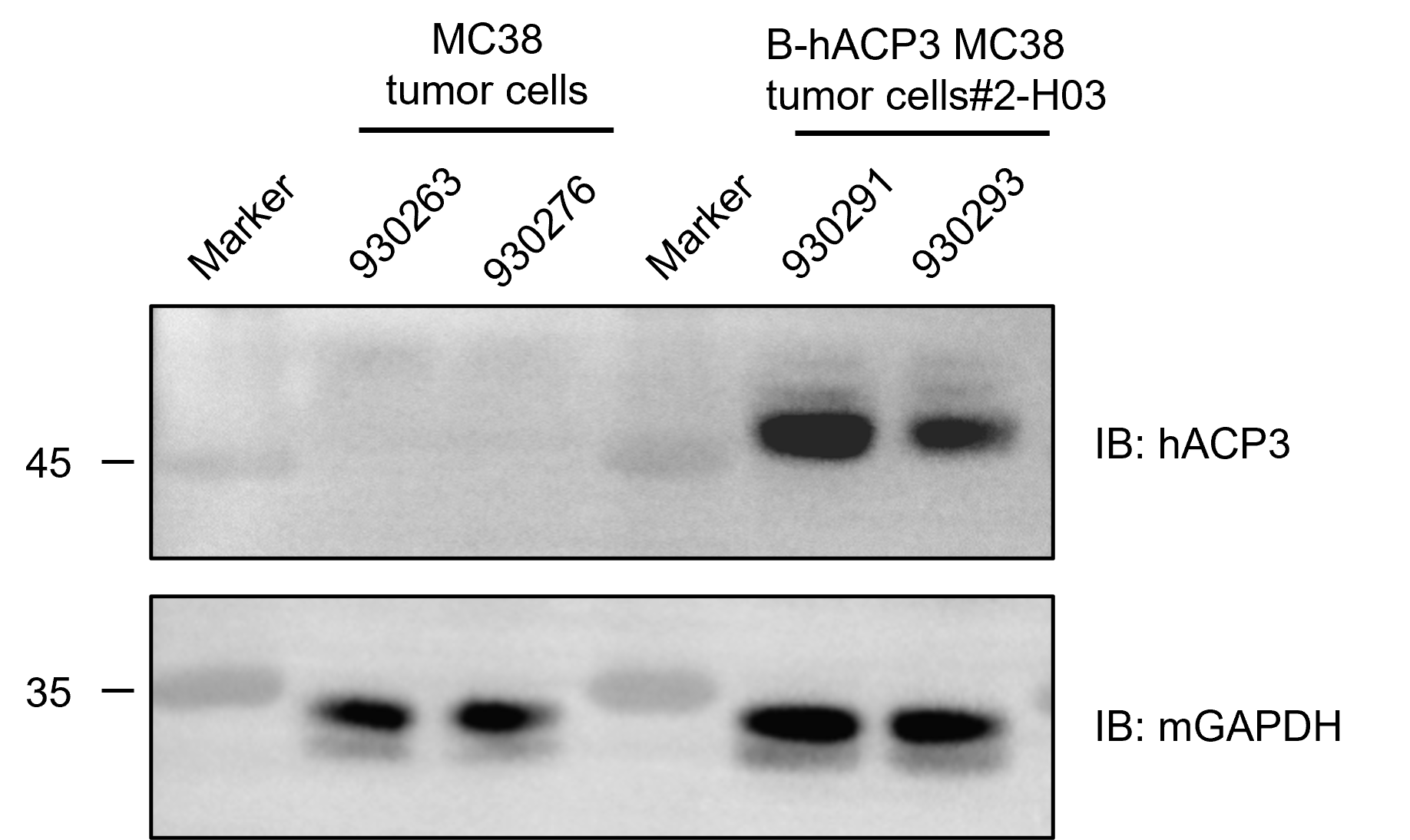
      • Human ACP3 was expressed in B-hACP3 MC38 tumor cells, but not in MC38 tumor cells.

      Human ACP3 expression evaluated in B-hACP3 MC38 tumor cells by western blot. B-hACP3 MC38 cells were subcutaneously transplanted into C57BL/6JNifdc mice (Male, 8-week-old, n=6). At the end of the experiment, tumor cells were harvested and assessed with anti-human ACP3 antibody (CST, 12861S).