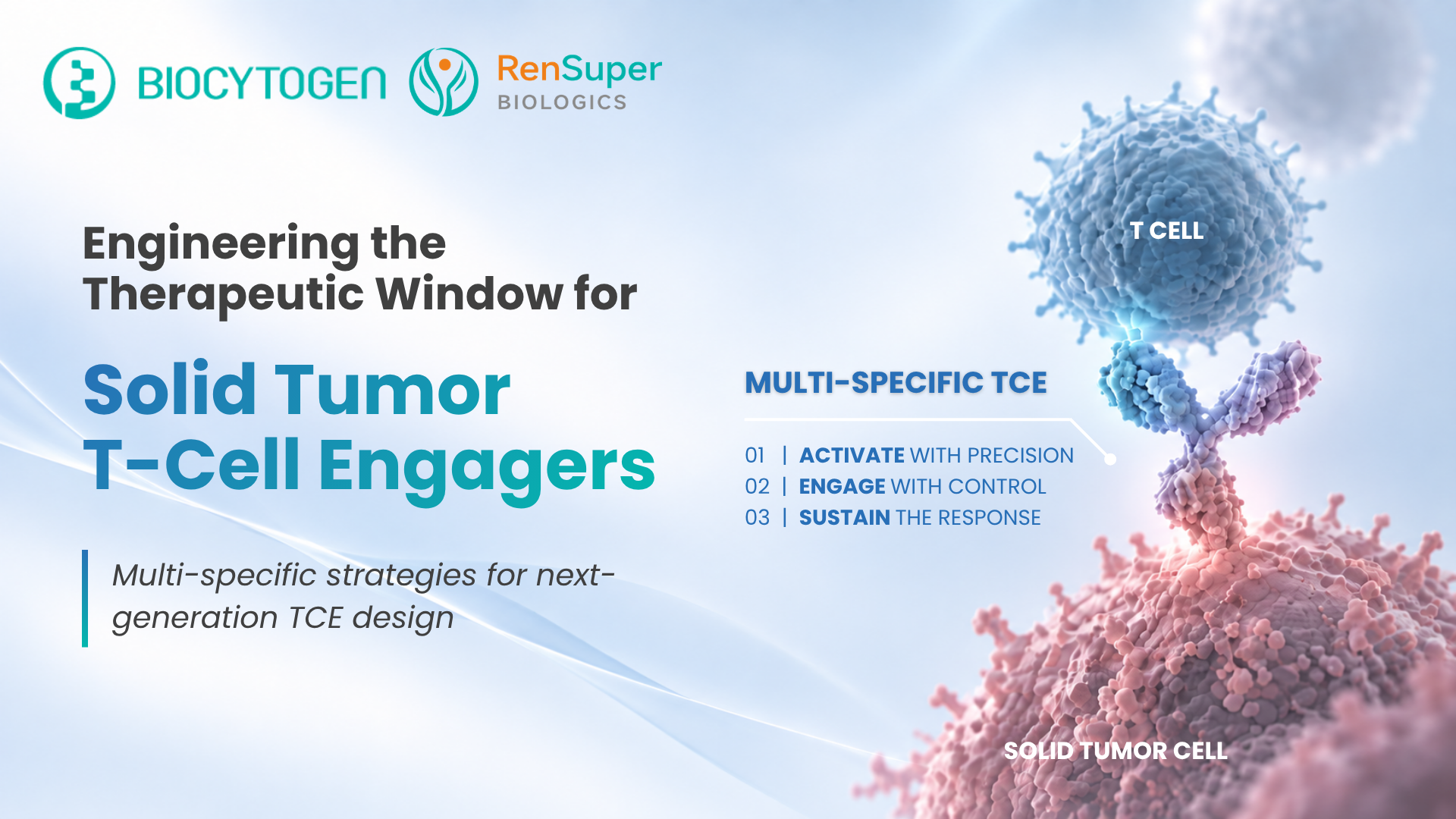
T-cell engagers have established their clinical value in hematologic malignancies, but translation into solid tumors remains more difficult. Solid-tumor targets are often heterogeneous, expressed to some degree in normal tissue, and embedded in immunosuppressive microenvironments—making efficacy and safety harder to balance (Baeuerle, et al. 2026).
Tarlatamab provides an important proof of concept. In previously treated SCLC, it achieved a 40% ORR with a median duration of response of 9.7 months, demonstrating that systemic T-cell engagement can deliver meaningful activity in solid tumors (Ahn, et al. 2023). At the same time, CRS and neurologic toxicity (U.S. Food and Drug Administration, 2024, Amgen Inc, 2025) highlight the central development challenge and opportunity for improvement: creating durable antitumor activity within a controllable therapeutic window.
♦ Representative Solid Tumor TCE Landscape:
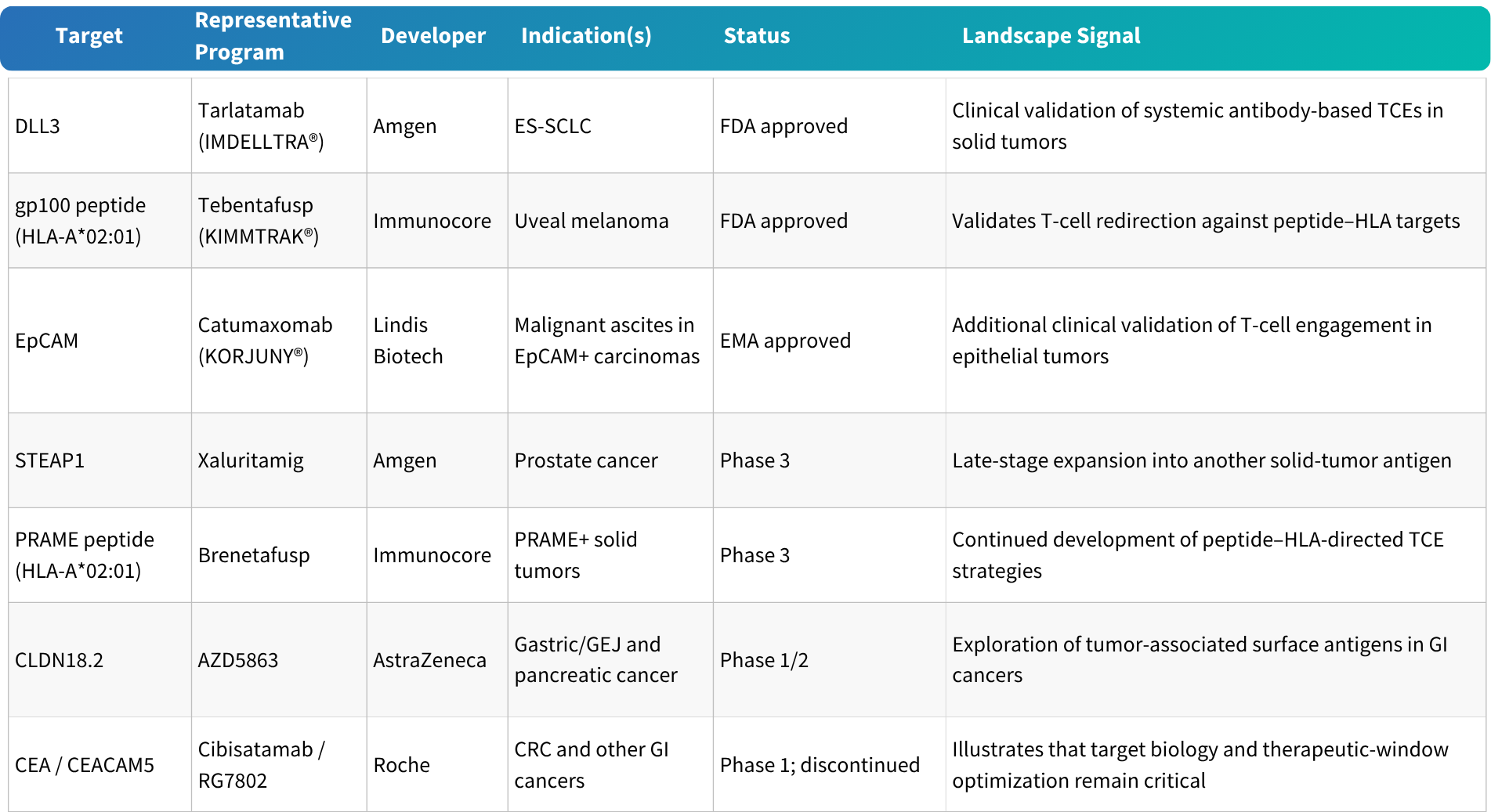
Together, these programs demonstrate that T-cell redirection is clinically feasible in solid tumors, but successful development remains highly dependent on target biology and control of T-cell activation.
The Solid Tumor TCE Bottleneck
1. T-Cell Activation & Persistence: The safety-efficacy trade-off
- Excessive systemic activation → CRS: Unlike payload-driven ADCs, TCEs activate living T cells and can amplify immune responses through repeated killing and cytokine release. Excessive CD3 activation therefore creates a systemic safety liability.
- Excessive CD3 attenuation → insufficient tumor killing: Simply reducing CD3 activity may improve safety, but solid tumors already face limited T-cell infiltration and an immunosuppressive TME, making adequate antitumor activation difficult to sustain. AMG 340, a PSMA x CD3 TCE, illustrates this trade-off: low-affinity CD3 engagement reduced severe CRS, but clinical antitumor activity remained insufficient for further development (Falchook, et al. 2024).
- Repeated stimulation → T-cell exhaustion: Continuous TCE exposure can progressively impair T-cell function and lead to exhaustion; T-cell persistence becomes as important as initial activation (Philipp, et al. 2022).
2. Tumor Selectivity & Accessibility: The antigen ceiling
- Limited tumor selectivity and therapeutic window: Unlike lineage-associated targets such as CD19 and BCMA, most solid-tumor antigens are TAAs with some degree of normal-tissue expression (Baeuerle, et al. 2026). This increases on-target/off-tumor risk and can limit dose escalation before achieving optimal tumor exposure.
- Heterogeneity and accessibility: Variable antigen density and restricted epitope accessibility can further reduce effective TCE engagement and create uneven responses across tumors.
Design Principles for Next-Generation Solid Tumor TCEs
Expanding the therapeutic window of solid-tumor TCEs requires coordinated engineering of target engagement, T-cell activation, costimulation, and molecular architecture. Rather than optimizing potency alone, these variables need to be balanced according to the biology of each tumor target.
- Select the right tumor target. Prioritize antigens with sufficient tumor density, limited accessible expression in normal tissues, and favorable epitope accessibility to support productive tumor engagement while reducing on-target/off-tumor risk (Garcia-Lorenzo, et al. 2026).
- Tune T-cell activation. CD3 signaling can be modulated through affinity, valency, and steric configuration to balance tumor-cell killing with systemic cytokine activation. Conditional strategies, such as protease-cleavable masking, can further restrict activation to the tumor microenvironment.
- Integrate tumor-directed costimulation. Incorporating costimulatory signals such as 4-1BB or CD28 can provide Signal 2 to support T-cell expansion, survival, and functional persistence alongside CD3-mediated activation (Sun, et al. 2025).
- Optimize avidity and molecular architecture. Valency, geometry, and multispecific format can be used to strengthen tumor-antigen engagement while maintaining controlled T-cell redirection. Format choices can also incorporate established heterodimerization and antibody-engineering approaches to enable increasingly complex TCE architectures.
Together, these principles support a target-specific approach to TCE design, in which target biology and molecular architecture are engineered as an integrated system to improve the balance between efficacy and safety.
Biocytogen’s Solid Tumor TCE Solutions
Different solid-tumor targets may require different solutions to the therapeutic-window problem. Biocytogen's portfolio illustrates three complementary design strategies: costimulation, tumor avidity, and controlled CD3 engagement.
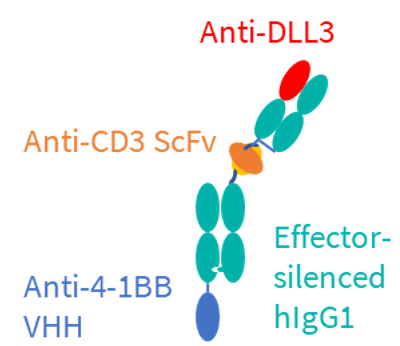
Design Strategy: Sustain T-cell function through localized 4-1BB costimulation
Asset Highlights:
- Validated DLL3 Tumor Targeting: The fully human anti-DLL3 antibody generated from RenMice® provides high-affinity DLL3 binding to support efficient tumor localization.
- CD3-Mediated T-Cell Redirection: BCG024 incorporates a SP34-derived anti-CD3 scFv, with a head-to-tail fusion designed to facilitate immunological synapse formation. Steric hindrance reduces CD3 binding, which helps further widen the therapeutic window.
- RenNano®-Derived 4-1BB Costimulation: The fully human anti-4-1BB VHH derived from RenNano® mice provides an additional costimulatory signal to enhance T-cell function, while its compact VHH format facilitates efficient trispecific antibody assembly.
- Balanced Preclinical Efficacy and Safety: BCG024 combines potent in vitro and in vivo activity with favorable preliminary safety, acceptable PK, and repeat-dose tolerability in non-human primates.
Preclinical Data Highlights:
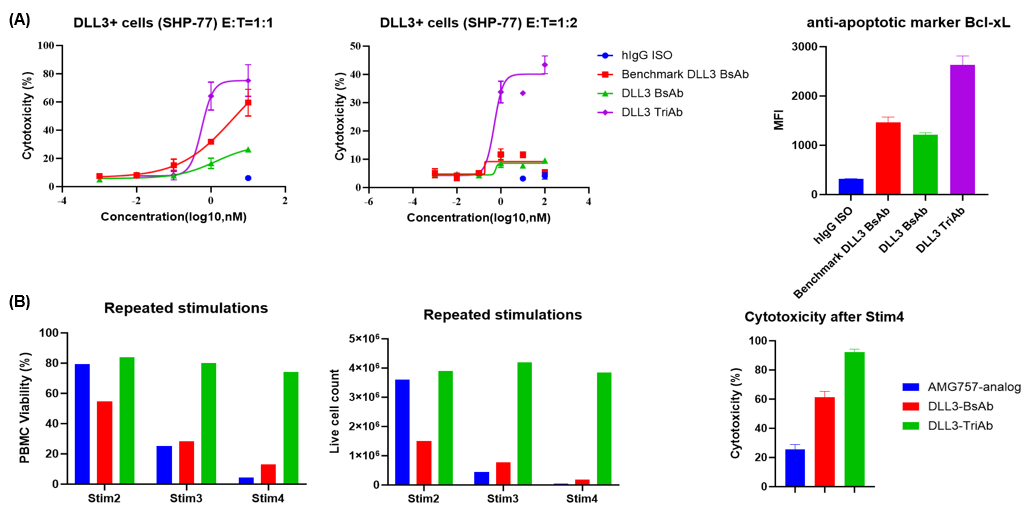
- BCG024 sustains T-cell function under repeated antigen challenge:
(A) BCG024 (DLL3 TriAb) induces superior cytotoxicity against DLL3-positive tumor cells at low effector-to-target ratios and upregulates the anti-apoptotic marker Bcl-xL. (B) BCG024 (DLL3 TriAb) maintains sustained T-cell function by preserving higher PBMC viability, live cell counts, and stronger cytotoxicity across repeated rounds of antigen stimulation.
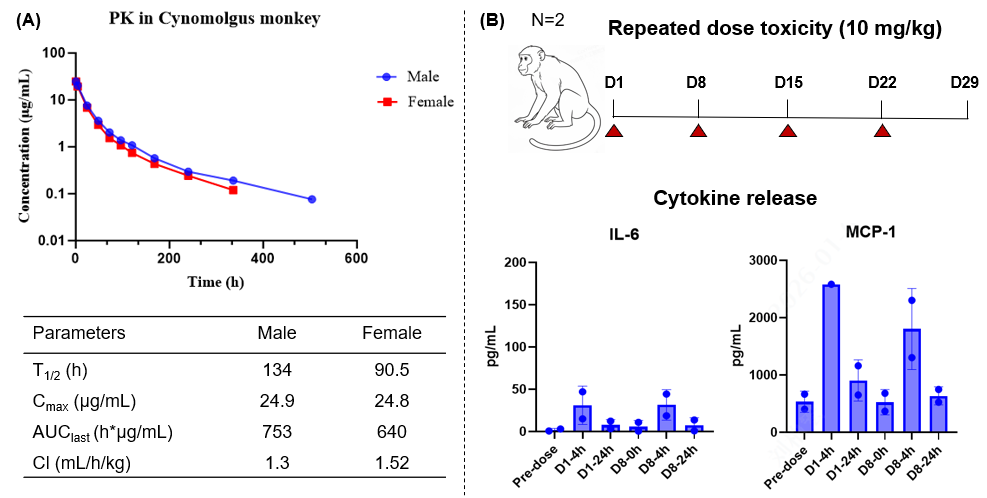
- BCG024 shows acceptable PK and favorable NHP tolerability:
(A) BCG024 exhibits an acceptable pharmacokinetic profile, half-life ~4-6 days following a single intravenous administration in cynomolgus monkeys. (B) BCG024 is well-tolerated under repeated dosing, showing no adverse clinical signs and minimal systemic cytokine induction.
► CDH17 × CD3 × CD28 Trispecific TCE
Design Strategy: Combine CDH17 tumor-selective targeting with T-cell costimulatory signal 2 (CD28)
Asset Highlights:
- Tumor-Selective CDH17 Targeting: CDH17 is highly expressed in colorectal cancer (CRC) with limited expression in normal tissues, supporting its potential as a differentiated tumor-associated antigen for TCE development.
- CD28 Costimulation for Enhanced T-Cell Activation: Integrated CD28 costimulation reinforces CD3-mediated T-cell activation, driving TAA-dependent cytotoxicity without significant T-cell exhaustion.
- Potent Preclinical Activity with Favorable Safety: The CDH17-directed TCE demonstrates potent in vitro cytotoxicity and robust in vivo antitumor activity, with favorable safety profile in mouse models.
Preclinical Data Highlights:
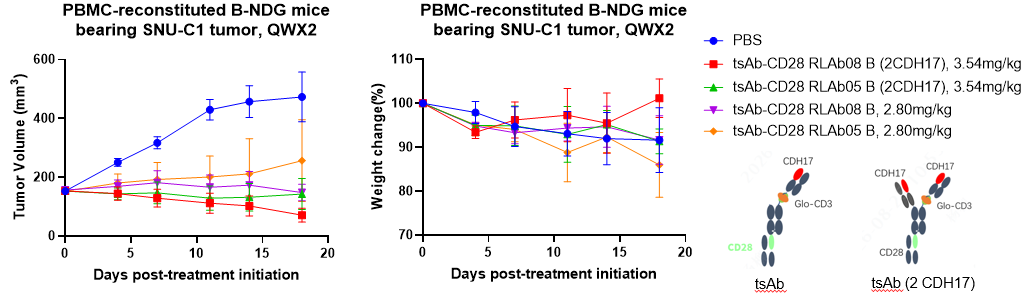
- CD3 × CD28 × dual-CDH17 TCE shows enhanced in vivo antitumor efficacy:
Dual-CDH17-targeting tsAbs (2CDH17, tsAb=trispecific Ab) exhibited enhanced antitumor efficacy compared to single-CDH17 tsAbs.
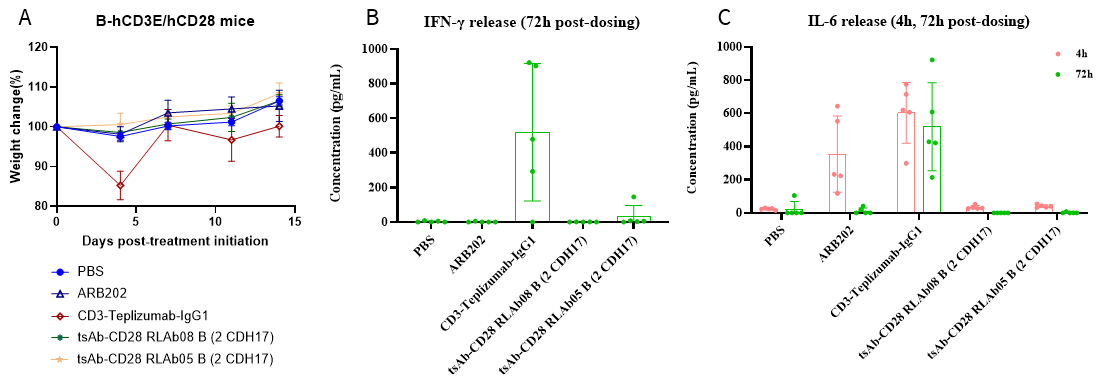
- CD3 × CD28 × dual-CDH17 TCE demonstrated favorable safety in humanized mice:
In non-tumor-bearing humanized B-hCD3E/hCD28 mice, lead tsAb candidates (A) maintained stable body weight and showed (B) low systemic IFN-γ and (C) IL-6 release relative to CD3-directed controls and benchmarks, supporting a favorable preclinical safety profile.
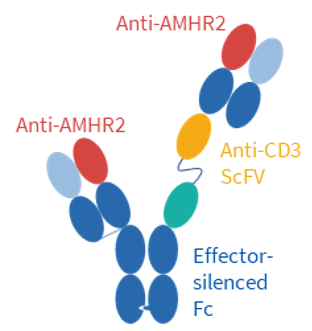
Design Strategy: Increase tumor avidity while maintaining monovalent CD3 engagement
Asset Highlights:
- Emerging AMHR2 Tumor Target: AMHR2, a member of the TGF-β receptor superfamily, is expressed in 69% of primary epithelial ovarian cancer and 53% of colorectal cancer, supporting its potential as a solid-tumor TCE target (Barret, et al. 2021, Bakkum-Gamez, et al. 2008).
- 2:1 Avidity-Driven Design: Two high-affinity AMHR2-binding arms (KD = 133 pM) are designed to enhance tumor-antigen engagement, while a single CD3 arm enables monovalent T-cell redirection.
- Preclinical validation data available to download: A Novel 2:1 AMHR2/CD3 T Cell Engager with Potent Antitumor Activity and Mitigated CRS Risk in AMHR2+ Solid Tumors
Partner with Biocytogen
Leveraging the RenMice® antibody discovery platforms—including RenMab®, RenLite®, and RenNano®—together with multispecific antibody engineering and off-the-shelf humanized preclinical models, Biocytogen supports solid-tumor TCE development from differentiated binder discovery to preclinical asset generation and validation.
Biocytogen welcomes global partners to explore asset evaluation, licensing, co-development, and binder-based collaborations for next-generation solid-tumor TCEs.
Frequently Asked Questions About Solid-Tumor T-Cell Engagers
1. What are T-cell engagers (TCEs), and how do they work in solid tumors?
T-cell engagers (TCEs) are bispecific or multispecific molecules designed to redirect T cells toward tumor cells. They typically bind a tumor-associated antigen and CD3 on T cells simultaneously, bringing the two cells into close proximity to promote immune-synapse formation and T-cell-mediated tumor killing.
2. Why are T-cell engagers more challenging to develop for solid tumors?
Solid-tumor TCEs face a narrower and more complex therapeutic window than many hematologic TCEs. Solid-tumor antigens often show heterogeneous expression and some normal-tissue accessibility, while limited T-cell infiltration and an immunosuppressive tumor microenvironment can reduce antitumor activity. Together, these factors make it difficult to achieve durable tumor killing without excessive systemic or on-target/off-tumor toxicity.
3. How can CD3 tuning improve the therapeutic window of a solid-tumor TCE?
CD3 engagement must be strong enough to support tumor-cell killing while avoiding excessive systemic T-cell activation. Lowering CD3 affinity can reduce cytokine release, but excessive attenuation may compromise efficacy. Affinity, binding kinetics, epitope, valency, steric configuration, and molecular geometry can therefore be optimized together to achieve more controlled T-cell activation.
4. How do 4-1BB and CD28 costimulation improve multispecific T-cell engagers?
4-1BB and CD28 can provide a second costimulatory signal (Signal 2) alongside CD3-mediated T-cell activation. CD28 is generally associated with more rapid and robust activation, while 4-1BB can support T-cell survival, proliferation, and longer-term functional persistence. The optimal costimulatory strategy depends on the tumor target, TCE architecture, and desired pharmacologic profile.
5. Why are 2:1 and multispecific TCE formats being explored for solid tumors?
Multispecific and 2:1 TCE architectures provide additional control over tumor avidity, T-cell engagement, and costimulatory signaling. A 2:1 format, for example, can use bivalent tumor-antigen binding to strengthen tumor engagement while maintaining monovalent CD3 binding for controlled T-cell redirection. More complex multispecific formats can also integrate tumor targeting, CD3 engagement, and costimulation within a single molecule.
6. Why choose Biocytogen for solid-tumor T-cell engager development?
Biocytogen combines fully human antibody discovery, multispecific antibody engineering, and translational preclinical models to support solid-tumor TCE development from binder discovery through preclinical validation. Its RenMice® platforms—including RenMab®, RenLite®, and RenNano®—provide antibody building blocks for diverse TCE architectures, while humanized models support evaluation of antitumor activity, immune activation, and safety.
Biocytogen's preclinical portfolio also demonstrates several complementary TCE design strategies, including BCG024 (DLL3 × CD3 × 4-1BB), CD3 × CD28 × dual-CDH17 trispecific TCEs, and collaboration experience with CRB2104, a 2:1 AMHR2 × CD3 TCE incorporating a Biocytogen-derived AMHR2 binder.
7. What solid-tumor TCE programs are available for collaboration with Biocytogen?
Biocytogen offers opportunities spanning preclinical TCE asset evaluation, antibody binders, licensing, and co-development. Current examples include DLL3-, CDH17-, and AMHR2-directed approaches representing different strategies for CD3 tuning, costimulation, and avidity engineering. Contact us for more to offer!
► Additional Resources:
► References:
- Baeuerle PA, Sauer K, Grieshaber-Bouyer R, et al. T cell engagers emerge as a compelling therapeutic modality. J Exp Med. 2026;223(2):e20251652.
- Ahn MJ, Cho BC, Felip E, et al. Tarlatamab for Patients with Previously Treated Small-Cell Lung Cancer. N Engl J Med. 2023;389(22):2063-2075.
- U.S. Food and Drug Administration. IMDELLTRA™ (tarlatamab-dlle) Prescribing Information. May 2024.
- Imdelltra (tarlatamab-dlle) [prescribing information]. Amgen Inc; 2025.
- Philipp N, Kazerani M, Nicholls A, et al. T-cell exhaustion induced by continuous bispecific molecule exposure is ameliorated by treatment-free intervals. Blood. 2022;140(10):1104–1118.
- Falchook GS, McKean M, Kelly WK, et al. Phase 1 clinical trial of AMG 340, a prostate-specific membrane antigen (PSMA)-targeted T-cell engager with a novel low-affinity CD3 binding domain designed to mitigate toxicity for the treatment of metastatic castration-resistant prostate cancer (mCRPC). J Clin Oncol. 2024;42(16_suppl):e14587.
- Garcia-Lorenzo E, Dorta M, Doger B, et al. Landscape of T-cell engagers in solid tumors. Oncologist. 2026;31(5):oyag129.
- Sun Y, Zhou L, Gu X, et al. Leveraging T cell co-stimulation for enhanced therapeutic efficacy of trispecific antibodies targeting prostate cancer. J Immunother Cancer. 2025;13(3):e010140.
- Barret J-M, Nicolas A, Jarry A, et al. The Expression of Anti-Müllerian Hormone Type II Receptor (AMHRII) in Non-Gynecological Solid Tumors Offers Potential for Broad Therapeutic Intervention in Cancer. Biology. 2021; 10(4):305.
- Bakkum-Gamez JN, Aletti G, Lewis KA, et al. Müllerian inhibiting substance type II receptor (MISIIR): a novel, tissue-specific target expressed by gynecologic cancers. Gynecol Oncol. 2008;108(1):141-148.