Description
LEPR: A crucial component of the leptin signaling pathway.
- Gene Information: The leptin receptor (LEPR) is a single membrane-spanning receptor that plays a crucial role in mediating the effects of leptin—a peptide hormone best known for its involvement in energy homeostasis, appetite regulation, and neuroendocrine function.
- Protein Expression: LEPR is predominantly expressed in hypothalamic regions—including the arcuate nucleus (ARC) and the paraventricular nucleus (PVN)—which integrate hormonal signals to control hunger, satiety, and growth hormone (GH) release.
- Signaling Pathway: LEPR interacts with leptin through its extracellular domain, initiating a series of intracellular signaling pathways that are primarily mediated by Janus kinase 2 (JAK2) and signal transducer and activator of transcription (STAT) proteins.
- LEPR Agonists: LEPR agonists activate downstream signaling cascades that regulate multiple physiological processes, including appetite suppression, energy expenditure, and glucose metabolism.
Leptin: A key regulator of the adipose organ
- Gene Information: Leptin is encoded by the LEP gene and is predominantly produced by adipocytes in proportion to fat mass.
- Protein Expression: In addition to adipose tissue, leptin is also expressed and produced in other tissues, including the stomach, placenta, and mammary gland.
- Signaling Pathway: Leptin mediates a wide range of regulatory effects at both central and peripheral levels. These actions include metabolic programming functions that are essential for the proper development and maintenance of adipose tissue, ultimately contributing to its key role in energy homeostasis.
- Leptin Deficient mice: Mice homozygous for the leptin deficiency, commonly known as ob/ob mice, develop a range of metabolic abnormalities, including severe obesity, hyperphagia, transient hyperglycemia, impaired glucose tolerance, and increased plasma insulin levels.
Targeting Strategy
LEPR
- The exons 3 17 of mouse Lepr gene that encode extracellular domain is replaced by human counterparts in B hLEPR, Lep KO mice.
- The genomic region of mouse Lepr gene that encodes signal peptide, cytoplasmic portion and transmembrane domain is retained.
- The promoter, 5’UTR and 3’UTR region of the mouse gene are also retained.
- The chimeric LEPR expression is driven by endogenous mouse Lepr promoter.
Leptin
- The exons 2 3 of the mouse Lep gene were knocked out in B hLEPR, Lep KO mice.
- As a result,the mouse Leptin protein is not expressed anymore.
B-hLEPR, Lep KO mice were obtained by mating B hLEPR mice (113250), and B ob/ob mice (110172).
Protein Expression by ELISA
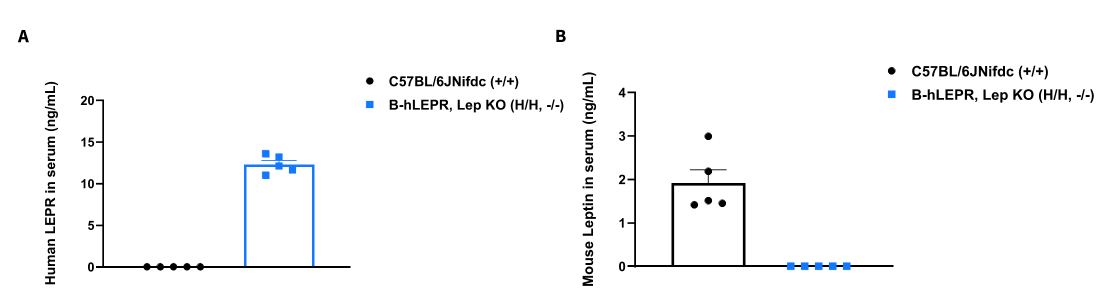
Human LEPR and mouse Leptin expression analysis in wild-type C57BL/6JNifdc mice and homozygous B-hLEPR, Lep KO mice by ELISA. Serum was collected from wild-type C57BL/6JNifdc mice (+/+) and homozygous B-hLEPR, Lep KO mice (H/H, -/-) (male, n=5, 7-week-old). Expression levels of human LEPR and mouse LEP were analyzed by ELISA (anti-mouse LEP ELISA kit: Abcam, ab199082; anti-human LEPR ELISA kit: Abcam, ab282876). (A) Human LEPR was exclusively detectable in homozygous B-hLEPR, Lep KO mice. (B) Mouse Leptin was exclusively detectable in wild-type mice, but not detectable in homozygous B-hLEPR, Lep KO mice. Values are expressed as mean ± SEM.
Body weight and Blood Glucose in B-hLEPR, Lep KO mice
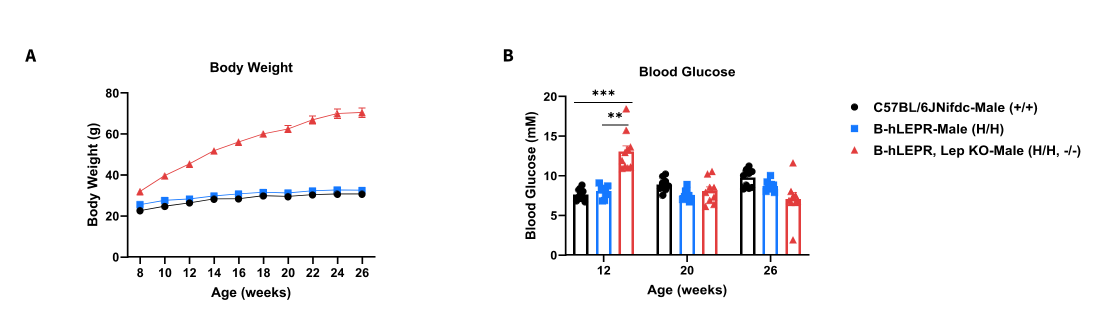
The body weight and blood glucose of wild-type C57BL/6JNifdc mice (+/+), B-hLEPR mice (H/H) and homozygous B-hLEPR, Lep KO mice (H/H, -/-) (male, n=10) were monitored at different ages. (A) The body weight at different ages. (B) The blood glucose levels at different ages. Significance was determined by two-way ANOVA. *p<0.05, p<0.01, ***p<0.001. Values are expressed as mean ± SEM. Note: The B-hLEPR, Lep KO mouse model was developed on the C57BL/6 background. Although it functions as a spontaneous obesity model, the concomitant hyperglycemia is transient and typically improves as the animals age.
* When publishing results obtained using this animal model, please acknowledge the source as follows: The animal model [B-hLEPR, Lep KO mice] (Cat# 114626) was purchased from Biocytogen.